
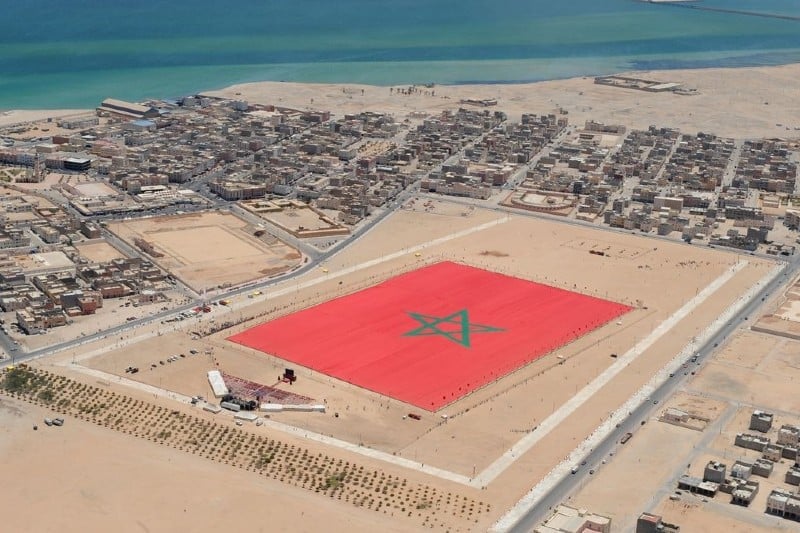
The United Nations’ decision regarding the Western Sahara has received widespread acclaim from West African media, which celebrated Morocco’s significant diplomatic success concerning its territorial sovereignty.
The local media in Côte d’Ivoire referred to the decision as “historic” due to the proactive diplomacy by HM King Mohammed VI, marking a significant milestone in the UN-driven process.
The AIP news agency states that this represents a significant shift in the United Nations’ position, emphasizing that the resolution must be based on the “realistic, pragmatic, and enduring” framework of Morocco’s autonomy plan.
The agency highlights important sections from the speech delivered by HM King Mohammed VI, who urged for a fraternal dialogue with Algeria and extended a gesture of peace to the people in the Tindouf camps, encouraging their participation in the development of the Moroccan Sahara under the autonomy framework.
The AIP notes that this historic resolution, which symbolically aligns with the 50th anniversary of the Green March, represents “a significant diplomatic success for Morocco,” one that is expected to enhance its sovereignty over the Sahara and reinforce its standing on the global stage.
In a different context, the agency highlights the visit of the Director-General of the Agence Française du Développement (AFD) Group to the Moroccan Sahara, referring to this effort as a “major step” toward strengthening ties between France and Morocco.
This trip is an example of a clear intention to put into practice the commitments agreed upon by the two Heads of State, His Majesty King Mohammed VI and President Emmanuel Macron, according to the same source, which emphasizes that this visit highlights the mutual resolve of both nations to enhance an already extensive bilateral collaboration and to actively promote inclusive and sustainable development across Moroccan territory.
In its coverage, the electronic media platform La Diplomatique d’Abidjan (LDA) states that the Security Council resolution and the Royal Speech after the vote “redefine regional dynamics,” highlighting that it delivers a powerful message to Africa and the global community, on the eve of the 50th anniversary of the Green March.
It goes on to state that with this significant diplomatic success, “Morocco now positions itself as a stabilizing force between the Atlantic, the Sahel, and the Mediterranean.”
In Benin, the daily newspaper La Nation reports that His Majesty the King stressed “a constructive and non-confrontational approach regarding the Moroccan Sahara issue” for “peace, unity, and Maghreb cooperation.”
It highlighted that the Sovereign “explicitly stated that Morocco has no intention of inciting conflicts or worsening splits” considering the recent events in this regard.
The King, His Majesty, personally spoke to the residents of the Tindouf camps, genuinely encouraging them to take advantage of the significant chance offered by the Autonomy Initiative.
This suggestion, it adds, “presents the opportunity to reunite with their families and actively participate in overseeing their local matters, develop their homeland, and shape their future within a united Morocco.”
In Ghana, the Ghana News Agency (GNA) also covered the Royal speech, noting that the Monarch praised the adoption of this resolution, referring to it as a “landmark step” and a “decisive turning point” in the contemporary history of Morocco.
In its view, the Burkina Information Agency (AIB) believes that the Security Council resolution marks “a new stage in the UN process, centered on strengthening the autonomy of the Sahara under Moroccan rule,” highlighting that “for Morocco, this decision represents a significant diplomatic success” and “also reflects the international support for the Kingdom.”
In Sierra Leone, the newspaper Sierraloaded states that this resolution, which officially endorses the autonomy plan under Moroccan rule, marks a significant milestone in addressing this fabricated conflict that has persisted for too long.
The news organization mentions that Sierra Leone, a non-permanent member of the Security Council, supported this resolution, which clearly endorses the autonomy plan as the sole viable, trustworthy, and practical foundation for addressing the dispute concerning the Moroccan Sahara.
As reported by the Sierra Leonean media, this new resolution signifies a “change in approach” regarding international policy on the Moroccan Sahara issue, provides official international recognition to the autonomy plan, and positions it as the only basis for settling this fabricated conflict.
It highlights that for Sierra Leone, which has strong diplomatic and economic relations with Morocco, this vote shows Freetown’s backing of the Kingdom’s territorial integrity, pointing out that the stance of this West African nation is also perceived as representing wider African support for Morocco’s position, especially among nations that view the autonomy plan as a practical approach to achieving regional stability.
In Gabon, the newspaper Gabonews highlights that this new UN resolution regarding the Moroccan Sahara issue represents a crucial moment in the history of this matter, noting that it affirms, on the international stage, the validity of His Majesty the King’s forward-thinking approach.
In an article titled “Moroccan Sahara: The consolidation of a royal vision that has become an international reference,” the Gabonese media highlights that due to the forward-thinking approach of His Majesty King Mohammed VI, Morocco has managed to turn this artificial conflict into a model for a long-term political resolution.
The Monarch has consistently maintained a stance that opposes principles of conflict and unrest, according to the same source, highlighting that Royal diplomacy has evolved over time, emphasizing international law, historical legitimacy, and the subtle power of progress.
Claiming that this deliberate approach has allowed Morocco to influence how the international community addresses the Moroccan Sahara issue, the article notes that the autonomy proposal has now become the sole viable, trustworthy, and practical foundation for reaching a lasting resolution.
For the Gabonese media, the international community has slowly adopted a stance that the Kingdom has consistently upheld for almost two decades, noting that beyond the diplomatic aspect, Morocco’s decision has been to show through actions that the suggested political solution is based on real circumstances.
Emphasizing the progress in the southern regions of the Kingdom, the newspaper points out significant investments in road, port, and airport facilities, the increasing power of renewable energy sources, especially via solar and wind centers, the growth of fishing, agro-industry, and transportation sectors, the upgrading of public services ranging from healthcare to education, and initiatives promoting social inclusion targeting young people and women.
“This energy has transformed the Moroccan Sahara into an economic center of interest in Africa, turning a region once seen as marginal into a key junction linking the Maghreb, Atlantic Africa, and the Sahel,” the same source states.
The post Moroccan Media Celebrate Landmark UN Resolution as a Major Diplomatic Achievement appeared first on English – Morocco News.

 jasdooit
Leave a comment