

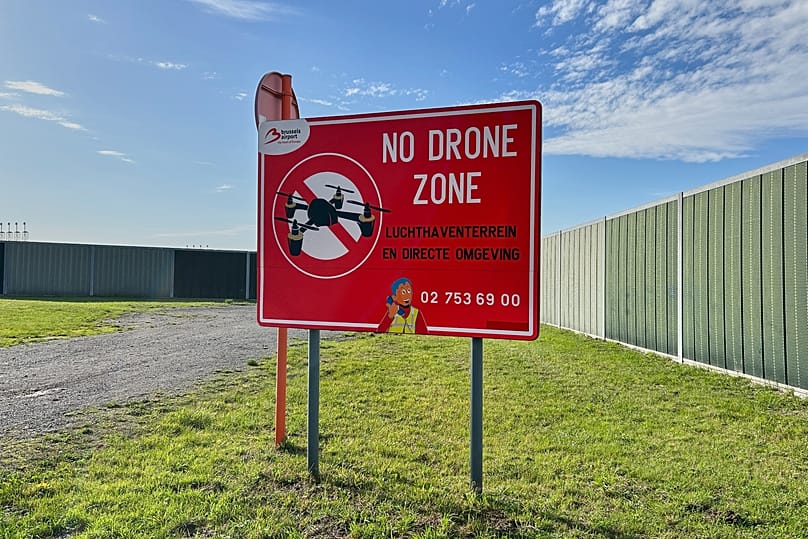
Hundreds of flights at Belgium’s primary international airport were canceled early on Wednesday following drone sightings during the night, which led to a temporary shutdown of the facility, causing Prime Minister Bart De Wever to call a meeting with senior officials to address safety issues.
This was the first instance in which Brussels airport was closed due to drones. The event that occurred overnight on Wednesday is the most recent in a string of unexplained drone sightings over the weekend.
Before the drone incident in Brussels, unmanned aerial vehicles were observed near a military installation in Belgium that houses US nuclear weapons.
Brussels Airport stated that 54 flights were canceled due to the shutdown on Tuesday evening “for safety reasons,” adding that “ensuring the safety of our passengers and staff is our highest priority.”
On a social media update released on Wednesday, the airport mentioned that flight activities had restarted, although some delays might still occur.
The airport authority mentioned that approximately 400 to 500 passengers remained overnight following the cancellation of 41 flights and the redirection of 24 others to different airports, and that they had provided beds and offered water and snacks to ensure passenger comfort.

De Wever held a meeting of Belgium’s National Security Council, comprising the nation’s defense, interior, justice, and foreign ministers, on Thursday morning.
A social media post from Interior Minister Bernard Quintin stated, “The recurring events associated with drones significantly impact our nation’s security. We need to respond in a composed, serious, and unified way.”
The individuals operating the drones in recent days remain unknown, yet Defence Minister Theo Francken stated that “this is not the work of amateurs,” without providing further details.
Belgium is home to the headquarters of NATO and the European Union, along with Europe’s biggest financial clearinghouse, which manages billions of euros in frozen Russian funds.
NATO and EU on heightened alert
Both NATO and the European Union have remained highly vigilant after a series of incidents in the airspace, believed to be linked to Russia, in recent weeks.
At the end of September, NATO issued a warning to Moscow, stating it would employ all available measures to protect itself from any additional violations of its airspace following the shooting down of Russian drones in Poland and Estonia’s account of a Russian fighter jet entering its territory.
The event that occurred on September 10 in Poland marked the initial direct confrontation between NATO and Russia since the latter’s comprehensive invasion of Ukraine started in early 2022.
Estonia reported that three Russian MiG-31 fighter jets violated its airspace for 12 minutes on Friday, a claim the Kremlin has denied.
The events led to significant concern among European leaders, prompting doubts about the alliance’s readiness in the face of increasing Russian hostility.
After the breach of Polish airspace, NATO Secretary General Mark Rutte statedthe establishment of the Eastern Sentry program, intended to prevent additional Russian advances and demonstrate support for Poland.
“We observe drones breaching our airspace. Regardless of whether it was deliberate or not, it is intolerable. The allies have shown complete support for Poland. It is essential to confront aggression and protect each member of the alliance,” said the NATO leader.



 jasdooit
Leave a comment