
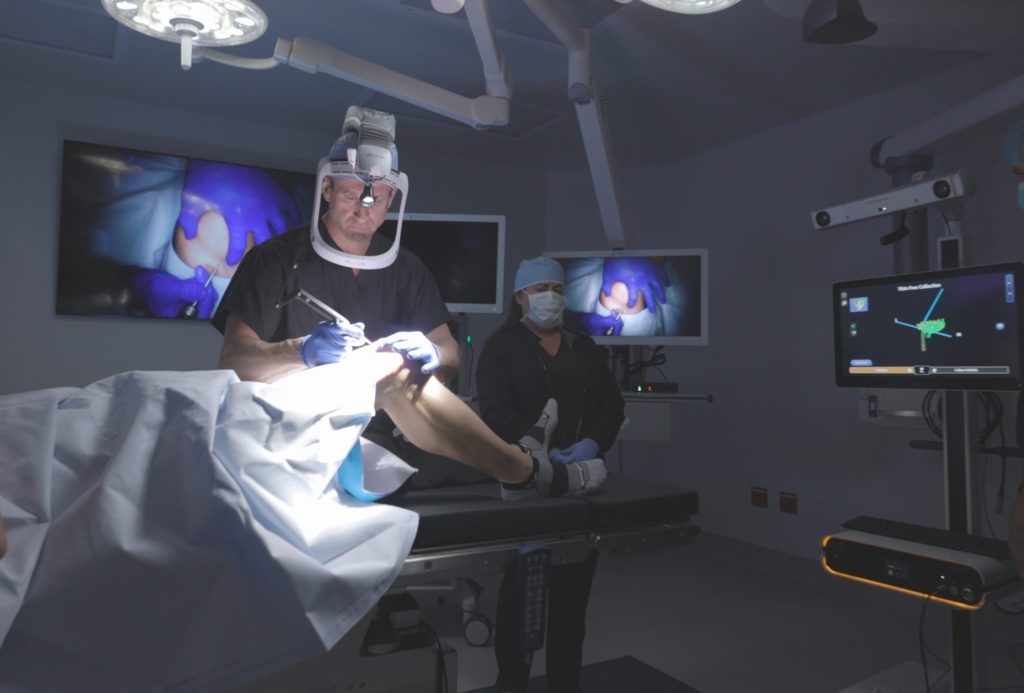
Setting a new standard for surgical accuracy and patient recovery, Samitivej Sukhumvit Hospital has introduced the most advanced Mako SmartRobotics system for knee and hip replacement surgeries. This robotic-assisted innovation allows doctors to design and carry out procedures with precision at the sub-millimetre level, greatly minimizing damage to bone and surrounding tissues.
“The robot enhances our capabilities; it doesn’t take our place,” stated Dr. Kriskamol Sithitool, an Orthopaedic Surgeon at Samitivej’s Sports and Orthopaedic Centre.
In addition, the capability to execute bone cuts with high precision and accuracy facilitates the implementation of innovative surgical concepts—such as positioning the artificial joint to correspond with the patient’s original anatomy prior to deterioration. This progress leads to more natural results after surgery, possibly resulting in better outcomes and increased patient contentment.
Knee and hip replacements are intricate surgeries, especially for older individuals and those with sports-related injuries or accidents. Historically, results have relied significantly on the surgeon’s skill, as joint angles differ among individuals.
“Having surgical expertise is essential to achieve precise results. For more than 13 years, case evaluation and accurate angles have been key to achieving positive outcomes,” Dr. Kriskamol stated.
Cutting-Edge Robotics for Enhanced Surgical Accuracy
The core identity of Samitivej Sukhumvit Hospital is rooted in its detailed focus on all elements of healthcare, guaranteeing that each patient achieves the greatest degree of contentment.
Although robotic-assisted surgery is accessible in other locations, Samitivej’s most recent Mako SmartRobotics system provides unique benefits for knee and hip replacement surgeries by integrating robotic accuracy with cutting-edge imaging and surgical preparation.
‘In fact, this model is the sole offering in the market that can generate a highly realistic 3D virtual representation of a patient’s knee or hip. This level of accuracy is attained by using simulations derived from the patient’s real CT scan data, enabling a surgical plan that closely aligns with their specific anatomy,’ stated Dr Kriskamol.
The system chosen by Samitivej Sukhumvit Hospital is one of the most sophisticated and high-end models on the market. It is designed to carry out both knee and hip replacement procedures. Regarding knee surgeries, Mako SmartRobotics offers support for both total and partial knee replacements, positioning it as one of the most extensive and flexible robotic systems currently available for surgical use.
Key capabilities include:
Exactness and reliability: Offers very precise incisions and implant placement, enhancing surgical effectiveness and minimizing issues.
Bone registration verification (0.5 mm): Reduces damage to bones and surrounding tissues, leading to decreased post-surgical discomfort and quicker healing.
AccuStop Haptic Technology: Limits the movement of surgical tools to designated safe areas, minimizing the chance of harming tissues and improving patient security.
Bone assessment: Examines bone alignment, tissue density, and joint angles to ensure accurate planning and proper placement of implants.
3D CT-driven simulation: Develops a highly detailed, individualized patient model to ensure accurate surgical procedures.
Full procedural assistance: Facilitates complete and partial knee surgeries, along with full hip replacements.
This accuracy also allows for new surgical approaches—like correcting the natural positioning of joints prior to deterioration—to be implemented, enhancing long-term results and patient contentment.
By incorporating these elements, the system guarantees the highest level of surgical accuracy, security, and results focused on patients, distinguishing Samitivej from other hospitals that use robotic-assisted surgery.
Benefits Focused on the Patient: Quicker Healing, Reduced Discomfort
The Mako SmartRobotics surgical system marks a significant advancement that raises the bar for medical treatment by improving safety and accuracy in complex surgical operations. Aligned with the hospital’s fundamental dedication to offering top-tier care, Samitivej Sukhumvit Hospital has adopted this state-of-the-art technology to ensure better results for its patients.
Robotic-enhanced operations provide substantial benefits compared to conventional surgical methods, such as:
Less pain: Post-surgical discomfort is significantly reduced, with decreases as high as 55.4%.
Enhanced movement: Individuals typically start walking within one to two days following the operation.
Reduced hospital stays: Faster recovery allows patients to return to their regular routines more quickly.
Fewer medications required and a decreased chance of needing surgery again: Managing pain is easier, and partial knee replacements can lead to as much as a 30% decrease in follow-up operations.
Enhanced joint performance: Accurate implant positioning enhances lasting movement ability.
High rate of survival: Partial knee replacements have a 95.6% survival rate after five years (Australian Orthopaedic Association, 2024).
Comments: Achievement rates are sourced from Stryker, a leading global company in medical technology.
While more long-term research is required to evaluate all facets of patient results, both global and local data indicate that robotic-assisted procedures provide outcomes that are at minimum comparable to, and frequently better than, traditional surgical techniques.
Comparison: Conventional vs Robotic Surgery
The benefits of robot-assisted surgery become more evident when contrasted with traditional techniques. The following table highlights the main distinctions in accuracy, recovery time, and general results between conventional and robot-assisted joint replacement:
“I am convinced that in the future, AI and robot-assisted surgical technologies will guide us toward personalized surgery—procedures specifically designed for each patient. These innovations will enable operations to be carried out with even higher precision and a smaller room for mistakes,” said Dr. Kriskamol.
Pain Management and Anesthesia Approach
A specialist anesthesiologist provides a spinal and nerve block for the leg scheduled for surgery by employing a Combined Spinal-Epidural Block along with a Nerve Block (Adductor Canal Block) method. The process lasts around 30 minutes and functions by desensitizing the spinal nerves involved in movement and the epidural nerves that manage pain perception.
Throughout the procedure, the patient cannot move their lower body or experience any feeling in the area being operated on until the surgery is finished. Following the operation, the anesthesiologist keeps a close watch on the patient to ensure they do not suffer from post-surgical pain. Pain management via the epidural remains in place, while the drugs that caused mobility issues from the spinal block are slowly stopped.
“This method enables patients to restore normal movement without discomfort, facilitating a more seamless recovery and preparing them for rehabilitation. These procedures demand significant experience and skill from the anaesthesiologist,” said Dr. Usanee Sermdamrongsak, Anaesthesiologist at Samitivej Sukhumvit Hospital.
Full Recovery for Best Results
Throughout the recovery phase, the anesthesiologist remains attentive to pain management, ensuring the patient avoids post-surgical discomfort, which facilitates a quicker and more pleasant recovery. When the patient is prepared to start physical therapy, most no longer experience pain at the surgical area. At this point, the anesthesiologist stops monitoring pain control and follows the usual procedure for referring the patient to rehabilitation.
Nevertheless, in certain situations where slight discomfort continues but physiotherapy is required for medical purposes, the anesthesiologist can specifically target and block the nerves that transmit pain signals. This is done in collaboration with a specialist in rehabilitation medicine, allowing the patient to receive physical therapy in a comfortable and pain-free manner.
“This approach to patient care facilitates a seamless recovery process, enabling the patient to resume their normal life without experiencing post-surgical discomfort,” said Dr. Paiyada Wongpakorn, a specialist in Rehabilitation Medicine at Samitivej Sukhumvit Hospital.
Samitivej combines robotic surgery with state-of-the-art rehabilitation and fitness programs to enhance recovery results:
Isokinetic Evaluation and Exercise: Assesses muscular strength and joint mobility to develop tailored rehabilitation strategies. For individuals aiming to restore higher levels of physical ability or resume demanding physical activities, exercising under the guidance of a sports expert, along with the use of an isokinetic device, offers an improved recovery approach.
Advanced Recovery Program: Assists patients who have undergone surgery in improving their physical capabilities and reaching greater levels of activity than prior to the operation, offering an exclusive service for individuals seeking high-level rehabilitation.
Medical Fitness Program: Supervised by experts with doctoral degrees in sports medicine, this initiative provides tailored exercise plans to enhance recovery and reduce the risk of future injuries.
The smooth combination of robotic surgery, recovery treatments, and tailored fitness plans sets Samitivej Sukhumvit Hospital apart from other medical facilities in Thailand.
“Recovery continues beyond the completion of surgery. By combining robotic surgery with targeted rehabilitation and customized exercise plans, we can enhance results for each patient,” said Dr. Kriskamol.
Commitment to Continuous Improvement
Medical professionals at Samitivej Sukhumvit Hospital consistently enhance their abilities by combining the most recent robotic systems with their clinical knowledge, guaranteeing that patients obtain the top level of treatment.
“Each patient’s body structure and recovery requirements are different. With the use of robotics and specialized rehabilitation, we can customize surgery and recovery to achieve the best results,” said Dr. Kriskamol Sithitool, an Orthopaedic Surgeon at Samitivej’s Sports and Orthopaedic Centre.
By continuously focusing on innovation and staff growth, Samitivej Sukhumvit Hospital maintains its role as a pioneer in high-quality, patient-focused orthopaedic treatment.
Provided by SyndiGate Media Inc. (Syndigate.info).




 jasdooit
Leave a comment