
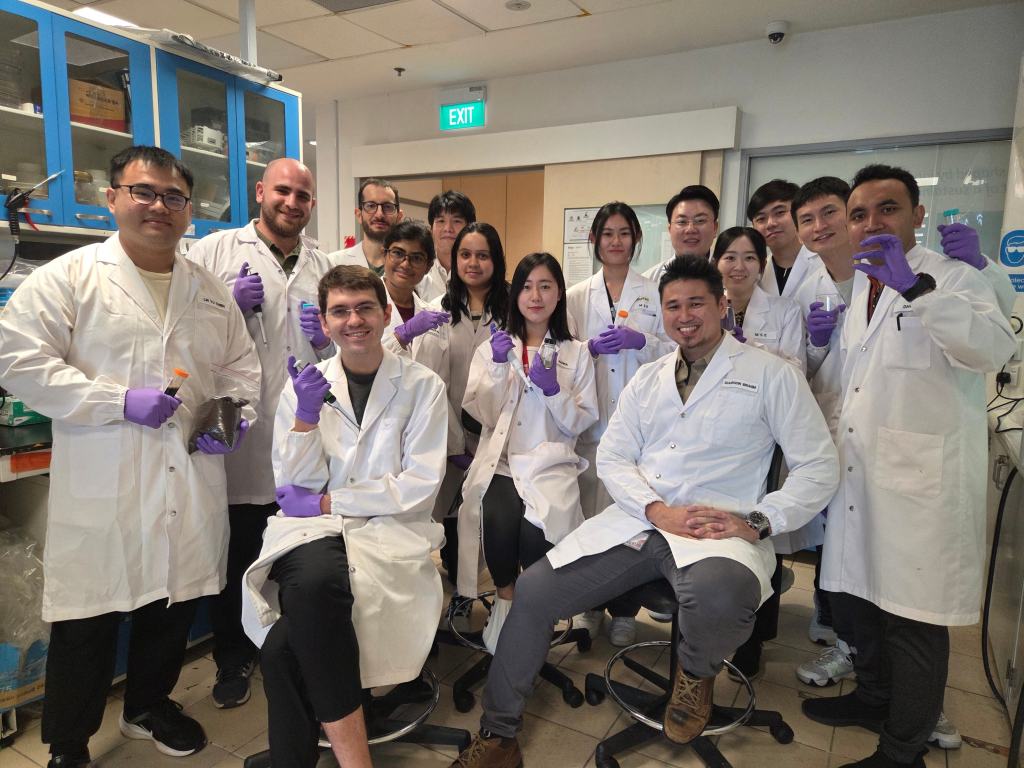
Park Seung-min, an assistant professor at Nanyang Technological University’s School of Chemical and Life Sciences in Singapore, is set to bring to market the world’s first “smart toilet” capable of diagnosing colorectal cancer through stool sample analysis. The system functions by gathering stool in the toilet and identifying DNA from cancer cells. Professor Park is also a leading contender for securing around 10 billion South Korean won in national research funding from Singapore, including university backing, by early next year.
This study, which has created new possibilities for detecting cancer at an early stage, almost didn’t come to fruition. In 2023, Professor Park was awarded the Ig Nobel Prize—chosen by Harvard University and known as the “quirky Nobel Prize” for honoring unusual scientific research—after creating AI technology to examine waste for health diagnostics. Although this accomplishment was recognized, his applications to five leading South Korean universities were turned down when he tried to further the research. The reason given was that “toilet-related research is unsuitable for a university.” However, NTU offered him a position, saying, “We value this groundbreaking work that no one has attempted before. We will fully support it,” and provided him with a professorship. With NTU’s support, Professor Park’s smart toilet research was published in August of this year in *Advanced Science*, a prestigious international journal.
Singaporean institutions, such as NTU, have gained international recognition in scientific research by actively seeking out young talents from around the globe who have shown remarkable accomplishments, including Professor Park. Their approach to hiring is more intense than that of any other country: they attract researchers who have made pioneering discoveries or achieved outstanding results, regardless of their background, by providing superior working conditions compared to universities in the U.S. or China. They cover international tuition fees for children and even employ both partners if one is a professor—a method known as “package recruitment.”
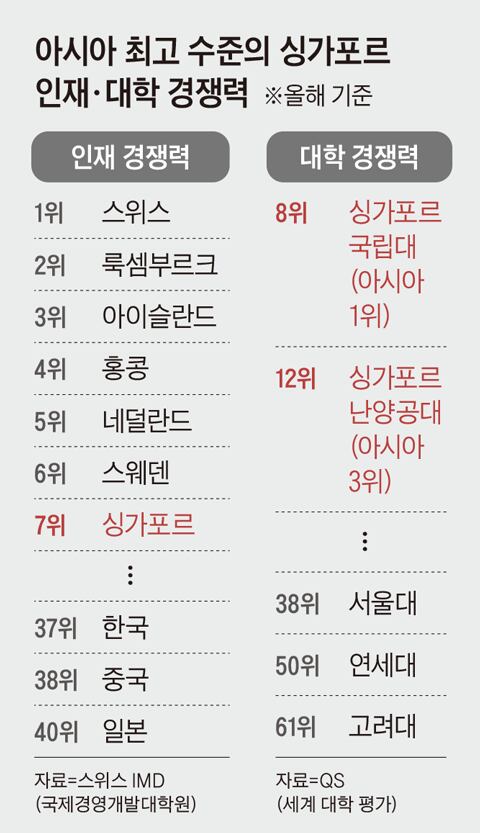
Due to this global talent recruitment, NTU and the National University of Singapore (NUS) now include faculty members, researchers, and students from more than 100 countries. This approach, developed out of necessity for a city-state with limited resources and population, has become the key factor in the universities’ top-tier global competitiveness. In the 2025 QS World University Rankings, NUS secured the 8th position worldwide, the highest in Asia. NTU, founded in 1991 by looking at Korea’s KAIST and POSTECH as models, has long surpassed Korean institutions in international rankings. In the 2025 QS rankings, NTU came in 12th, the third-highest in Asia after the University of Hong Kong (11th).
Kim Geon, a faculty member in the School of Civil and Environmental Engineering, transitioned from the Ulsan National Institute of Science and Technology (UNIST) to NTU in 2023. His work on employing ultrasound for assessing structural integrity—a unique interdisciplinary method within civil engineering—faced challenges in obtaining governmental support in South Korea. Professor Kim stated, “At NTU, professors from chemical engineering, materials science, and medicine work together seamlessly, and the university provides substantial funding, enabling me to conduct research that was not feasible in Korea.”
Rewards for accomplishments are also straightforward. The National Research Foundation (NRF) of Singapore annually chooses approximately 10 researchers, irrespective of their nationality, and provides them with 5 billion to 10 billion South Korean won or more. At Nanyang Technological University (NTU), even assistant professors who have published in top-tier journals can receive annual salaries of 1 million Singapore dollars (around 1.1 billion South Korean won), surpassing the earnings of full professors.
This courageous strategy is made feasible by the government’s “non-intervention support” and contributions from international corporations. NUS received 1.30135 billion Singapore dollars (roughly 1.4 trillion South Korean won in 2023) in government funding while functioning without any administrative or research interference. Lam Kinyong, vice president of NTU, stated to this newspaper, “Singapore is home to over 4,200 global corporate headquarters and regional offices—more than three times the number in Hong Kong. Partnerships with these companies also help in attracting international talent. On NTU’s campus, joint laboratories with multinational firms such as Alibaba, HP, and Hyundai Motor Company are active, drawing researchers from around the world to Singapore.”


 jasdooit
Leave a comment