
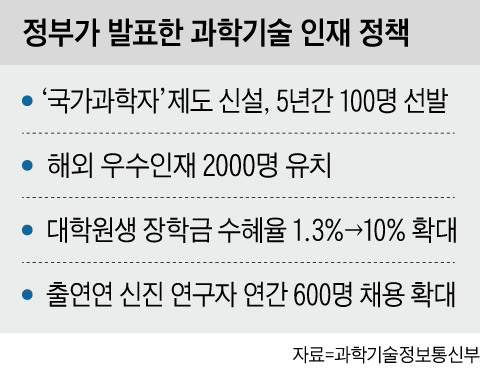
The government revealed plans to allocate roughly 1.2 trillion South Korean won by 2030 in an effort to bring in 2,000 top international and up-and-coming researchers, while also creating a ‘National Scientist’ program to assist local science and technology professionals. This comes in response to increasing worries about the loss of domestic talent to other countries, leading to a coordinated initiative across multiple ministries to tackle the shortage of skilled personnel.
President Lee Jae-myung, along with the Ministry of Science and ICT, the Ministry of Education, and the Ministry of Trade, Industry and Resources, conducted a national briefing session named ‘Reimagining Science and Technology Professionals: A Report to the People of the Republic of Korea’ at the National Science Museum in Daejeon on the 7th. The event revealed plans aimed at drawing in talent and transforming the research and development (R&D) environment.
Initially, the government plans to designate approximately 100 researchers who have made outstanding contributions globally as ‘National Scientists’ over the next five years, choosing roughly 20 each year. These National Scientists will be awarded a ‘Presidential Certificate’ along with 100 million South Korean won in annual research funding. They will engage in research and development as well as contribute to the formulation of national science and technology policies. This initiative is similar to China’s ‘Academician’ title for leading scientists. Earlier, Deputy Prime Minister and Minister of Science and ICT Bae Kyung-hoon mentioned in an interview with this newspaper, on the October 21 edition, page B2, that a ‘Korean-style Academician system’ would be established to discourage domestic scholars from moving overseas.
The government also plans to increase research and development funding to 5% of overall government expenditure each year. It highlighted the importance of choosing innovative R&D projects rather than opting for secure, predictable results and ensuring effective assessment of outcomes. President Lee Jae-myung criticized, “How ridiculous is it that South Korea’s R&D success rate is over 90%? Only by accepting failure can genuine R&D flourish, and the country will grow prosperous.”
The government intends to develop ‘versatile expertise’—combining AI with science and technology—beyond the capital area. This involves setting up and growing specialized science schools and enhancing collaborations with science and technology institutions to ease the concentration of medical schools.
Graduate students in science and engineering will see their scholarship rates increase from 1.3% in 2025 to 10% by 2030. Additionally, government-financed research organizations will hire 600 new researchers each year.
Critics claim that the government’s actions show a lack of creativity, simply repeating previous strategies. For example, the National Scientist system is almost the same as the ‘National Scholar’ program (2005–2008), which sought to develop talent capable of winning a Nobel Prize by offering up to 2 billion South Korean won each year (200 million for theoretical disciplines) over a five-year period.
A strategy to allocate 1.2 trillion South Korean won over five years to bring in international talent—70% of whom are researchers based domestically overseas—has also faced scrutiny. With global rivals competing to keep talent from leaving due to U.S. research funding reductions, South Korea’s method is considered too inactive.


 jasdooit
Leave a comment