
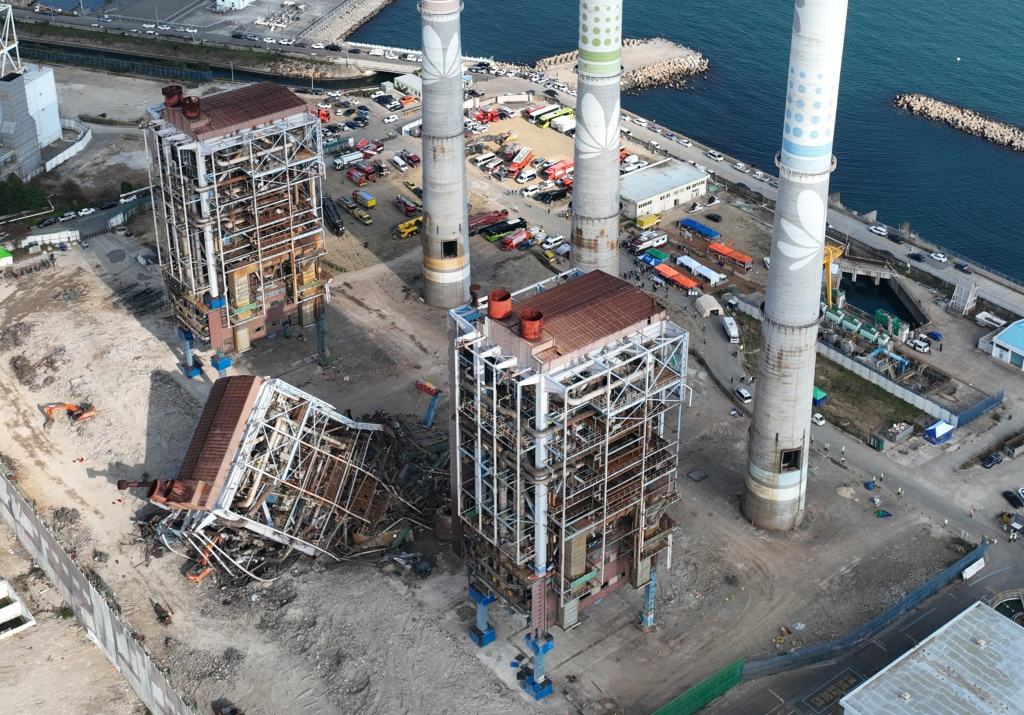
On the 6th, specialists suggested that an inquiry is needed to ascertain if the collapse of the boiler tower at the Ulsan Thermal Power Plant, which was being dismantled, resulted from not following the demolition procedure correctly.
The boiler tower is a steel framework designed to heat water for power production. During the incident, the tower had already undergone weakening procedures on its lower part in preparation for a planned explosion on the 16th. The weakening process includes cutting through strong pillars and supports to allow the structure to fall as a single unit. In the demolition field, this technique is referred to as “trunk chopping,” since it is similar to slicing the base of a tree to facilitate its fall.
Video of the accident reveals the tower collapsed when one column could not support the load. Initially, the lower part of the tower contained equipment such as burners for boiling water, but these had been taken out, leaving just the columns.
Safety professionals stated, “Demolition poses greater risks compared to building a structure,” and mentioned, “It is possible that the original demolition plan did not correctly assess the loads.”
Ham Eun-goo, a research director at the Korea Disaster Information Society, stated, “The collapsed building, which was 44 years old and unused for four years, probably suffered significant deterioration. It is possible that the demolition plan failed to consider this and only used outdated architectural drawings.”
The demolition project was awarded to HJ Shipbuilding & Construction Co, with the actual work delegated to Koreacaco.
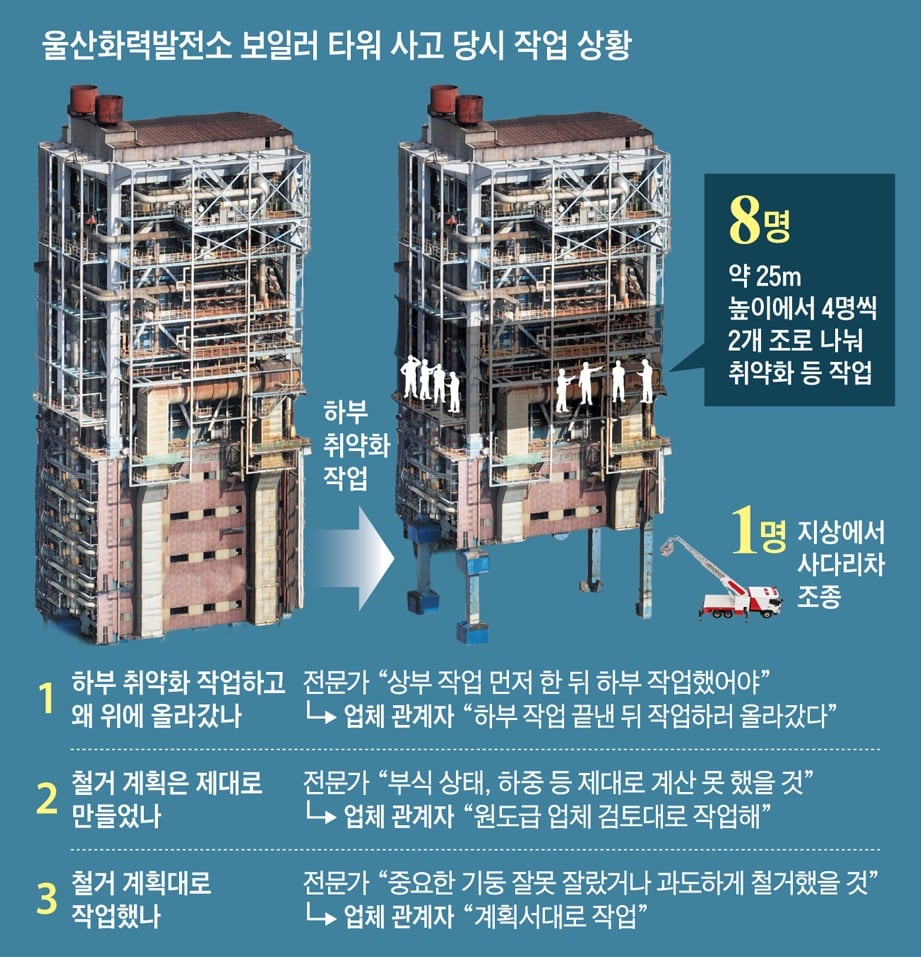
Cho Won-cheol, a retired professor from Yonsei University’s Department of Construction and Environmental Engineering, said, “Unlike concrete buildings, ensuring the balance of the center of gravity is essential when tearing down steel structures. The plan must carefully differentiate between sections to be removed and those to remain, but this might have been handled improperly.”
Moreover, the boiler tower, situated close to the shoreline, had been subjected to salty winds for more than 40 years. Ham noted, “Steel deteriorates faster than anticipated. Even if it looks undamaged, there might be internal corrosion.”
Dongseo Power seemed to have foreseen this situation. In its 2023 technical guidelines for the demolition proposal, it mentioned, “Because of various maintenance activities, the design drawings might not align with the real structure, so safety factors should be considered when determining weight and structural stability prior to dismantling.”
Concerns were raised regarding the sequence of work. Why were workers positioned on the upper section after the base had been weakened? Fire officials estimated that eight out of the nine workers trapped were carrying out weakening tasks around 25 meters above ground, while the ninth was operating a ladder truck at ground level.
Experts noted, “For safety reasons, tasks on the upper levels are usually finished before reducing the stability of the base. Doing it in the opposite order increased the number of injuries.”
A representative from Koreacaco stated, “The workers had completed the process of weakening the structure and were in the process of climbing up to carry out protective measures,” which involved covering the building with materials such as cloth to stop debris from spreading during the explosion. “We adhered to the demolition plan,” they noted. However, a source from the demolition industry commented, “Protective work should come before weakening—this is confusing.” Authorities and the Ministry of Employment and Labor are currently examining the specific duties the workers were performing at that time.
Although the tower was more than 60 meters tall, the demolition company did not provide a demolition plan to local authorities or assign a supervisor. This is due to the fact that the boiler tower is categorized as a “structure” instead of a “building,” placing it in a “regulatory gap.” As per the Building Management Act, demolishing a building requires submitting a dismantling plan—covering construction details, demolition techniques, and measures to prevent falls—to local governments and assigning a supervisor. Structures, on the other hand, are not required to follow these regulations.
Critics remarked, “This indicates that the work was carried out without a formal plan for demolition or supervision.” A representative from Nam-gu district in Ulsan said, “The collapsed boiler tower is not considered a structure, so local authorities are unable to get involved in its removal or detonation.”

 jasdooit
Leave a comment