
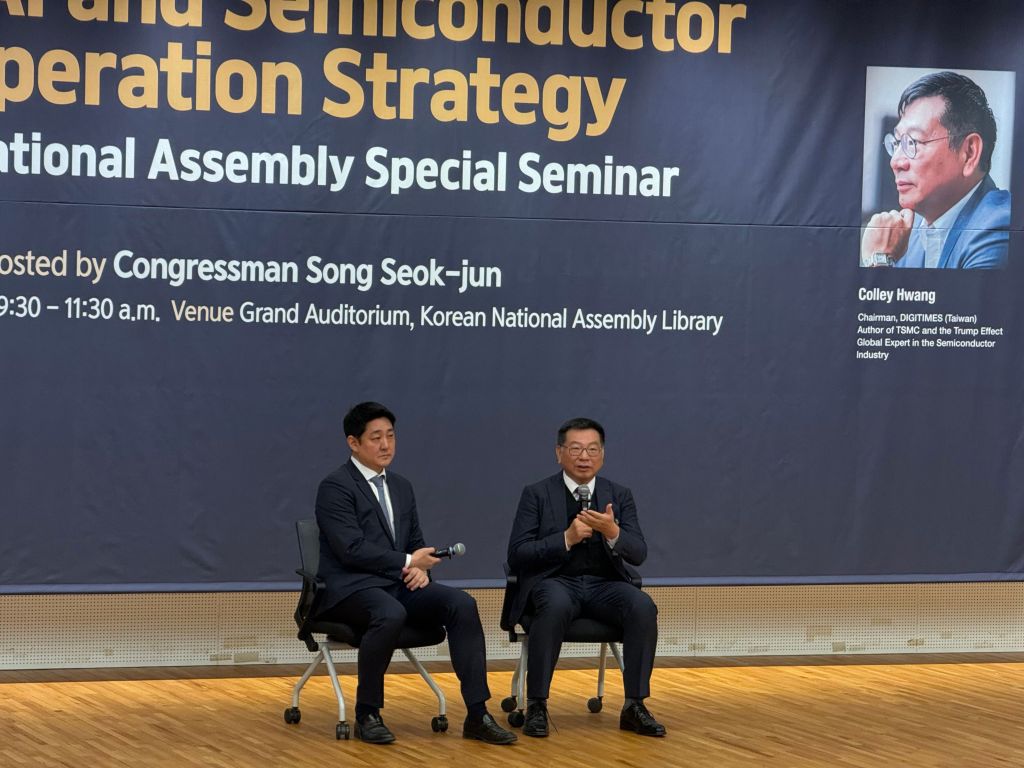
Colley Hwang, the head of DIGITIMES, a media and research organization focused on Taiwan’s semiconductor sector, suggested, “South Korea and Taiwan should create a collaborative framework.”
Hwang made the comments on the morning of the 10th during the ‘Global AI and Semiconductor Cooperation Strategy Seminar’ organized by Representative Song Seok-jun’s office at the main auditorium of the National Assembly Library. He said, “South Korea and Taiwan are the only two nations that have independently developed their electronics and semiconductor industries over the last 50 years,” and added, “My vision is to establish a new industrial framework that exceeds both the U.S. and China through collaboration with South Korea.” DIGITIMES, a global media and research organization in the semiconductor industry, was co-established by Morris Chang, founder of TSMC, and Stan Shih, founder of Acer. Hwang, the company’s founder, is recognized as a globally esteemed semiconductor strategist.
He highlighted that the semiconductor sector benefits more from government-driven infrastructure investment than from democratic market competition. Consequently, South Korea and Taiwan emerged as the two nations that successfully progressed through the semiconductor industry. Hwang stated, “South Korea entered the industry by leveraging technology and capital-intensive brands such as Samsung, while Taiwan developed by concentrating on manufacturing infrastructure and production ecosystems.” South Korea is known for its expertise in memory semiconductors, while Taiwan is renowned for its foundry (semiconductor contract manufacturing) and EMS (electronics manufacturing services).
At present, the AI semiconductor industry functions in this manner: NVIDIA, based in the United States, develops chips, TSMC produces them in Taiwan, and SK Hynix from South Korea provides high-bandwidth memory (HBM) to develop AI accelerators. Hwang stated, “For the last 30 to 40 years, South Korea and Taiwan were rival countries, but this year, South Korea became Taiwan’s top trading partner with a deficit, showing that the two supply chains have started to merge.” He proposed, “We should think about constructing a highway linking South Korea’s semiconductor hub with Taiwan’s Hsinchu Science Park.”
Hwang suggested creating an ecosystem-based alliance model focusing on South Korea and Taiwan. He stated, “If I had the opportunity to talk to South Korean government officials, I would recommend they seriously think about a plan where Samsung or SK Hynix invest directly in Taiwanese IC design firms.” He further mentioned, “This would enable direct control over supply chain infrastructure.” He emphasized, “Semiconductor dominance is a battle of ecosystems, not individual countries. Initiatives to develop an Asian ecosystem led by South Korea and Taiwan are essential.”
Kim Sung-soo, an adjunct professor at Yonsei University’s Graduate School of Business, who co-hosted the seminar, proposed that South Korea could establish itself in the semiconductor industry by leveraging its advantages in small modular reactors (SMR). As power supply for global AI data centers becomes a significant challenge, South Korea, with its nuclear energy expertise, could meet this demand. He mentioned, “The semiconductor industry is very competitive, and our strengths in materials, components, and equipment are still developing.” However, he added, “Nuclear energy is one area where we currently lead globally, and we have already exported it.” He further said, “The UAE and Saudi Arabia are placing large orders for data centers; we should consider partnerships based on our SMR capabilities.”

 jasdooit
Leave a comment