
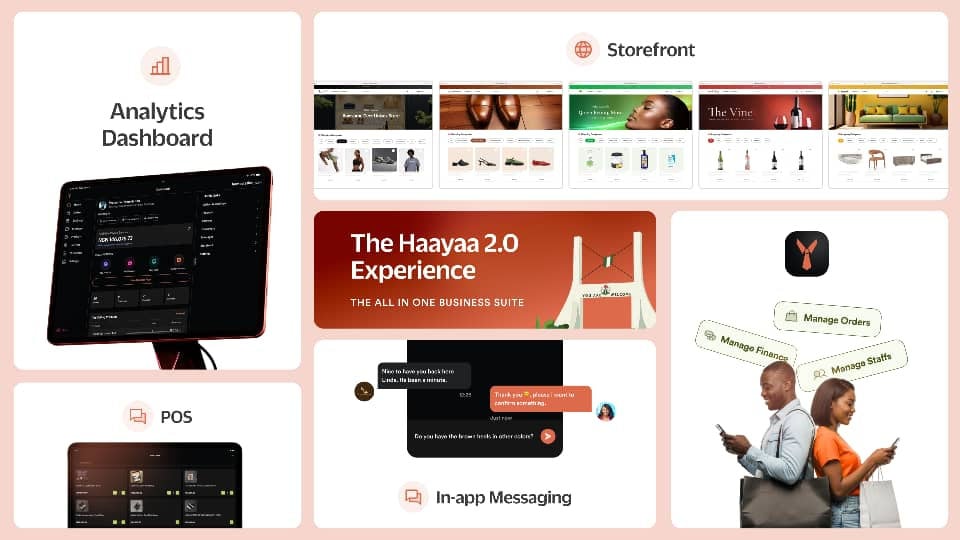
As Nigerian small and medium enterprises keep dealing with the challenges of digital change, a local platform named Haayaa is advocating for locally developed solutions tailored for SMEs and MSMEs.
Haayaa, created by three Nigerian entrepreneurs, subtly indicates a change in how digital systems for businesses are conceived, developed, and implemented in regional markets.
Haayaa is a comprehensive e-commerce platform that provides user-friendly, customizable business solutions designed to assist individuals and small and medium enterprises in expanding their operations.
Over the past ten years, Nigerian companies, especially those in retail and trade, have relied significantly on social media, text messaging, and personal trust to facilitate sales, monitor progress, and maintain customer interactions. However, with increasing demand, these approaches are becoming unsustainable.
As stated by Kene Aniekwena, co-founder and Chief Operating Officer at Haayaa, “What we discovered wasn’t merely a technological shortfall, but a systemic issue. Companies weren’t failing because they lacked sales knowledge. They were having trouble maintaining organization. They were dedicating more time to managing operations than to expanding.”
Haayaa aims to address this issue through a business-oriented strategy.
This idea became reality at the recentHaayaa 2.0 Launch Celebration in Abuja, where business owners and innovators came together to witness the new development of the platform.
It offered a preview of the future of digital business management for Nigerian SMEs, revealing Haayaa’s updated interface, enhanced capabilities, and broader range of features. From interactive product demonstrations to lively discussions on digital infrastructure, the launch highlighted Haayaa’s dedication to equipping business owners with user-friendly tools that align with the realities of local trade. Participants got an immediate look at the platform’s latest improvements, including theNo-Code Website Builder, Integrated Logistics, Local Payment Support, POS (Point of Sale)and Staff Access Accounts, which reshape responsibility and confidence in small business activities.
At its foundation, Haayaa 2.0 represents an effort that many startups in the area are still trying to tackle, which is contextual innovation. Instead of copying Western e-commerce approaches, Haayaa focuses on how Nigerian businesses function: from handling sales through various channels to coping with unstable infrastructure. One of the most significant issues in local trade that is seldom discussed isstealing and absence of openness within the employees.Many business owners rely on trust, sometimes even blind trust, by giving their physical stores or social media direct messages to employees without much insight into real transactions. Haayaa 2.0 introducesStaff Access Accounts, A functionality that enables business owners to allocate sales responsibilities to employees while keeping track of all transactions as they happen. Owners can view who made the sale, when it occurred, and the method used. This real-time responsibility helps business owners to assign tasks confidently.
What Haayaa is accomplishing extends beyond creating a platform; it is reshaping the concept of digital infrastructure within Nigerian markets. The platform is set to transform business infrastructure by embedding its innovations in the everyday experiences of Nigerian businesses.
It is becoming the foundation of informal and semi-formal trade throughout the nation, offering functionalities that facilitate local transactions, no-code website creation, combined logistics, and sales through community networks.
Haayaa’s philosophy is centered around subtle change. It aims not to “disrupt” but to empower. It doesn’t compel companies to stop their current methods, but rather improves them through organization, knowledge, and productivity.
Provided by SyndiGate Media Inc. (Syndigate.info).




 jasdooit
Leave a comment