
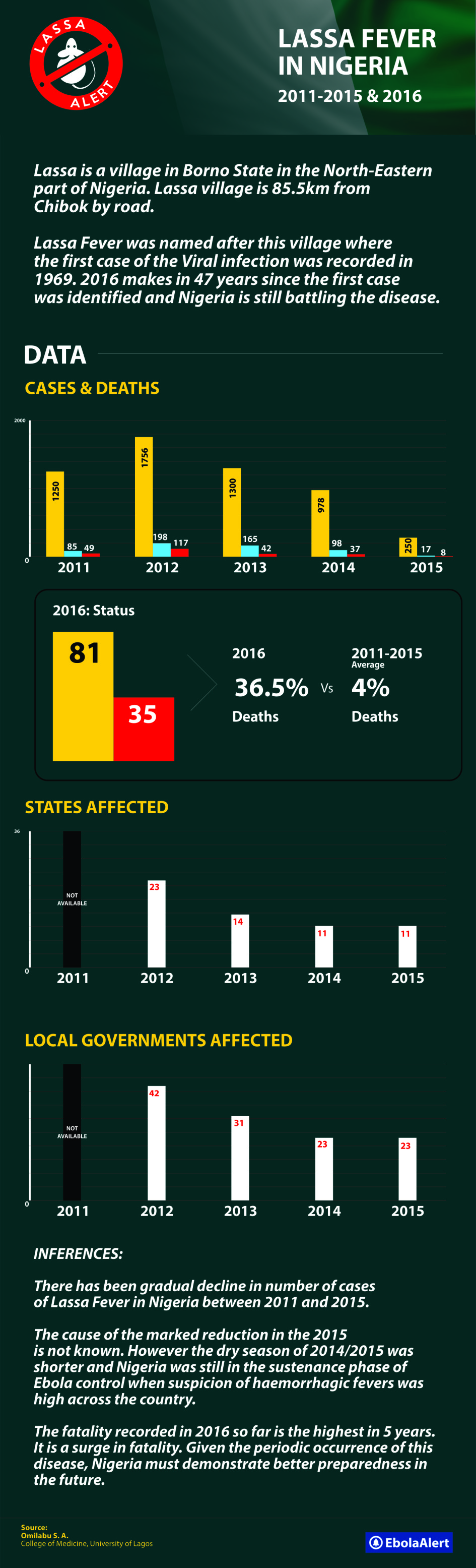
The nation has reported 8,463 suspected cases, 966 confirmed infections, and seven possible cases in 21 states and 102 Local Government Areas.
Nigeria has noted a minor rise in new Lassa fever cases, with 12 confirmed instances documented in epidemiological week 44 of 2025, as opposed to 11 cases reported in the prior week.
The Nigeria Center for Disease Control and PreventionThe NCDC, in its situation report published on Thursday, mentioned that the most recent cases were identified in Ondo, Edo, and Benue States, indicating ongoing spread in major affected regions.
The NCDC reported that by the end of week 44, a total of 177 fatalities had been recorded, indicating a Case Fatality Rate (CFR) of 18.3 percent.
This number is higher than the 16.5 percent CFR documented in the same period in 2024. The nation has recorded 8,463 suspected cases, 966 confirmed infections, and seven probable cases across 21 states and 102 Local Government Areas so far.
Even though the total number of suspected and verified cases is less than the accumulated figures from 2024, the agency cautioned that spread is still extensive, with multiple states still experiencing ongoing activity.
Four states contributing to the spread
The NCDC stated that four states, Ondo, Bauchi, Edo, and Taraba, made up 87 percent of all confirmed cases recorded in 2025.
Ondo had the largest share at 36 percent, followed by Bauchi with 21 percent, Edo with 17 percent, and Taraba with 13 percent.
The majority of those impacted are still people between the ages of 21 and 30, although there were cases spanning from one to 96 years old, with an average age of 30.
The proportion of males to females among confirmed cases was 1 to 0.8.
The NCDC reported that no cases of healthcare workers being infected were noted during week 44.
Ongoing response efforts
The National Lassa Fever Technical Working Group (TWG), along with national and international collaborators, carried out extensive response efforts throughout the nation.
Throughout the reporting week, the agency enhanced its collaboration with the Nigerian Medical Students’ Association (NiMSA) to promote and disseminate prevention and control information.
It was also involved in a bilateral discussion with Médecins Sans Frontières (MSF) Switzerland to examine potential areas of cooperation in anticipation of a possible increase in cases.
The era also included the completion of several After Action Reviews (AARs) for the 2024/2025 outbreak season in Edo, Ondo, and Ebonyi States.
Furthermore, the NCDC implemented S.O.A.R analysis during a capacity-building workshop focused on strategic planning and consistently distributed Lassa fever radio jingles to stakeholders to enhance public awareness.
The organization also supported discussions regarding the national Lassa fever vaccine access strategy and participated in the 2nd ECOWAS Lassa Fever International Conference held in Côte d’Ivoire.
Additional response actions involved sending 10 National Rapid Response Teams to the affected states, introducing the NCDC’s Infection Prevention and Control (IPC) online learning platform, and providing revised Viral Haemorrhagic Fever IPC guidelines to healthcare facilities.
Lagos State distributed thermometers to contacts for temperature tracking, while health professionals in Bauchi, Ebonyi, and Benue underwent further case management training backed by the World Health Organisation (WHO).
The INTEGRATE medical study also began in Ondo State, with assistance from local and global research collaborators.
The organization kept providing critical supplies including personal protective gear, Ribavirin, body bags, hand sanitizers, and thermometers to the states impacted.
It further enhanced continuous scientific efforts, such as a quarterly follow-up and blood sampling initiative at specific treatment locations, and aided in the creation of a community-driven One Health empowerment approach.
Targeted community communication approaches were also created using the latest survey results, with further awareness initiatives carried out via radio and environmental health programs in areas with significant disease prevalence.
Challenges
Nevertheless, the NCDC pointed out a number of difficulties that still hinder the country’s response.
Leading the chart is the delayed presentation of cases at healthcare facilities, which plays a major role in the increasing death rate.
The organization stated that limited efforts to seek medical care, primarily due to the expensive nature of treatment, continues to be a significant issue.
It also highlighted ongoing problems with inadequate environmental hygiene and limited knowledge in communities heavily affected.
Recommendations
In response to these issues, the NCDC encouraged states to boost community involvement and health awareness initiatives all year round.
It urged healthcare professionals to remain vigilant and to guarantee prompt referral and timely commencement of care.
The organization also highlighted the importance of ongoing funding for state-level capabilities to identify, stop, and quickly address Lassa fever outbreaks.
Lassa fever
Lassa fever is a sudden viral bleeding disease triggered by the Lassa virus, which spreads to people mainly through interaction with food or household objects that have been tainted by the urine or feces of infected rats.
It can also transmit between individuals via contact with body fluids.
The illness typically starts with symptoms like fever, fatigue, and a headache, and can later develop into more serious conditions including bleeding, trouble breathing, swelling, and failure of internal organs.
Early detection and immediate administration of Ribavirin are essential for enhancing survival rates.
Copyright 2025 Premium Times. All rights reserved. Shared by AllAfrica Global Media ().
Tagged: Nigeria, Health and Medicine, Governance, West Africa
Provided by SyndiGate Media Inc. (Syndigate.info).




 jasdooit
Leave a comment