
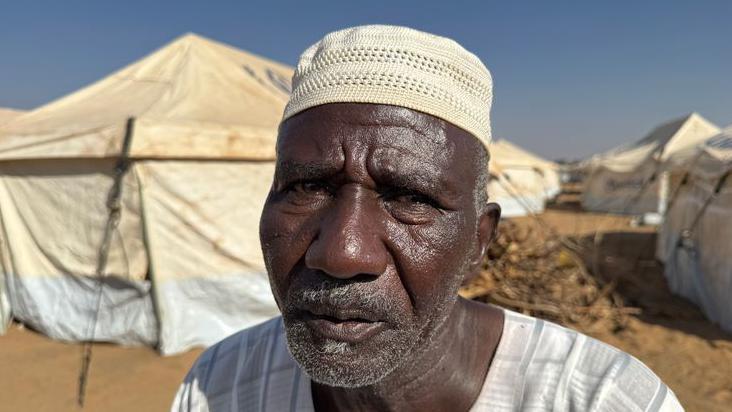
Abdulqadir Abdullah Ali experienced significant nerve damage in his leg during the extended siege of the Sudanese city of El-Fasher, as he was unable to obtain medication for his diabetes.
A 62-year-old man moves with a noticeable limp, yet when fighters from the paramilitary Rapid Support Forces (RSF) eventually took control of the city in the western Darfur region, he was so frightened that he didn’t feel any pain while fleeing.
“The morning the RSF arrived, there was gunfire, a lot of gunfire, and explosions happening,” he says.
People lost control [due to fear], fleeing their homes, with everyone moving in separate directions, the father, the son, the daughter — all running.
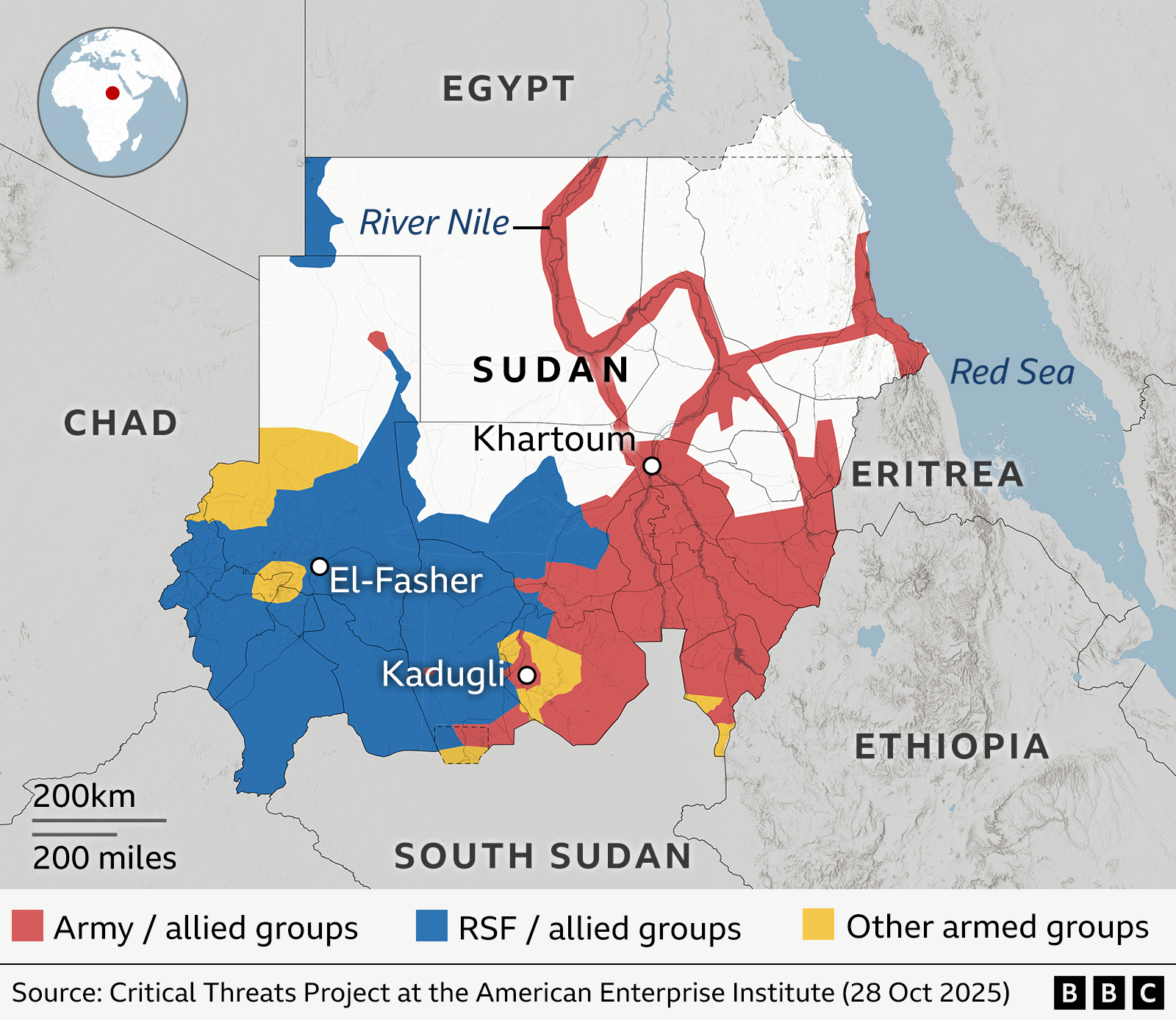
The capture of El-Fasher following an 18-month blockade marks a particularly harsh phase in Sudan’s ongoing conflict.
The team has traveled to a tent camp in northern Sudan, established in army-controlled area, to listen to the personal accounts of those who managed to escape. The group was observed by the authorities during the entire visit.
The RSF has been engaged in conflict with the regular army since April 2023, following a power dispute that escalated into warfare.
Capturing el-Fasher marked a significant triumph for the armed group, forcing the military to abandon its final base in Darfur.
However, proof of large-scale atrocities has led to global criticism and increased U.S. focus on efforts to conclude the conflict.
Caution: This report includes information that some individuals might find upsetting.
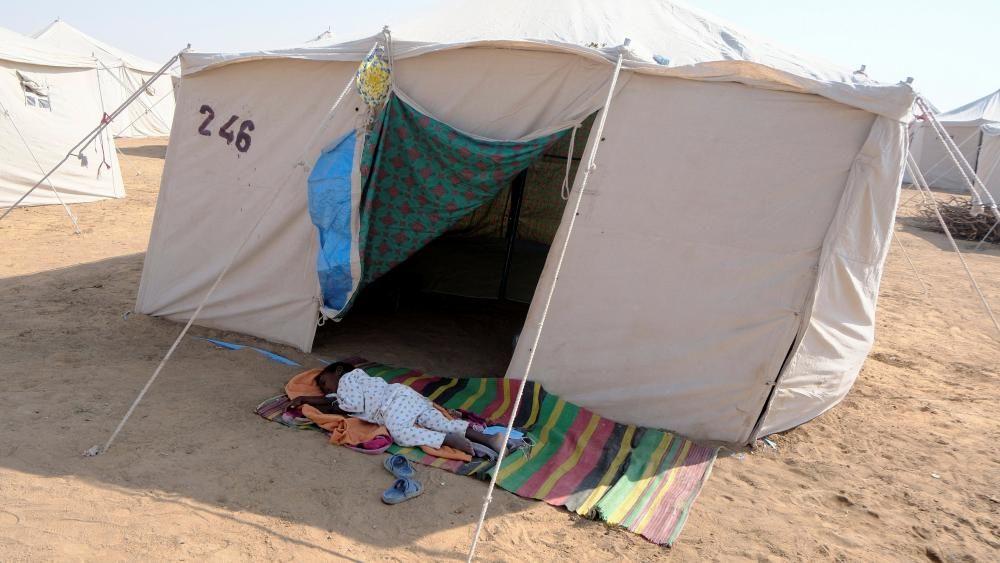
We located Mr. Ali roaming the camp, situated in the desert approximately 770km (480 miles) north-east of el-Fasher, close to the town of al-Dabbah.
He was attempting to enroll his family for a tent.
“They [RSF fighters] were firing at the people—the elderly, the civilians—using live bullets, emptying their weapons on them,” he said to us.
Some of the RSF arrived in their vehicles. If they noticed someone was still alive, they ran them over.
Mr. Ali mentioned that he fled whenever possible, moving along the ground on his hands and knees or taking cover when the danger became too intense. He eventually reached the village of Gurni, located a few kilometers from El-Fasher.
Gurni was the initial refuge for numerous individuals escaping the city, among them Mohammed Abbaker Adam, a local administrator at the nearby Zamzam camp for those forced to leave their homes.
Mr. Adam went to el-Fasher when Zamzam was taken over by the RSF in April, and he departed the day prior to the city’s capture.
He developed a white beard to appear older, hoping it would result in more compassionate treatment.
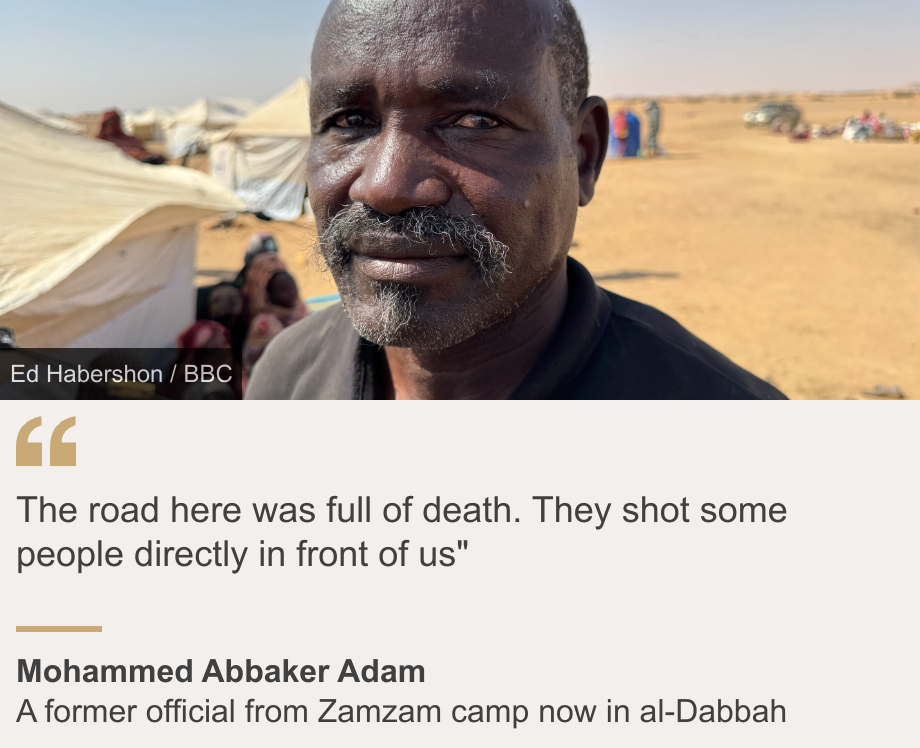
“The path leading here was filled with demise,” he stated.
They fired at people right in front of us and then took them and hurled them far away. Along the road, we encountered corpses lying openly, not buried. Some had remained there for two or three days.
Many individuals are spread out,” he continued. “We have no idea where they are.
Several individuals who did not embark on the lengthy journey to al-Dabbah managed to reach a humanitarian center in Tawila, approximately 70 kilometers away from el-Fasher.
Some moved into Chad. However, the UN states that fewer than half of the 260,000 individuals who were believed to be in the city prior to its fall have been located.
Relief organizations think that numerous individuals didn’t manage to travel far—prevented from leaving due to risks, or being held back by detention, or the expense of paying their way out.
Mr. Adam stated that the combatants also committed acts of sexual assault, supporting the numerous reports of sexual violence.
“They would take a woman behind a tree, or lead her away from us, out of your sight, so you wouldn’t witness it with your own eyes,” he said.
But you would hear her yelling: ‘Help me, help me.’ And she would arrive and say, ‘They violated me.’
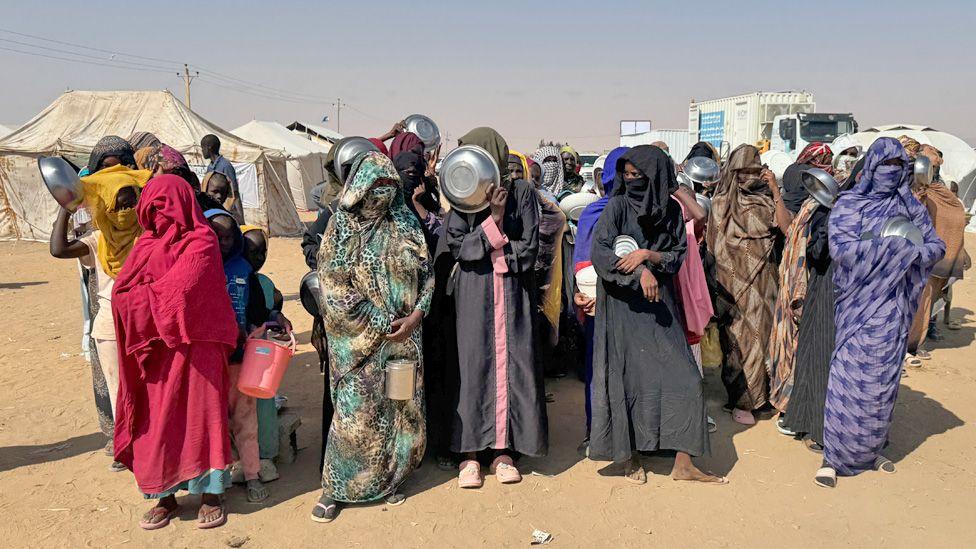
Most of the people in the camp are women, and many prefer not to be recognized to safeguard those who remain.
A 19-year-old woman shared with us that RSF fighters at a checkpoint removed a girl from the group she was traveling with, forcing them to leave her behind.
I was frightened,” she said. “When they removed her from the car at the checkpoint, I feared that at each checkpoint they would take a girl. However, they only took her, and that was all until we arrived here.
She came here with her younger sister and brother. Her father, a soldier, died in combat. Her mother was not in El-Fasher when the town fell.
The three siblings fled the city on foot alongside their grandmother, but she passed away before they arrived at Gurni, forcing them to continue without her.
“We didn’t carry enough water as we weren’t aware how long the journey would be,” the young woman said.
We kept walking and walking, and my grandmother collapsed. I believed it could be due to not having enough food or water.
I examined her pulse, but she remained unconscious, so I sought out a physician from a nearby town. He arrived and stated, “Your grandmother has bestowed her soul upon you.” I was struggling to remain composed for the sake of my sister and brother, yet I had no idea how I would break the news to my mother.
They were all especially concerned about their 15-year-old brother since the RSF believed that men who had escaped had engaged in combat with the military.
The young man recounted his experience at a single checkpoint where all the male youths were removed from the vehicles.
He explained, ‘The RSF questioned us for hours under the sun. They claimed we were soldiers – some of the older ones might have actually been.’
The fighters from RSF loomed over us, encircling us while beating us and pointing their guns at us. I had no more hope left and said to them, ‘Do whatever you want to me.’
Eventually, they released him – following his 13-year-old sister informing them that their father had died, and he was her sole brother. They were reconnected with their mother at the al-Dabbah camp.
Numerous individuals mention the RSF isolating elderly men and women from those of fighting age.
This occurred to Abdullah Adam Mohamed in Gurni, separating him from his three young daughters—two, four, and six years old. The perfume vendor had been taking care of them since his wife was killed in shelling four months prior.
I gave my daughters to the women [who were traveling with us],” he said to the. “After that, the RSF arrived with large vehicles, and we [the men] were afraid they would force us to join them. So some of us ran away and escaped into the neighborhood.
All night, I kept wondering, how will I ever find my children again? I’ve already lost so many people – I was terrified I’d lose them as well.
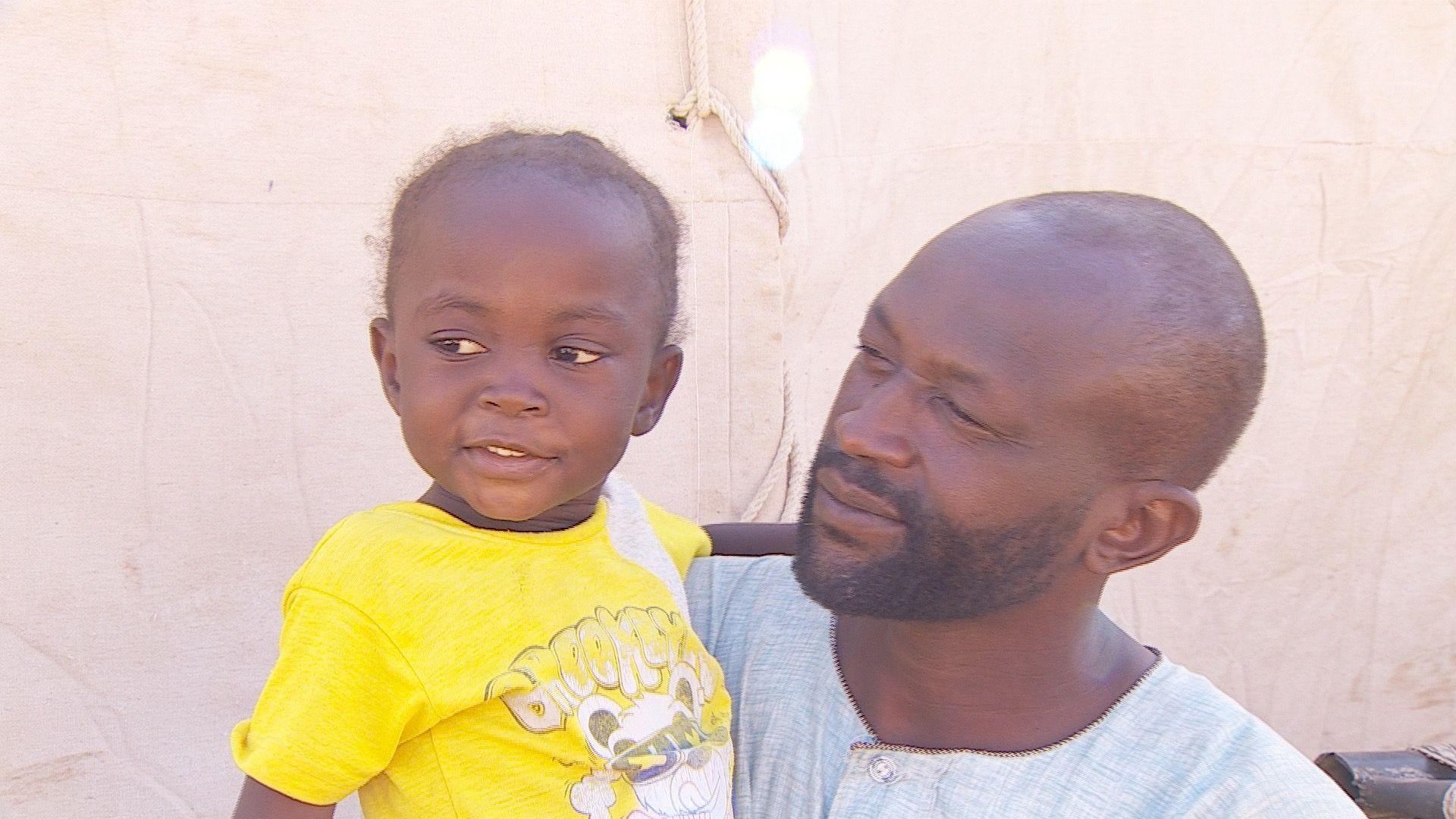
Mr. Mohamed managed to flee, but others were not as fortunate. Mr. Ali stated that he observed from a distance as the RSF opened fire on a group of men.
They executed the men, but left the women unharmed,” he said to the. “There were many corpses, and we fled.
Mr. Ali and Mr. Adam departed from Gurni on donkeys, traveling during the night towards the next village, Tur’rah.
Mr. Mohamed also reached Tur’rah, where he was reunited with his daughters. From there, they used vehicles for the long journey to al-Dabbah.
Numerous individuals reached the camp with nothing. They had departed the city carrying barely anything and were required to pay to pass through checkpoints.
The fighters from RSF took away everything we owned: money, phones, and even our good clothes,” Mr. Adam stated. “At every stop, they forced you to call your family to transfer money to your mobile phone account before allowing you to proceed to the next checkpoint.
The RSF stated that it dismissed claims of widespread mistreatment of civilians.
“The particular accusations made—plundering, murders, sexual assault, or the abuse of civilians—do not align with our instructions,” stated Dr. Ibrahim Mukhayer, an advisor to the head of the RSF, Gen Mohammed Hamdan Dagalo.
Every RSF member found guilty of misconduct will face complete responsibility.
He stated that the group felt the claims of extensive atrocities were part of a politically driven media effort targeting them, as he referred to Islamist factions within Sudan’s military-run government.
The RSF has released videos aiming to alter the story, depicting its personnel welcoming those escaping el-Fasher, trucks delivering humanitarian assistance, and medical facilities being reopened.
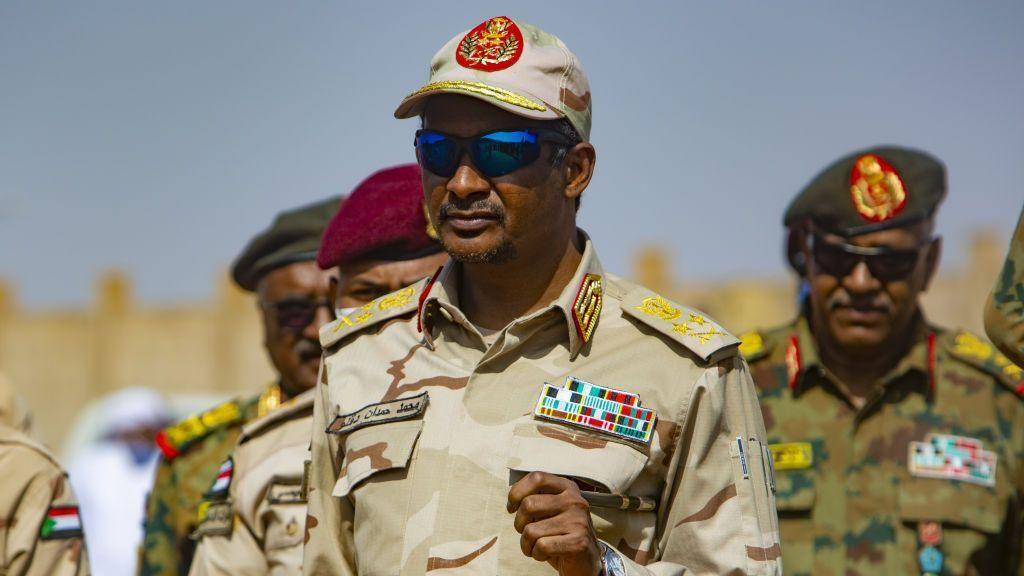
Mr. Mohamed stated that RSF fighters were more violent when their officers were not around, whereas Mr. Adam rejected what he called efforts by the paramilitary group to enhance its reputation.
They follow this approach,” he said. “They bring together 10 or 15 individuals, offer us water, and record us as if they are being kind to us.
Once the cameras leave, they will begin to assault us, mistreat us severely, and take all that we possess.
This year, the United States concluded that RSF was responsible for genocide in Darfur.
However, the Sudanese military and its allied militias have also faced allegations of committing atrocities, such as attacking civilians believed to support the RSF, and bombarding residential zones without discrimination.
This especially harsh phase in Sudan’s destructive conflict has captured the interest of US President Donald Trump. He has pledged to become more actively engaged in current US initiatives aimed at facilitating a truce.
For individuals who managed to flee el-Fasher, this appears to be a far-off hope. They have been repeatedly devastated by the conflict and are uncertain about what lies ahead.
But they are strong-willed. Mr. Ali was unaware of Trump’s unexpected interest; he had been approaching officials to obtain permission to remain in the camp within a tent, which he claims, “we can live and rest.”
More tales from the conflict in Sudan:

Go to Africa.comfor additional news from Africa.
Follow us on Twitter @Africa, on Facebook at Africa or on Instagram at africa
- A basic overview of the current situation in Sudan
- How Trump’s promise to address Sudan’s atrocities might unfold
- “A climate of fear existed”: A Sudanese hospital employee recounts escaping prior to an alleged mass killing
- He earned his wealth by trading camels and gold. Now this warlord governs half of Sudan.
- “Our task is solely to kill” – how Sudan’s violent militia executed a massacre




 jasdooit
Leave a comment