
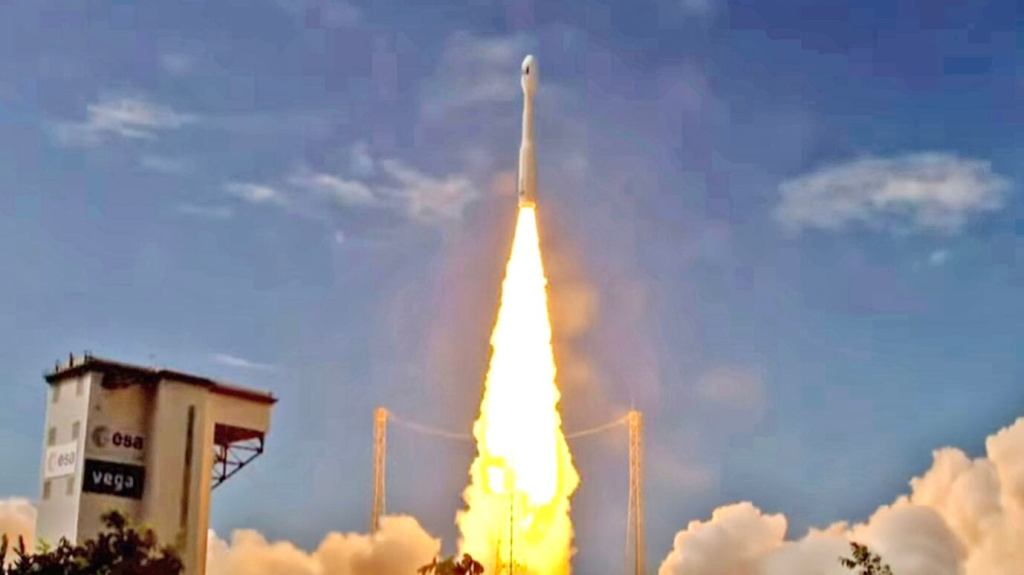
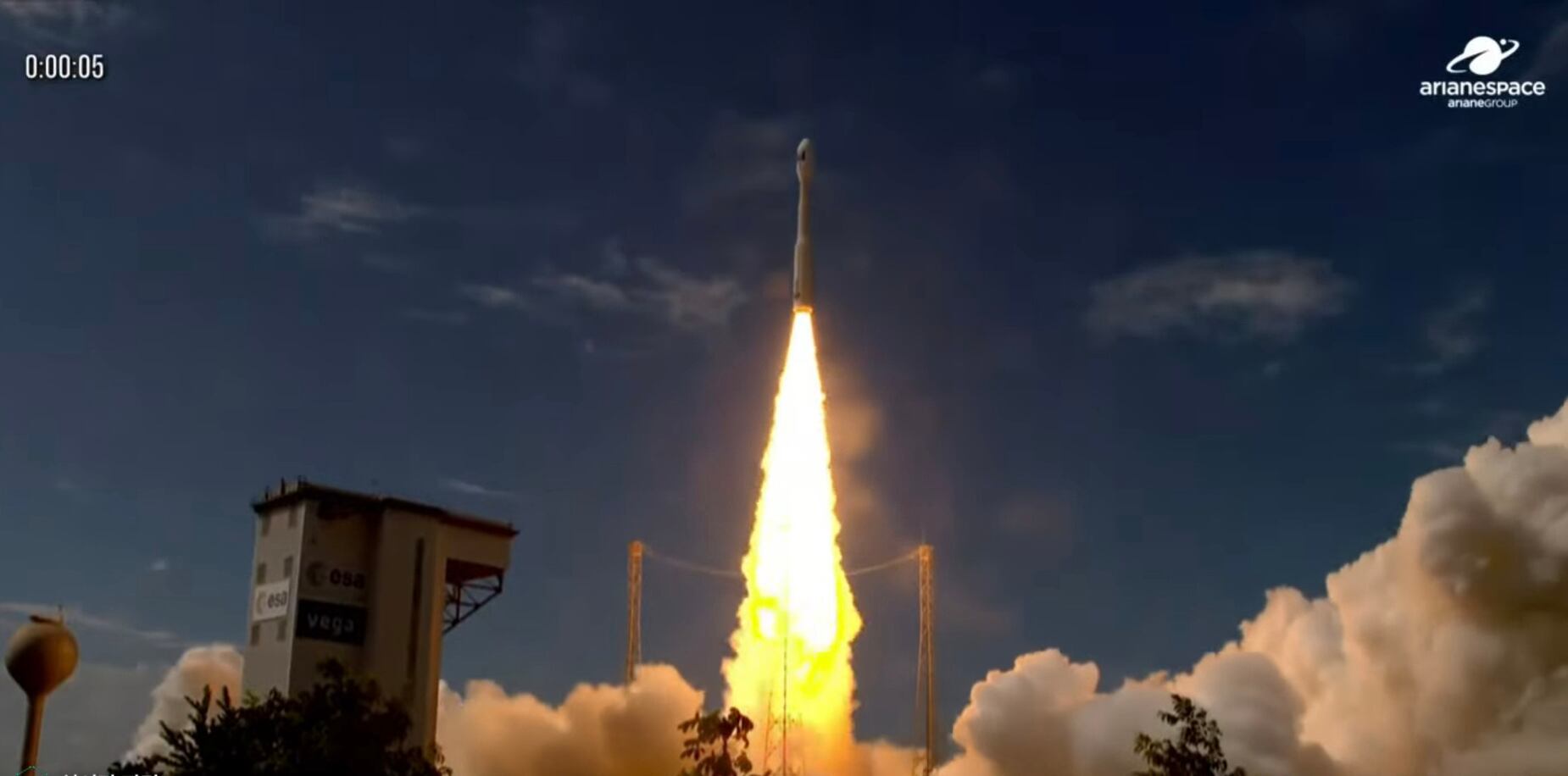
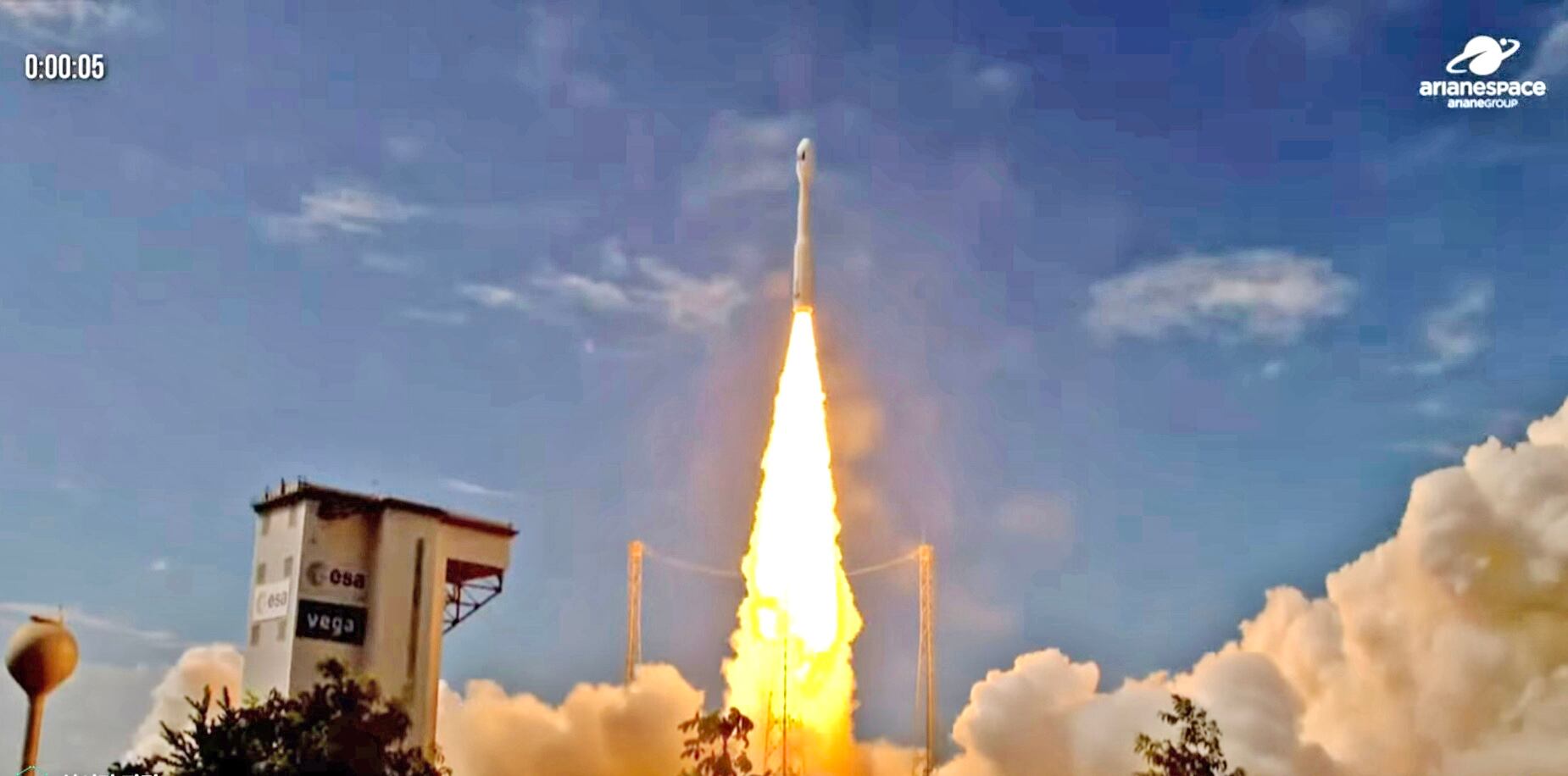
On the 2nd, South Korea’s multi-functional practical satellite ‘Arirang 7’ successfully connected with ground stations and entered its orbit following its launch on the Arianespace Vega-C rocket.
The Korea Aerospace Administration stated that Arirang 7 detached from the Vega-C rocket, which launched at 2:21 a.m. on that day (2:21 p.m. local time on the 1st) from the Kourou Guiana Space Center in French Guiana, South America. It also verified the initial contact with the Troll Station in Antarctica at 3:30 a.m.
During the first contact, the activation of Arirang 7’s solar panels was confirmed. The management and KARI verified the satellite’s initial condition through communication with the Troll Ground Station and stated that it had successfully arrived at its designated orbit, as confirmed by the launch vehicle supplier.
Arirang 7 is a substantial satellite with a weight of around 2 tons. It is 3 to 4 times bigger than the next-generation mid-sized satellite that was deployed during the Nuri rocket’s fourth mission.
Arirang 7’s objective is to conduct highly accurate Earth monitoring. It is an ultra-high-definition optical satellite designed with a 30 cm (black-and-white) resolution. A 10 cm resolution implies that the satellite identifies a 10 cm by 10 cm section of the Earth’s surface as one pixel. This degree of accuracy enables the recognition of individuals or specific vehicle types on the ground.
Although 30 cm resolution is not as accurate as 10 cm, it is still remarkably advanced. It is considered among the top in the world for military, disaster, wildfire, and land monitoring purposes.
Functioning at an altitude of roughly 500–600 km, Arirang 7 offers a black-and-white resolution of 30 cm and a color resolution of 1.2 meters. In the commercial satellite industry, it is regarded as a top-tier ‘eye’ that only major space nations such as the United States and China have acquired. The satellite is expected to operate for about four years.
Following the completion of orbital testing and initial operations, Arirang 7 is set to begin delivering comprehensive Earth observation images in the first half of next year. It is also expected to rapidly evaluate the extent of damage caused by major wildfires or floods.
The Korea Aerospace Administration and the Korea Aerospace Research Institute also stated that they managed to establish contact with 9 out of the 12 Cube satellites deployed through the Nuri rocket’s fourth mission.
The Nuri rocket was successfully launched on the 27th of last month, transporting the Compact Advanced Satellite 500-3 along with 12 Cube satellites as additional payloads. All 13 satellites were positioned in a 600 km orbit.
On the day of the launch, contact was established with five satellites: ETRI Satellite, JACK-3, JACK-4, Inha-Ro Satellite, and K-Hero. On the 28th, Spyron, Cosmic, and Sejong-4 successfully made their initial communication. On the 29th, SnuGLITE-3 accomplished two-way communication for the first time. Three satellites—EEE Tester-1, PurSat, and Bicheon (BEE-1000)—are still not in contact.



 jasdooit
Leave a comment