
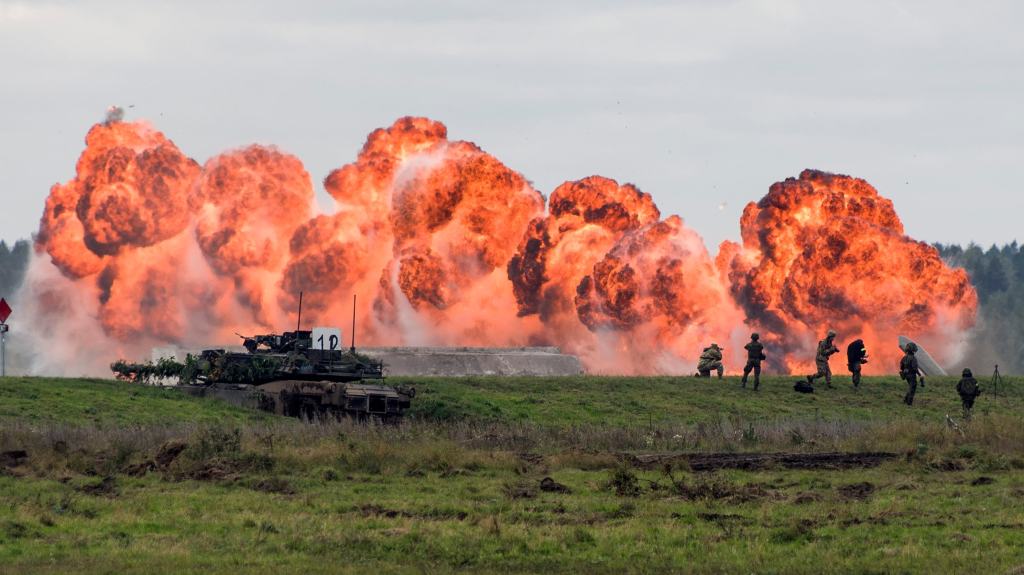
France, which currently has a standing army of 200,000 soldiers, has chosen to increase its military strength by 50,000 personnel by 2035. Following the abolition of conscription in 1997, when it was believed that large-scale conventional forces were no longer needed after the Cold War ended, France is now reintroducing a system that effectively resembles “quasi-conscription” after 28 years. Italy has announced plans to deploy an air defense system named the “Michelangelo Dome,” inspired by Israel’s “Iron Dome,” by 2028, while Germany has confirmed a defense budget of 82.7 billion euros (around 141 trillion South Korean won), the highest since the end of the Cold War.
The pace of military buildup in various European nations is increasing. With Russia pushing Ukraine towards a peace deal that effectively amounts to a “surrender” through the use of armed force, and the U.S. Trump administration consistently suggesting that “Europe must manage its own security,” there’s a growing belief that “independence” is the sole solution.
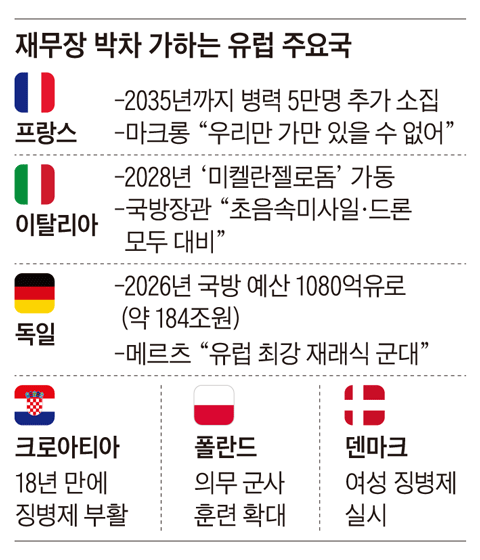
French President Emmanuel Macron recently met with frontline troops and introduced a proposal for a “voluntary military service” aimed at young people between the ages of 18 and 19. Macron said, “Russia’s invasion of Ukraine has put the whole of Europe in serious danger,” and added, “As European allies take steps to deal with the threats we all face, France cannot stay inactive.” He stressed, “In a world full of uncertainty where force comes before law and war is now a reality, our country cannot afford fear, unpreparedness, or division.” The French government plans to recruit 3,000 new soldiers next summer, gradually increasing the number to 10,000 by 2030 and up to 50,000 by 2035. The current French military includes 200,000 active personnel and 47,000 reservists. Although it is the second-largest in the EU after Poland, which has 200,000 active troops and 300,000 reservists, France aims to grow its reserve forces to 100,000. Macron mentioned that the objective is a “hybrid army” that enables individuals to balance military service with education or employment.
A growing feeling of crisis is emerging in French society, with fears that “Ukraine might be followed by France.” General Fabien Mangon, head of the French Joint Chiefs of Staff, recently cautioned, “Russia is getting ready for direct conflict with Western nations by 2030,” and called for readiness to face the suffering of losing children during war or the economic challenges. A recent survey in France revealed that 79% of people back the “voluntary military service” system. The New York Times, NYT, pointed out, “France, which ended conscription in 1997, was taken aback by Russia’s invasion of Ukraine in 2022.”
Italy’s proposed “Michelangelo Dome” air defense system aims to identify and neutralize not only supersonic missiles but also unmanned aerial vehicles. The initiative involves combining equipment spread across space, air, land, and sea into a single defensive network. Leonardo, an Italian defense firm, presented the concept in Rome on the 28th of last month and remarked, “The Michelangelo Dome will serve as a key example for the security of Italy, Europe, and NATO nations in the years ahead.”
Italian Defense Minister Guido Crosetto has recently expressed concerns about Europe’s lack of vigilance in the face of continuous unidentified drone incidents and cyberattacks targeting military installations, nuclear power stations, airports, and other critical infrastructure throughout the continent. He suggested creating a “European Hybrid Warfare Response Center” and “cyber units.”
Germany concluded a defense budget of 82.7 billion euros last week. When adding a special fund set aside following Russia’s invasion of Ukraine, the overall amount becomes 108 billion euros (about 183 trillion South Korean won). Germany aims to raise its defense spending to 152 billion euros (around 257 trillion South Korean won) by 2029, which is three times the 2022 level of 51 billion euros. While keeping its current volunteer-based system, Germany has started to reform its military service structure to permit mandatory conscription if recruitment targets are not met—effectively nearing the point of bringing back conscription. Friedrich Merz, Germany’s Chancellor, said, “Weakness invites invasion,” and confirmed the objective of making the German military the most powerful conventional force in Europe.
The United Kingdom has also revealed intentions to boost defense expenditures, including efforts to enlarge missile manufacturing plants and acquire more submarines. Leading UK policy institutes have consistently emphasized the importance of enhancing military cooperation with mainland European nations such as Germany.
Nations that share a border with Russia are also taking quick actions. Croatia, a country in the Balkans, resumed compulsory military service in October following an 18-year pause. Denmark, which already had conscription, started enlisting both women and men from last July, increasing the service duration from four to 11 months. Poland, leading in military expansion across Europe, is advocating for an “extended mandatory military training program” akin to conscription, while Serbia intends to introduce mandatory training for all men over the age of 19 starting next year.



 jasdooit
Leave a comment