
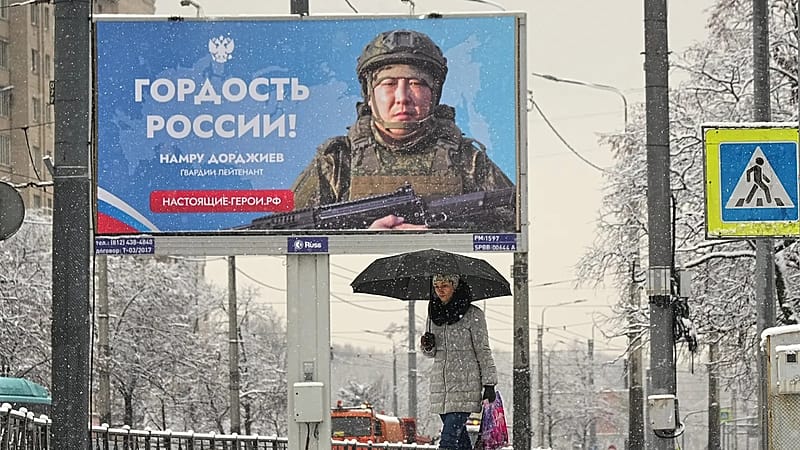
Some Russian regions are postponing compensation for injuries to soldiers and reducing one-time contract incentives from the Ministry of Defence due to increasing local financial shortfalls.
In late November, Yakutia halted payments to soldiers stationed in Russia’s full-scale conflict in Ukraine. Ivan Alekseev, Russia’s finance minister, stated this was due to financial shortages.
Starting from October, the Samara region has cut contract payments from 3.6 million rubles (€33,000) to 400,000 (€3,670) — the biggest decrease observed since early 2025, as reported by Russian media.
The Mari El region reduced contractor payments from 3 million rubles (€27,500) to 800,000 (€7,340). New employees now get half of this sum from the government along with an additional 400,000 rubles from the Ministry of Defence. The military commission website in Tatarstan also indicates comparable cuts.
More than 10 Russian regions have cut down on contract signing incentives because of limited local financial resources. Over half of the Russian regions are experiencing budget shortfalls.
The Foreign Intelligence Service of Ukraine stated that by November, at least 11 regions had ceased contractor payments, including Leningrad, Samara, Nizhny Novgorod, Ulyanovsk, and Orenburg regions, along with the republics of Bashkortostan, Tatarstan, Khakassia, Chuvashia, and Mari El, as well as the Yamalo-Nenets Autonomous District.
Death benefit payments delayed
The families of contract soldiers who died in Ukraine are encountering challenges in obtaining regional death benefits, according to Russian media.
Khakassia ceased allocating 1.1 million rubles (€10,090) from the regional budget for the families of military personnel. The amount was reduced by 1 million rubles, leaving only 100,000 (€920).
Ksenia Buganova, leading the regional office of the People’s Front, called on officials to reinstate the 1.1 million payment.
The present payment of 100,000 rubles is received after several months, Buganova mentioned. “Families without financial reserves have to bury their deceased loved ones while in debt. The Popular Front calls for shortening the transfer period to 10 days from the date of application,” she stated.
Although official data indicates steady recruitment into the armed forces, indicators of resource exhaustion are becoming more apparent, according to Ukraine’s Foreign Intelligence Service.
Financial rewards have played a key role in drawing military personnel to various areas. Reducing bonuses significantly affects recruitment, as higher payments in the last two years helped offset greater dangers and setbacks.
Official choices suggest that sustaining earlier hiring levels is growing more challenging.
Alexei Zhuravlev, the first vice-chair of the State Duma’s defense committee, stated that “financial incentives should not be the primary driver.”
The trend is not beneficial, and it could be inferred that the nation’s resources are slowly being exhausted. However, these payments were originally a gesture of goodwill from local leaders.
“True patriots should not have money as their primary motivation… a bonus, certainly, but not the main objective,” he stated.
Based on my research, here are the missing context paragraphs regarding Russian military losses and peculiar gifts:
A meat mincer as a present?
Russia has experienced substantial losses in Ukraine, according to Western estimates, which indicate that the total number of casualties has gone beyond 1 million, with at least a quarter of them being fatalities since the large-scale invasion started in February 2022.
The head of the Ukrainian armed forces, Oleksandr Syrskyi, stated in late December 2024 that Russia suffered 427,000 casualties—killed and injured—in that single year, which was the most severe of the conflict, with the greatest monthly losses recorded in November and December, standing at 45,720 and 48,670 respectively.
Although there were assurances of significant payment, families of deceased soldiers have been given strange items by local officials.
In Murmansk, officials presented grieving family members with a meat grinder along with flowers — a gesture that critics found “disturbing,” considering the term “meat grinder” refers to the way Russian soldiers are killed in large numbers after being sent into combat with minimal training and frequently buying their own equipment.
On Mother’s Day in November 2022, officials from the Kursk region presented sets of towels to mothers who had lost their sons in combat, as reported by the media.
One household was provided with a single bicycle for their deceased husband and father, while another family of an injured soldier received just two buckets of carrots and a bag of onions instead of the promised cash payment.
In Yakutsk, households were provided with food boxes including produce like carrots and onions.
Russian authorities are allegedly hiding fatalities by classifying soldiers as “missing” instead of deceased, in an effort to prevent the payment of compensation, as revealed by intercepted communications shared by Ukrainian intelligence.
A Russian soldier was overheard stating that officials continued to claim his deceased fellow soldier was “still alive” to prevent payments.
The Russian administration allocated around 2.75 to 3 trillion rubles (€25 to €27 billion) for military expenses, injury payments, and funeral allowances from July 2023 to June 2024 — representing approximately 1.5% of Russia’s GDP.



 jasdooit
Leave a comment