
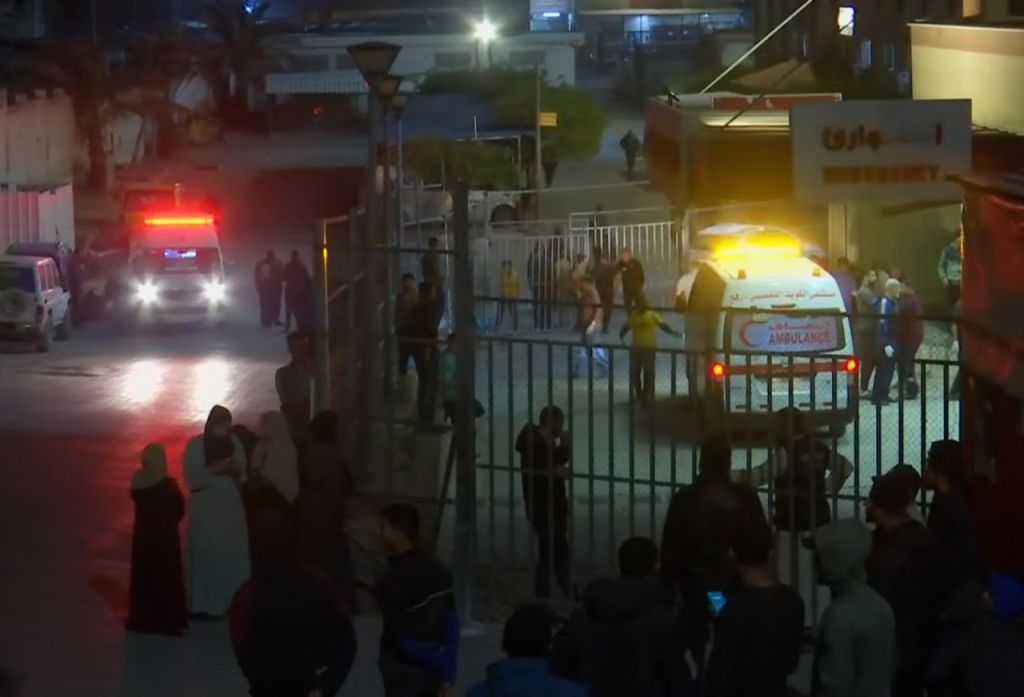
Israel claimed it conducted an air strike against a Hamas fighter in southern Gaza late Wednesday as a response to an earlier attack that injured five Israeli soldiers.
The strike represents the most recent challenge to a delicate truce that has largely remained intact since early October, even though both Israel and Hamas have alleged breaches. Hamas issued a statement denouncing the Israeli attack in Khan Younis.
On Wednesday morning, Israel received remains that might belong to one of the final hostages in Gaza and announced it would start permitting Palestinians to exit the area via a border crossing with Egypt.
Prime Minister Benjamin Netanyahu claimed that Hamas broke the ceasefire on Wednesday, as reported by the military, with fighters emerging from a tunnel to assault Israeli troops in a region under their jurisdiction.
Hundreds of Hamas militants are entrenched in tunnels in southern Gaza, beneath regions under Israeli military control. Israel has been eliminating any combatant who tried to escape the tunnels.
Hamas has urged countries acting as mediators to urge Israel to grant safe exit for the fighters remaining within the tunnel system in southern Gaza. It has also alleged that Israel is breaching the ceasefire agreement by “pursuing, eliminating, and arresting” resistance fighters who are surrounded in the Rafah tunnels.
Nevertheless, Israel seems unwilling to make concessions regarding their safe exit from the tunnel.
An Israeli government representative informed AFP this month that Prime Minister Benjamin Netanyahu “is not granting safe passage to 200 Hamas militants.”
Israel has previously claimed that Hamas breached the ceasefire before carrying out airstrikes. Bombings resulted in the deaths of 104 individuals in late October and 33 people in late November, as reported by local health authorities.
The remains discovered on Wednesday by fighters in northern Gaza were sent back to Israel, where they are being analyzed by forensic specialists. The remains that fighters handed over on Tuesday did not correspond to either of the last two captives.
The release of all the captives seized during the attack on October 7, 2023, which marked the beginning of the conflict, is a crucial part of the initial stage of the truce that started in October. In return, Israel has been freeing Palestinian detainees.
Final hostages in Gaza are an Israeli and a Thai national
After the final remains of the hostages are handed back and Israel frees additional Palestinian detainees in return, the U.S.-supported truce initiative is expected to move forward to subsequent stages, which include establishing an international security force, setting up a technocratic Palestinian administration, and dismantling Hamas’s arms.
On Wednesday morning, Netanyahu stated that forensic analysis revealed the partial remains provided by militants on Tuesday did not correspond to either of the remaining hostages in Gaza. Later, Palestinian militants reported they had discovered additional remains in northern Gaza and handed them over to the Red Cross, which is serving as a middleman.
The two remaining hostages taken to Gaza are Israeli Ran Gvili and Thai national Sudthisak Rinthalak. Gvili was an Israeli police officer who assisted individuals in fleeing the Nova music festival during the Oct. 7 attack and was later killed while fighting in another area. Sudthisak Rinthalak was an agricultural worker from Thailand who worked at Kibbutz Be’eri, one of the most severely affected areas during the attack.
A total of 31 workers from Thailand were taken hostage, forming the biggest group of foreign captives. Many of them were freed during the initial and subsequent ceasefires. The Thai Ministry of Foreign Affairs has stated that, besides the hostages, 46 Thais have lost their lives throughout the conflict.
Rafah crossing entrance faces complications due to a disagreement
According to the ceasefire agreement, the previously closed Rafah border crossing will be reopened for medical evacuations and travel to and from Gaza. The World Health Organization reports that over 16,500 individuals who are ill or injured require evacuation from Gaza for medical treatment.
It was not immediately apparent when the border crossing would reopen, however.
Egypt hopes that Palestinians will be permitted to return to Gaza via the crossing and states that it will only be opened if there is mutual movement. Israel claims that Palestinians will not be allowed to return to Gaza through the crossing until the remains of the last hostages are brought back from Gaza.
The Israeli organization responsible for managing aid to Gaza, COGAT, stated that Israel will work with Egypt regarding the departure of Palestinians, under the oversight of an EU delegation. Individuals who want to leave Gaza must obtain “Israeli security clearance,” according to COGAT.
Palestinians wishing to exit Gaza will be able to do so via Rafah if Egypt agrees to accept them, stated Israeli government spokesperson Shosh Bedrosian. However, the border crossing will not be available for Palestinians aiming to return to Gaza until all the captives in the area are handed back to Israel, she added.
Citing an unnamed Egyptian official, Egypt’s State Information Service said, if an agreement is reached, the crossing will be opened for travel in both directions in accordance with the ceasefire plan advanced by U.S. President Donald Trump.
Egypt is concerned that Palestinians who are permitted to leave Gaza may face difficulties in returning.
Egypt’s President Abdel-Fattah el-Sissi has cautioned that Israel could incite a mass departure from Gaza as a means to permanently remove residents and “do away with the Palestinian issue” regarding statehood. Over 100,000 Palestinians who fled Gaza since the war began, including those injured in the fighting, have been residing in Egypt, as reported by Egyptian officials.
The Rafah border point was closed in May 2024 when Israel’s armed forces entered the region. It was temporarily opened in February of this year as part of a prior truce to allow the evacuation of ill and injured Palestinians.
Clashes in Gaza City result in one Palestinian fatality
In Gaza City, a Palestinian man was shot dead by Israeli forces, according to a hospital, making him the most recent confirmed fatality in the area.
Israeli troops shot the 46-year-old individual in the Zeitoun area, as reported by Al-Ahli hospital, which received the body. Israel’s military did not promptly reply to a request for statement.
The hospital stated that the man was injured by gunfire while in the “safe zone,” which, according to the ceasefire agreement, is not under Israeli military control. The Gaza Health Ministry reports that over 360 Palestinians have died throughout Gaza since the ceasefire began on October 11.
Return of Palestinian corpses in flux
Twenty active captives and the bodies of 26 more have been handed back to Israel since the truce was established.
Israel is returning 15 Palestinian bodies for each captured individual under the truce deal. The Gaza Health Ministry reported that a total of 330 remains have been received so far. Gaza health officials mentioned that they have only managed to identify a small portion of the bodies provided by Israel, with the process being challenging due to the shortage of DNA testing kits.
The truce seeks to reduce the conflict that began with an attack by Hamas on southern Israel, resulting in approximately 1,200 deaths and 251 individuals taken as hostages.
The Gaza Health authority reports that the number of Palestinian fatalities resulting from the conflict exceeds 70,100. The ministry does not separate militants from civilians, but states that approximately half of the deceased are women and children. The ministry functions under the administration of the Hamas-led government. It is composed of healthcare workers and keeps thorough records that are generally considered trustworthy by global observers.
Provided by SyndiGate Media Inc.Syndigate.info).




 jasdooit
Leave a comment