
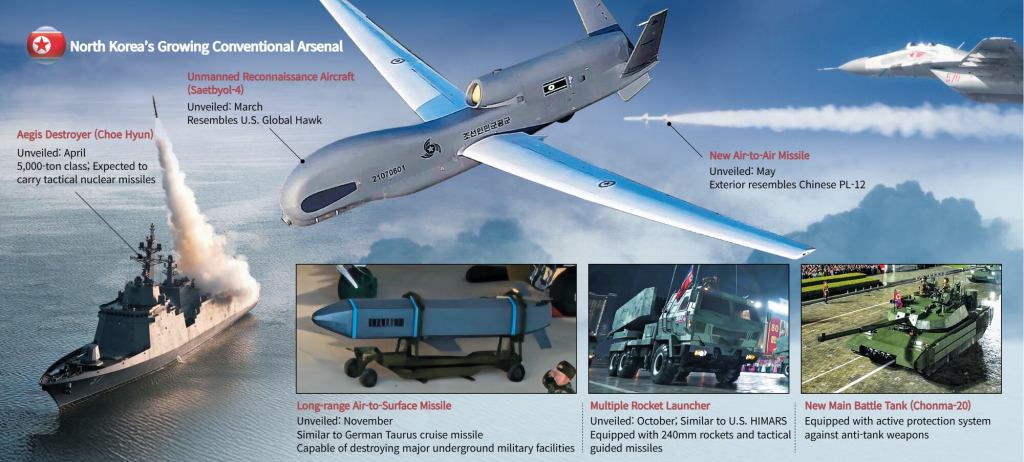
North Korea showcased a missile believed to be a long-range air-to-surface weapon, referred to as the “North Korean version of Taurus,” during an event celebrating the 80th anniversary of its air force last month. The German-produced Taurus (KEPD 350) is an air-launched cruise missile capable of accurately hitting targets up to 500 km away, and the North Korean missile displayed this time has a comparable exterior design. South Korea’s military currently employs Taurus as a bunker buster to disable North Korean bunkers. If this missile becomes operational, North Korea may be able to target significant underground military facilities in the capital area of South Korea from above Pyongyang. North Korea also introduced a new air-to-air missile thought to be similar to Germany’s IRIS-T and precision-guided bombs. All of these represent conventional military capabilities that South Korea had previously considered it to have a clear advantage over.
◇Quick Expansion of North Korea’s Traditional Military Forces… Has It Obtained Technology to Outdo South Korea?
South Korea’s military perceives this latest public demonstration of air force capabilities as a component of North Korea’s continuous attempts to enhance its traditional military forces. In May, North Korea showcased live-fire exercises for a newly developed medium-range air-to-air missile that was fired from a fighter jet. This year, South Korea initiated an internal development program aimed at replacing current air-to-air missiles that are imported from the U.S. and Europe, while North Korea has already created and successfully tested such weapons. North Korea is also utilizing unmanned aerial vehicles (UAVs) that resemble the U.S. attack drone “Reaper” and the surveillance drone “Global Hawk.” A military source stated, “North Korea’s air force capabilities are still considered to be less advanced than South Korea’s, but recent efforts to bolster its forces are significant.” Until two or three years ago, North Korea had largely given up on achieving air superiority due to outdated fighter jets and a lack of aviation fuel, which led to inadequate training. However, this situation has recently changed.
Naval strength is also increasing. In April and June, North Korea launched the 5,000-ton class “Choe Hyon” and “Kang Kon” destroyers, referred to as the North Korean equivalent of Aegis-equipped vessels. During the launch event for the Choe Hyon, North Korean leader Kim Jong-un said, “Our navy’s operations should not be limited to our territorial waters and must reach the open ocean.”
Advancements in the army’s traditional forces are also significant. During a military parade in October, North Korea introduced a new multiple rocket launcher (MRL), resembling the U.S. “HIMARS,” featuring 240 mm rocket shells and tactical guided weapons. The event also displayed the newly developed tank called “Chonma-20.” According to lawmaker Yu Yong-weon from the People Power Party, the Chonma-20 is fitted with an active protection system to defend against anti-tank weapons. Although its effectiveness is yet to be determined, this feature is absent in South Korea’s K2 “Black Panther” tank, which is still under development.
◇Complete Execution of the Policy for the Parallel Development of Nuclear and Conventional Forces
North Korea’s efforts to develop and enhance traditional weaponry seem to be based on the belief that its nuclear capabilities have achieved a certain level. Lee Sang-kyu, head of the Nuclear Security Research Division at the Korea Institute for Defense Analyses (KIDA), recently estimated that North Korea has up to 150 nuclear warheads and could reach approximately 200 by 2030 and 400 by 2040. The variety of intercontinental ballistic missiles (ICBMs) capable of carrying nuclear warheads has also increased. North Korea has created the Hwasong-18, a mobile-deployed ICBM with a range of 15,000 km, which can be launched instantly.
Nevertheless, it is agreed that even these nuclear weapons are less effective without support from conventional forces. Yu Yong-weon stated, “North Korea is believed to have already developed somewhat advanced nuclear weapons. However, since their conventional weapons are still behind, if only nuclear weapons are neutralized, it would be challenging to conduct warfare effectively, which is why they seem to be considering countermeasures.” In September, Kim Jong-un visited a weapons research institute and said, “At the 9th Party Congress next year, we will introduce a policy of parallel development of nuclear and conventional forces.” This is seen as a promise to increase investment in balancing conventional forces, which are currently inferior to nuclear capabilities.
Some people claim that Kim Jong-un’s stated policy of developing nuclear and conventional forces in parallel is similar to the U.S.-South Korea integrated nuclear-conventional (CNI) strategy. CNI is a plan aimed at countering North Korea’s nuclear threats by combining U.S. nuclear capabilities with South Korea’s advanced conventional military forces. Leaders from South Korea and the U.S. officially introduced this system through the “Washington Declaration” in 2023. Additionally, there are observations suggesting that North Korea is following the global trend of arms races. A military official noted, “With global arms expansion competitions taking place due to the Russia-Ukraine war, the Israel-Hamas conflict, and other factors, North Korea is also showing a tendency to follow this trend.”
◇Enhancing Skills via Russian Technological Exports and Cyber Intrusions
The swift enhancement of North Korea’s traditional military capabilities is supported by its improved ties with Russia after the conflict in Ukraine. Several newly introduced weapons indicate the presence of Russian technology. The air-to-air missile introduced in May closely resembles China’s “PL-12,” indicating that North Korea might have obtained technological transfers from Russia, as China is also known to have received similar assistance from Russia. The Choe Hyon, North Korea’s Aegis-like destroyer, is believed to be fitted with Russian systems. Its cruise missile bears a resemblance to Russia’s hypersonic “Zircon,” and the four-sided phased array radar installed on its mast is comparable to those found on Russian vessels. The Choe Hyon’s integrated air defense system also seems similar to Russia’s “Pantsir.” The airborne early warning and control aircraft introduced in March is thought to be an Il-76 transport plane modified with a radar, a Russian design.
Hacking is also being utilized to enhance North Korea’s traditional military capabilities. Last year, the German defense firm Diehl Defense fell victim to a cyberattack by the North Korean hacking group “Kimsuky.” Diehl Defense manufactures air-to-air missiles such as the IRIS-T. The latest air-to-air missile introduced by North Korea last month bears a striking resemblance to this weapon. North Korea has previously infiltrated South Korea’s submarine technology.
Although Kim Jong-un’s efforts to modernize conventional weapons may not present an immediate danger to South Korea’s military, many believe it should be monitored over the medium to long term. Cha Du-hyeon, deputy director of the Asan Institute for Policy Studies, stated, “If North Korea maintains its close relationship with Russia for now, it is expected that it will take 5–10 years for North Korea to reach a level where its conventional forces could threaten South Korea.” Some suggest that North Korea’s enhanced conventional weapons capabilities have raised the chances of localized provocations. While nuclear weapons are strategic and difficult to deploy, conventional weapons could be utilized for limited provocations in regions such as the Northwest Islands.
Kim Jong-un Expected to Reveal New 5-Year Military Strategy Next Month
North Korea’s advancement in conventional weaponry is a component of the “Five-Year Defense Development Plan” established in 2021. This initiative resembles South Korea’s medium-term defense strategy. Although the main focus of the plan is to bolster nuclear capabilities, it also encompasses improvements in conventional military forces.
North Korea has not revealed specific project details, although some were discussed during the Party Central Committee’s plenary session in December 2023. The information covers improving naval underwater and surface capabilities, creating UAVs, producing electronic warfare equipment, and increasing the capacity of conventional weapons factories. The Defense Intelligence Command believes that numerous tasks outlined in North Korea’s Five-Year Defense Development Plan have been advancing. Hong Min, a senior researcher at the Korea Institute for National Unification, stated, “Although North Korea’s enhancement of conventional forces is primarily rooted in the Five-Year Defense Development Plan, the speed has recently increased. This is probably due to the quick transfer of Russian technology following the improved relations between North Korea and Russia.”
Kim Jong-un is anticipated to expand upon the “nuclear-conventional force parallel development” strategy he introduced this year during the 9th Party Congress in January next year. A fresh defense plan is required since the current Five-Year Defense Development Plan has been finalized. A military official stated, “It is expected that a military parade will take place during the Party Congress to showcase a vision for enhancing new conventional weapon systems.”
However, some people believe that due to North Korea’s current circumstances, its policy of developing nuclear and conventional forces simultaneously might have negative economic consequences. As one of the world’s poorest nations, North Korea’s economy could face collapse if it allocates massive funds to enhance its conventional military capabilities. According to the Bank of Korea, North Korea’s gross national income (GNI) last year was 44.4 trillion South Korean won, which is less than South Korea’s defense budget of 59 trillion won. Even the part of South Korea’s defense budget dedicated to weapons-related (defense enhancement) expenses amounted to 17.6532 trillion won, making up 40% of North Korea’s GNI. Park Won-gon, a professor at Ewha Womans University, stated, “Just as the former Soviet Union fell apart because of excessive defense spending to counter the U.S. ‘Star Wars’ initiative, full-scale investment in conventional weapons will inflict a severe blow on North Korea’s entire economy.”
☞Policy of Concurrent Development of Nuclear and Conventional Forces
A strategy for the combined advancement of nuclear and traditional weaponry, referenced by Kim Jong-un in September. The objective is to enhance conventional forces, which are less developed compared to nuclear capabilities.
☞Star Wars Project (SDI)
The Strategic Defense Initiative introduced by U.S. President Ronald Reagan during the 1980s aimed to prevent Soviet nuclear missiles from reaching American soil by utilizing satellites in space. The former Soviet Union significantly increased its defense spending in reaction, which contributed to its eventual downfall.



 jasdooit
Leave a comment