
The airspace over war-affected Yemen was temporarily shut on Monday, according to an official, as tensions rose in the southern part of the country following a separatist group, supported by the United Arab Emirates, seizing control of an oil-rich area. This development could potentially weaken the anti-Houthi coalition.
A representative from the Yemeni government stated that the Saudi-led coalition had not provided necessary approvals for air travel to and from Yemen, causing a temporary interruption in flights to and from Aden, the southern city serving as the base of the internationally recognized government.
The official characterized the action as a “Saudi statement” regarding the recent conflicts involving the separatist Southern Transitional Council in southern Yemen, including its capture of a large portion of the oil-rich Hadhramaut province, which shares a border with Saudi Arabia.
The decision was eventually overturned, enabling air traffic at Aden airport, where hundreds of travelers had been stuck for several hours, according to an official who requested anonymity as he was not permitted to speak to the press.
A reporter from Associated Press at the airport stated that staff have started handling passengers on a flight heading to Cairo, which was scheduled to depart early Monday.
Since the Saudi-led coalition became involved in Yemen’s conflict in 2015, it has maintained control over the nation’s air space. Saudi Arabia did not confirm the closure of Yemen’s airspace on Monday.
UAE-backed council expands control
The Southern Transitional Council, also known as STC — a coalition of armed groups supported and funded by the UAE — has increased its authority in southern Yemen this month. They took over Seiyun in Hadhramaut, including key oil fields and energy facilities after short conflicts with the Yemeni military and allied tribes.
The secessionist group’s forces were positioned throughout the key Wadi Hadramout region, encompassing significant cities and military installations, as reported by STC-aligned media. They captured the presidential palace and the international airport in Seiyun last week, and moved into the Mahra province, which shares a border with Oman, according to the group.
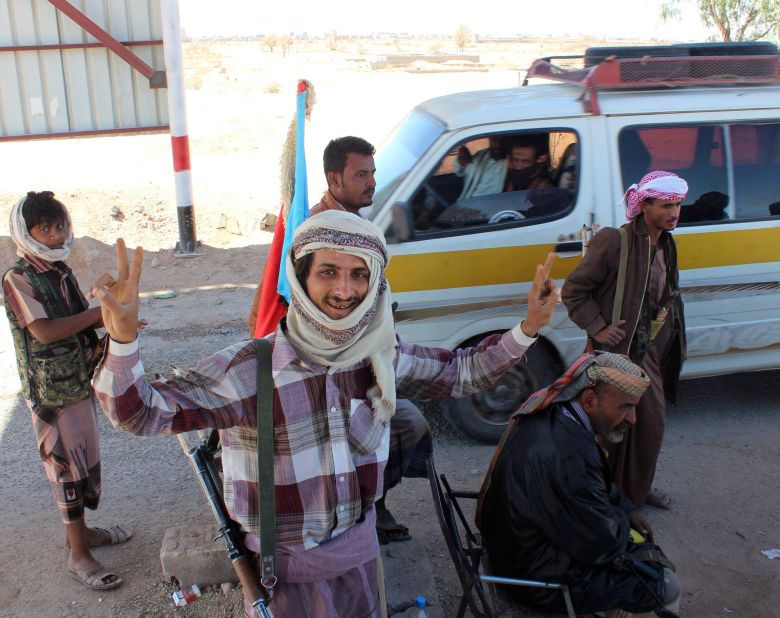
STC raised the flag of South Yemen at government structures throughout the southern region of the country, including at the border checkpoint with Oman. Pictures shared through STC-aligned media depicted the South Yemen flag, featuring a light blue chevron and a red star, waving over government buildings and schools in the south.
The rebels gain support across much of southern Yemen and have consistently sought to divide Yemen into two nations, similar to the period between 1967 and 1990.
Hundreds of STC supporters marched in Aden demanding the creation of a separate state in the southern region. Protesters carried the banner of South Yemen and displayed images of Aidarous al-Zubaidi, the STC head, who also serves as vice president of the nation. Similar demonstrations occurred in Hadramout.
“It’s the summit day, the day of significant victory … when we freed all areas in the south,” said Mohamed al-Zaher, a Yemeni citizen, while waving the flag of South Yemen, formerly called the People’s Democratic Republic of Yemen.
They promised to remain in the streets until the announcement of the south’s independence, and on Monday, a group of protesters was observed establishing a demonstration camp in the Khor Maksar area.
Government sources reported that STC forces took control of the presidential palace in Aden during the weekend, compelling the presidential security personnel to leave the building.
The STC aimed to present its military progress as essential for bringing back order in the area, and to combat the Houthis backed by Iran, as well as al-Qaida and the Islamic State. It claimed that Hadhramaut Valley has become a “base for smuggling activities” by the Houthis and a “center” for al-Qaida and IS fighters, adding that its actions there followed “the failure of all solutions suggested in recent years to bring stability.”
The head of the ruling Presidential Council, Rashad al-Alimi, on Sunday urged Emirati-supported forces to pull out from regions they have recently captured in Hadhramaut and Mahra.
“We firmly oppose any one-sided actions that could weaken the state’s legal standing, damage the public good, or establish an alternative reality,” he stated in a speech after meeting with envoys from the United States, United Kingdom, and France in Riyadh, the capital of Saudi Arabia.
‘Major shift’
The STC’s most recent escalation marked a “significant change,” which is expected to impact the region, with the UAE seeming to be “the primary beneficiary,” by increasing its influence in Yemen, according to Ahmed Nagi, a senior Yemen expert at the International Crisis Group, a think tank based in Brussels.
This alters the distribution of power in Yemen,” he stated. “The main issue at hand is how Saudi Arabia will react, considering the direct effects on its national security.
The United Arab Emirates’ backing of the separatists has put pressure on the Saudi-led alliance that has been engaged in a conflict with the Houthis for over ten years. The UAE is a member of this coalition.
The conflict in Yemen started in 2014, as the Houthis moved from their northern base and captured the capital, Sanaa, as well as a significant portion of the northern region. In reaction, a coalition led by Saudi Arabia got involved in 2015 with the aim of bringing back the government that was recognized internationally.
Provided by SyndiGate Media Inc.Syndigate.info).

 jasdooit
Leave a comment