
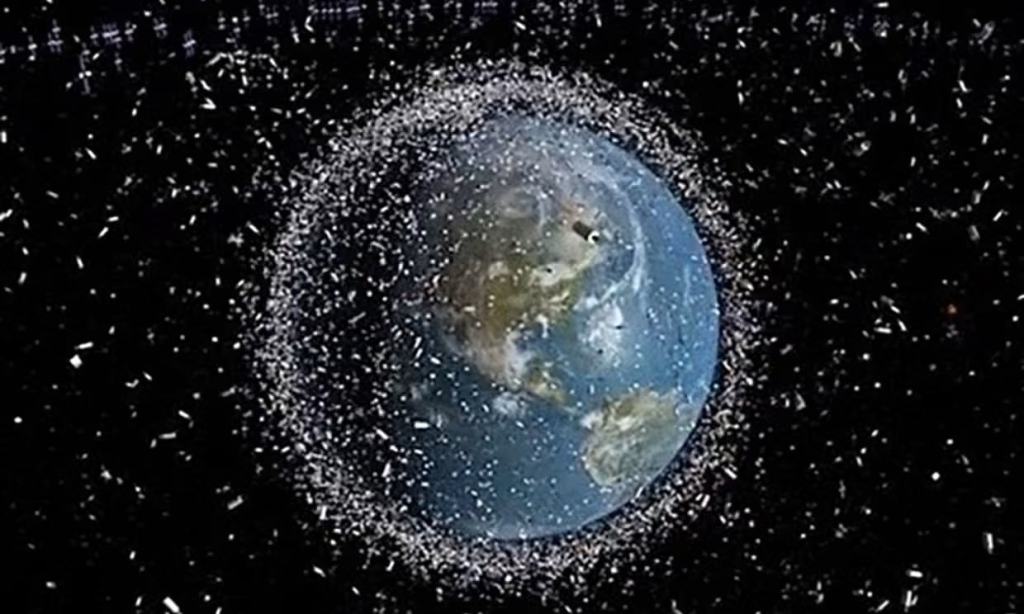
Research has shown that if satellites circling the Earth suddenly lose their capacity to steer clear of one another—like in the event of a solar storm—significant crashes might happen in as little as 2.8 days.
The science publication *New Scientist* highlighted the research from Princeton University on the 16th. The group developed a new measure known as the “Collision Clock (CRASH Clock)” by utilizing newly available information about the quantity and locations of satellites to assess collision dangers more accurately.
The study revealed that in the event all satellites lost their ability to avoid each other, mutual collisions would begin within 2.8 days. When examining data from 2018, prior to the deployment of SpaceX’s low-Earth orbit satellite constellation (Starlink), the initial collision was expected to happen after 121 days. The research group mentioned, “We hadn’t anticipated the risk of satellite collisions would increase so quickly.”
Is it feasible that all satellites in low-Earth orbit might genuinely cease performing avoidance actions? The scientific community states, “Although the likelihood is very small, the danger remains.” For example, a strong solar storm could cause significant harm to most satellites. In May of last year, some Starlink satellites were seen moving up and down like waves during a major solar storm.
Recently, besides SpaceX, Amazon has also introduced a satellite network service called “Leo.” China is also planning to launch groups of satellites to establish networks like “Guowang” and “Qianfan.” There are increasing worries that if tens of thousands of satellites circle the Earth in the future, the schedule for major collisions will speed up.
Professor Hugh Lewis from the Space Engineering Department at the University of Birmingham stated, “We keep adding cards to a house of cards. The more cards we place, the bigger the collapse will be when it eventually occurs.”




 jasdooit
Leave a comment