
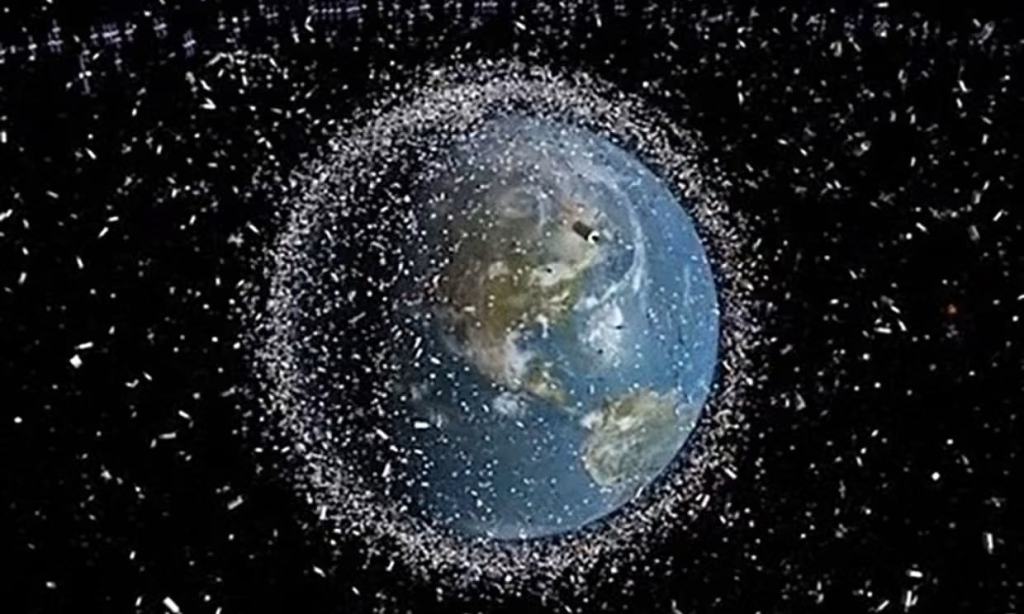
A research finding indicates that in the event satellites circling the Earth lose their ability to avoid collisions because of natural events such as solar storms, significant impacts might happen within 2.8 days.
With the U.S. SpaceX and Chinese firms striving to enhance low-Earth-orbit satellite systems in recent years, the rising number of satellites in space has sparked worries over escalating chances of collisions.
◇Increasing Satellites, Growing Risk of Collisions
A science news platform, New Scientist, highlighted research released on the 16th, authored by Princeton University researcher Sarah Thiele along with other specialists in the space environment.
The quantity of satellites in low-Earth orbit has significantly increased lately. SpaceX’s Starlink satellites have already launched more than 9,000 units at altitudes ranging from 340 to 550 km. In the last seven years, the overall number of satellites in Earth’s orbit has risen from 4,000 to about 14,000, tripling in size.
The research group cautioned that with an increasing number of satellites, the likelihood of space collisions could rise accordingly. Although uncommon, occurrences such as solar flares, widespread power or communication disruptions, or concurrent GPS/orbital forecasting system malfunctions might impair satellites’ ability to move, leading to crashes. This could make certain areas of low-Earth orbit inaccessible.
To accurately assess the likelihood of collisions, the team created a new measure known as the “CRASH Clock” (Collision Risk Analysis Simulation Hourglass), utilizing newly released satellite count and positioning data.
The study revealed that without avoidance systems, the time until the first collision would decrease from 121 days (pre-Starlink deployment in 2018) to only 2.8 days under similar circumstances in 2025. Sarah Thiele stated, “We hadn’t anticipated the collision risk to increase so quickly.”
◇Low Probability, but Possible
Is there a possibility that all satellites in low-Earth orbit could lose their ability to move? Experts respond, “While it’s very improbable, the danger is still present.”
A significant solar storm has the potential to interfere with satellite operations. In May 2024, a robust solar storm led to certain Starlink satellites experiencing wave-like movements.
The 1859 Carrington Event, the most intense solar storm ever documented, caused significant disruption to Earth’s magnetic field. Globally, auroras were visible, and telegraph systems experienced fires or failures. Back then, only land-based telegraph networks were impacted, as there were no satellites in space. Nevertheless, a comparable storm today—given the presence of thousands of satellites—might lead to widespread collisions.
Satellite collisions are not a new occurrence. In 2009, an Iridium Communications satellite crashed into an inactive Russian Cosmos satellite. Many debris pieces from this incident continue to circle the Earth. The issue is that the quantity of satellites in low-Earth-orbit is expected to grow.
In recent times, Amazon introduced its “Project Kuiper” satellite system, while China intends to launch tens of thousands of satellites for its “Güowang” and “Tianfan” constellations. This may further reduce the CRASH Clock period.
Professor Hugh Lewis from the University of Birmingham’s Space Engineering department said, “We’re adding cards to a house of cards. The more cards we place, the more significant the collapse will be when it occurs.”



 jasdooit
Leave a comment