
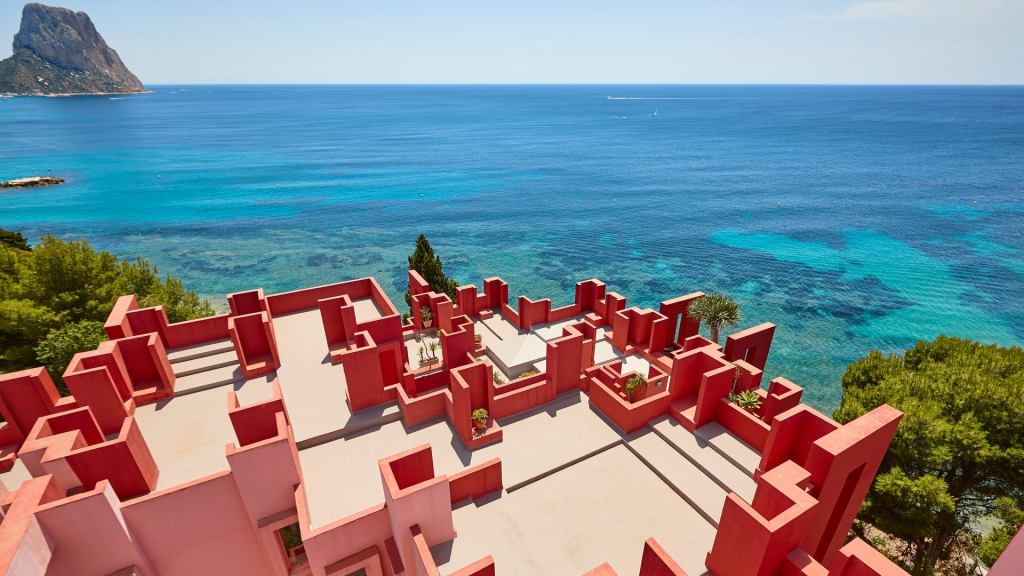
Hanging between the sky and the sea, this geometric fortress contrasts with the pure white of the Costa Blanca. Constructed in 1973 by Ricardo Bofill, La Muralla Roja merges the lines between architecture and art, taking inspiration from the kasbahs of the Maghreb to transform collective living into a postmodern scene.
A maze of colored concrete ignites the Mediterranean skyline in Spain: La Muralla Roja,an icon of Calpeand a significant creation by Ricardo Bofill. Fifty residences are interconnected within a labyrinth of terraces and staircases, as though taken from a vivid dream. Vermilion red, soft pink, Klein blue – each color directs both the eye and movement throughout the area.
Looking to discover Spain? These articles can assist you in planning your journey:
- This stunning Spanish beach, located in a lesser-known part of the country, has recently been recognized as one of Europe’s most breathtaking shores.
- In Spain, this delightful and less-familiar town has recently been recognized as one of Europe’s top hidden gems.
A pop labyrinth
Bofill turned to North Africa while creating this architectural design. The kasbahs of the Maghreb influenced him with their expertise in navigating complex layouts: twisting streets, interconnected staircases, and terraces that ascend into the air. This traditional urban style is expressed in a modern way, where every floor offers fresh perspectives.
The apparent fantasy is grounded in geometry. Bofill selected the Greek cross as the fundamental unit, which is used in different arrangements. The five-meter arms create patios and pathways. At the points where they intersect, technical towers are located, containing kitchens and bathrooms. This structural logic reflects the Russian avant-garde from the 1920s.
A chromatic symphony
Red for the fortifications, pink for the secondary courtyards, blue for the passageways. With Bofill, every aspect of color is meticulously planned. The red highlights the mineral characteristics of the facades against the limestone rock, while the blues create a sense of…a continuous conversation with the Mediterranean.
This vibrant use of multiple colors alters the sense of space. Color serves as an instinctive direction, guiding inhabitants to their residences. The building includes studios and family apartments located on various floors. On the upper level, a swimming pool, sauna, and solariums transform the terraces into elevated green spaces.
Ricardo Bofill, the rebellious architect who challenged Franco
Barcelona, late 1930s. Ricardo Bofill was raised in a family of Catalan builders. His political beliefs led to conflict with the Francoist government, and at the age of twenty-three, he was banned from the Barcelona School of Architecture due to his opposition to the regime. He finished his education in Geneva before coming back to his home country, more resolved than ever.
The year 1963 represented a significant shift with the establishment of the Taller de Arquitectura. Bofill completely transformed the conventional methods of architecture by gathering architects, philosophers, and sociologists around him. This teamwork-driven approach brought his work to a global level, resulting in over a thousand projects from the famous Barcelona-based studio. In France, he is most recognized for theEspaces d’Abraxas in Noisy-le-Grandand the impressive Antigone district in Montpellier.
From a contentious symbol to an international sensation
The Red Wall is in sharp contrastto the Costa Blanca’sStandard white facades and modest shapes. From the beginning, this aesthetic change caused disagreement. Critics criticized what they viewed as an ostentatious architecture that disturbed the conventional scenery. For many years, the structure remained largely ignored.
The era of digital technology transformed everything. Instagram introduced its dizzying viewpoints to a worldwide audience. The creators ofSquid Gametook inspiration from its maze-like environments. Nowadays, photographers and filmmakers are keen to discover its very visually appealing geometries.
Private stronghold or global treasure?
This global recognition brings up unforeseen issues. Within the structure that has become an architectural and media symbol, inhabitants strive to maintain their privacy. Entry into the internal areas is tightly controlled: only those who are permanent residents or seasonal renters can go past the vibrant colored boundaries.
A heritage designation might safeguard the building, but property owners are strongly against it. Their concern? A surge in visitors overwhelming their common courtyards.
At the base of the Parque Natural del Peñón de Ifach
Sixty-five kilometers away from Alicante, Calpe is located beneath the shadow of themajestic Peñón de IfachRising 332 meters above sea level, this limestone formation has stood over the Costa Blanca for thousands of years. Today, it is a protected natural park, home to an impressive variety of wildlife.
It was in this environment that the La Manzanera project emerged during the 1960s and 1970s. In this area, Ricardo Bofill designed two significant structures: La Muralla Roja and the Xanadú complex, which served as another innovative studio from this highly productive era. Even now, as before, this vibrant fortress continues to raise the same lasting question: should architecture merge with the surroundings — or alter them?


 jasdooit
Leave a comment