
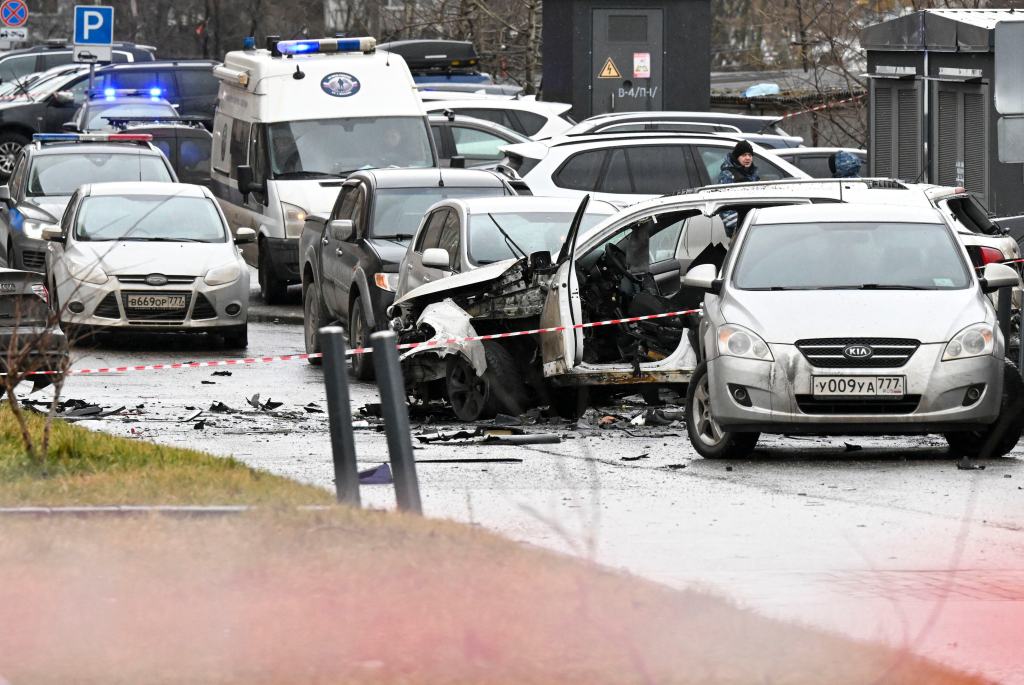
Lieutenant General Fanil Sarvarov, head of the Russian General Staff’s Operations and Training Directorate, was killed on the 22nd when a bomb placed in his vehicle detonated in central Moscow. Russia labeled it a “terrorist act organized by Ukrainian intelligence.” This is the third instance in the last year that a senior Russian military figure has been killed in a bombing in Moscow. As the Russia-Ukraine conflict nears its fourth year, more than 150 “rear-area terror attacks” have taken place in major cities across both nations, including Moscow and Kyiv. The global conflict research organization ACLED stated, “The shadow war of assassinations between the two countries is escalating,” noting, “Mossad-style elimination operations are happening everywhere.”
As per the Russian Federal Investigative Committee, the bombing took place on the morning of the 22nd in a parking area within a southern Moscow neighborhood. While Sarvarov was driving his white Kia Sorento a short distance, an explosive device affixed underneath the vehicle detonated. He sustained severe injuries and eventually passed away in the hospital. The doors of the Sorento and its rear window were blown away, and the frame of the car was significantly twisted by the explosion. Russian President Vladimir Putin was reportedly informed about the incident right away. The Operations and Training Directorate of the Russian General Staff is a crucial division tasked with organizing and supervising the military readiness of the Russian armed forces. The attack happened just hours after the U.S. conducted separate meetings with Ukrainian and Russian representatives in Miami to explore the possibility of a ceasefire, causing confusion in Russia.
In its “shadow assassination” report, ACLED stated, “Although Russia was the main force behind targeted killings around the time of the 2022 invasion, Ukraine has been gradually closing the gap.” In 2022, Russia executed 46 assassination missions on Ukrainian territory, while Ukraine carried out just one. However, this year, Ukraine’s assassination operations increased to 18, exceeding the combined total from the previous three years (2022–2024). Initially, these operations focused on Russian propagandists and former lawmakers, but recently, Ukraine has started targeting high-ranking military officials directly. In December last year, Ihor Kirillov, the head of nuclear, biological, and chemical defense at the Russian Defense Ministry, was killed in a bombing in Moscow. In April, Yaroslav Moskaliv, a deputy head of the Main Operations Directorate of the General Staff, died in a vehicle explosion near Moscow.
Russia has also been targeting Ukrainians through “local killer recruitment.” Ukrainian officials detained British military instructor Ross David Curtmoor on the 2nd, who is suspected of being recruited by Russia. He faces charges of supplying weapons for assassination missions against Ukrainian propagandists and politicians. In July, Colonel Ivan Boronich from Ukraine’s Security Service was killed by Russian intelligence agents in central Kyiv.
The scene for assassination missions has broadened throughout Europe. In May, Viktor Yanukovych, a former pro-Russian consultant to the Ukrainian president, was killed in Madrid, Spain. In the previous year, Maxim Kuzminov, a Russian helicopter pilot who switched allegiance to Ukraine, was fatally shot in Alicante, Spain.

 jasdooit
Leave a comment