
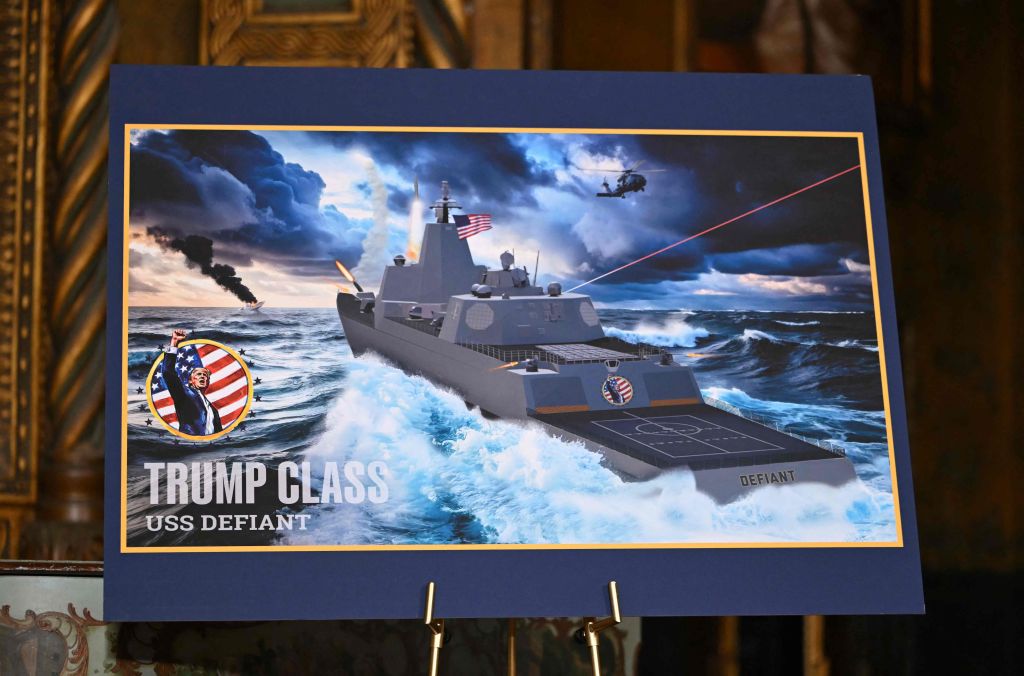
On the 22nd, U.S. President Donald Trump disclosed that the central element of the ‘Golden Fleet’ idea is the ‘Trump-class battleship.’ He also stated that new aircraft carriers and new frigates, whose development plans were unveiled last week, will become part of this ‘Golden Fleet.’
President Trump has repeatedly stated his desire to reform the ‘unattractive’ existing warships during his first term. The ‘unattractive’ appearance stems from advanced stealth features, yet President Trump strongly advocates for creating a ‘Golden Fleet’ that demonstrates his ‘superior sense of style.’
Despite the absence of official design plans, the Trump-class battleship’s capabilities are impressive. It will be outfitted with energy-based weapons such as electromagnetic rail guns and lasers, which the U.S. Navy has previously suspended development on, along with conventional 5-inch (127 mm) artillery and cruise missiles armed with nuclear warheads. Furthermore, it will include 128-cell missile vertical launch systems (VLS) positioned at both the front and rear.

Measuring three to four times the size of the Arleigh Burke-class guided-missile destroyers, which currently form the core of the U.S. Navy, President Trump declared, “This is a new battleship class that is 100 times more powerful, bigger, and faster than any existing battleship.” Described as an “invincible warship” equipped with the most advanced futuristic weaponry, President Trump mentioned that he plans to construct between 20 and 25 of these vessels. He also disclosed that the construction of the ‘Defiant,’ which will serve as the lead ship of the Trump-class battleship, will commence “almost immediately” and is expected to take two and a half years to finish.
Nevertheless, U.S. Navy and defense specialists claim that the Trump-class battleship idea contradicts the present U.S. Navy’s ‘distributed maritime operations’ strategy, and even if built, its delivery and commissioning would not take place before the mid-2030s. Moreover, the initial expense of constructing such a battleship is projected to amount to 9.1 billion dollars (around 12.7 trillion South Korean won).
In the end, once Trump’s second term concludes, the next president is expected to quickly drop the project. The Center for Strategic and International Studies (CSIS), a U.S.-based policy institute, stated on the 23rd, “These battleships will never set sail.” Mark Montgomery, head of the Foundation for Defense of Democracies and a former U.S. Navy rear admiral, strongly criticized in *The Wall Street Journal*, “The Golden Fleet is the most unnecessary initiative, not designed to deliver decisive strikes against the Chinese Navy,” and noted, “It is a battleship idea driven by the president’s desire to appear impressive.” *Atlantic Monthly* commented, “The Golden Fleet is Trump’s ‘Vanity Fleet.’”
◇Fictional Battleship, Essentially a Destroyer Several Times Bigger Than Current Models
The U.S. Navy currently has 287 vessels, such as aircraft carriers, destroyers, frigates, and submarines. The Chinese Navy has more than 370 ships. Although China’s primary objective is to position a large number of missiles on its mainland and prevent U.S. warships from getting close to the South China Sea, Taiwan, and the western Pacific, the U.S. needs to maintain naval presence in these regions. Hence, President Trump’s comment, “We really need warships, and some are too old and corroded,” is correct.
Nevertheless, the ‘battleship’ that Trump refuses to let go became outdated following World War II. During WWII, American battleships equipped with steel armor could endure enemy shells and overpower opposing warships from dozens of kilometers away using their massive main guns, leading to their destruction. Today, enemy vessels launch missiles from hundreds of kilometers away. Even the U.S. aircraft carrier USS *Eisenhower* has faced missile and drone attacks from Yemeni Houthi rebels.
In reality, senior U.S. government officials have mentioned that the ‘Trump-class battleship’ will be a three to four times bigger and more advanced version of the Arleigh Burke-class destroyers (DDG; guided-missile destroyers), which currently serve as the backbone of the U.S. Navy. Should a name be required, it could be referred to as a ‘ballistic missile battleship (BBG).’ The Arleigh Burke-class has a displacement of 9,000 tons, whereas the Trump-class is expected to range between 30,000 and 40,000 tons. A greater displacement allows for more space to accommodate missile launchers, rail guns, significant radar systems, and other weapons.
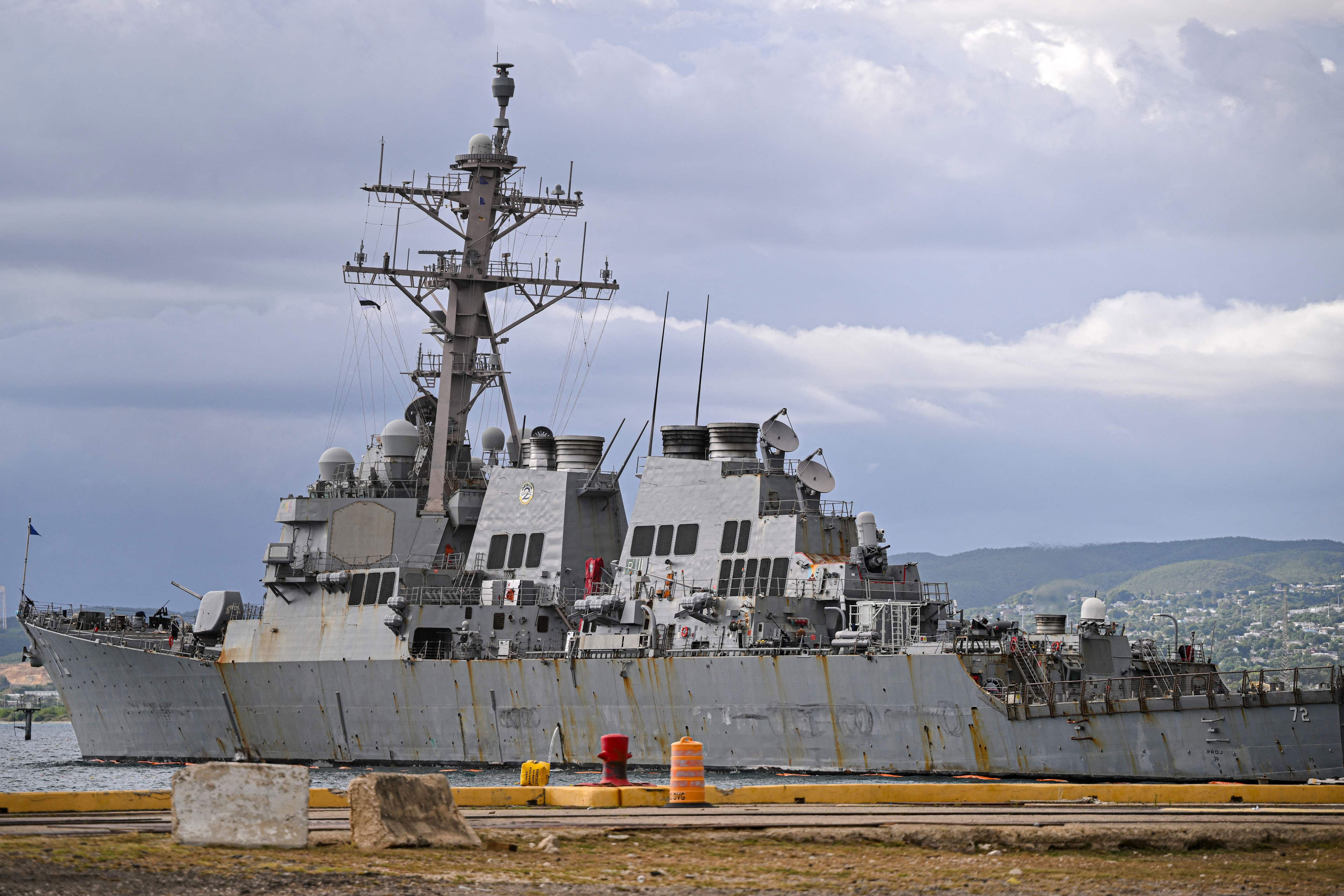
The United States constructed the Zumwalt-class destroyers, which have a displacement of 15,000 tons and emphasize stealth technology, as replacements for the Arleigh Burke-class. Nevertheless, their stealth design has led some to find them unattractive, a fact that Trump strongly disliked.

◇No Design Plans Available, When Can It Be Finished?
The Zumwalt-class required 11 years, from the program’s initiation in 2005 to the commissioning of the lead ship in 2016. Initially intended to construct 24 vessels, only three were completed before the project was halted. Because of challenges in mass production and rising development expenses, the cost of building a single Zumwalt-class destroyer amounted to 9.1 billion dollars.
The Trump-class is at least double the size of the Zumwalt-class. The U.S. Congressional Budget Office estimated that even with large-scale production, a new-generation destroyer would cost roughly 9.1 billion dollars. CSIS predicted, “As lead ships are generally 50% pricier than standard ones, the Trump-class lead ship (BBG-1) would be around 13.5 billion dollars, comparable to the cost of the most recent aircraft carriers.” The first ship of the Gerald R. Ford-class aircraft carrier, launched in 2017, had a construction cost of 13 billion dollars.
The Trump-class battleship will also feature artificial intelligence (AI). Its intricate design will require more time and incur higher expenses. According to the military media source TWZ, “While initial construction costs per ship are estimated to be between 5 billion and 15 billion dollars, the commencement of the first ship’s construction is expected to occur no earlier than the early 2030s.”
◇U.S. Navy’s New Approach to Counter China: ‘Distributed Maritime Operations’
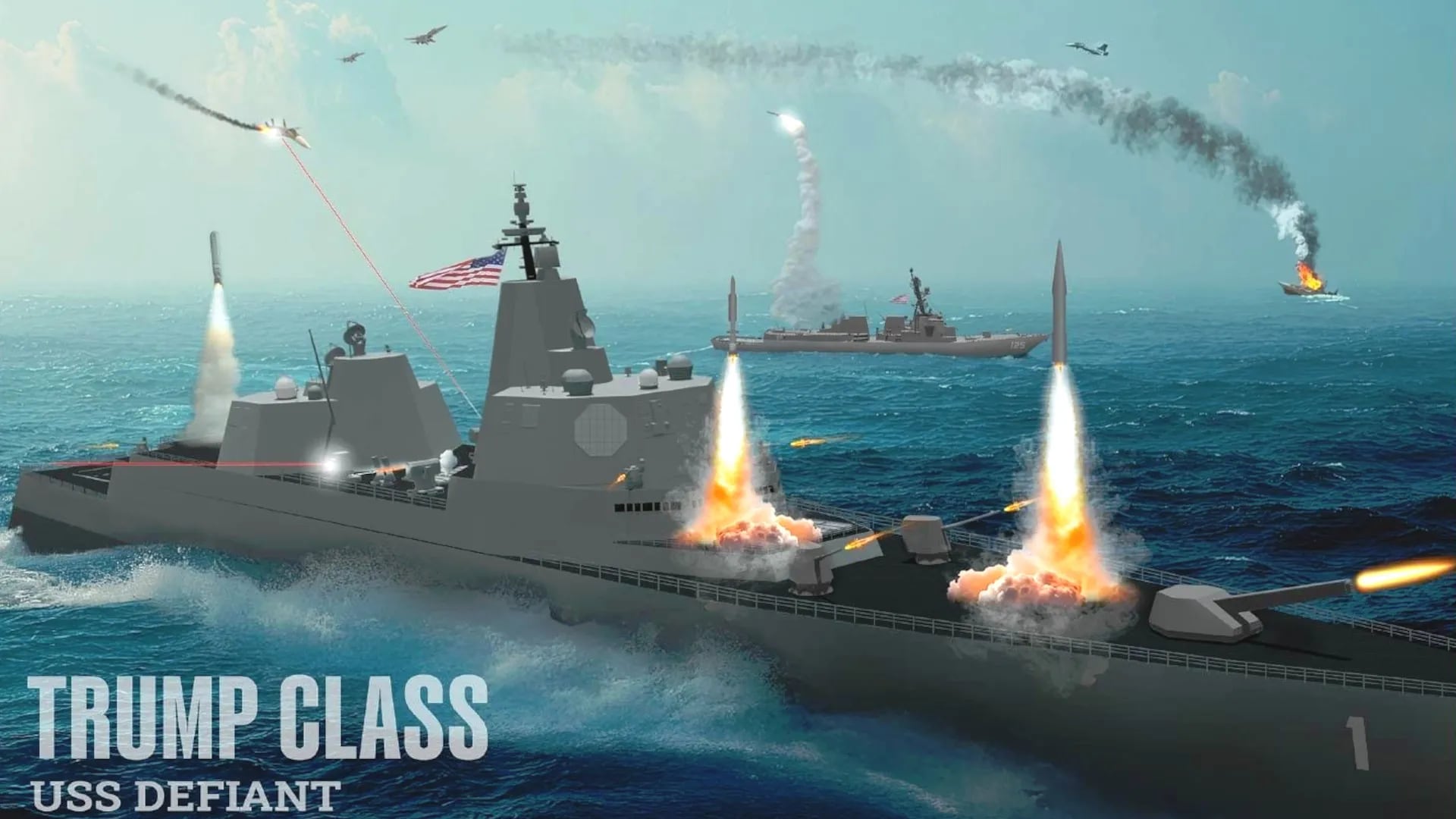
Previously, the U.S. conducted focused operations by establishing a single combat group centered on aircraft carriers. This allowed for concentrated firepower and more straightforward command and control. However, as the Chinese Navy has grown quickly, U.S. aircraft carriers have now become “large and costly targets” that are susceptible to China’s long- and medium-range anti-ship ballistic and hypersonic missiles.
Since 2019, the U.S. Navy has enhanced training to integrate all ships, aircraft, and satellites into a unified combat network, spreading them over extensive maritime regions to enhance long-range accurate attacks and resilience through network-based warfare, where “it doesn’t matter who spots or fires first.” Even if one vessel is lost, the overall force remains intact, and the enemy finds it difficult to identify “the main force.” In this decentralized operation, what is required are many mid-sized ships and strong connectivity, rather than a few “100 times more powerful” Trump-class battleships.
◇U.S. Navy Secretary: “Trump-class Battleships Will Evoke Wonder and Esteem in Every Port”
The U.S. Navy Secretary John Phelan unveiled the Trump-class battleship construction initiative, saying, “It will be the most visually impressive, and I guarantee it will evoke admiration and respect in every port it arrives at.”
Despite holding the top civilian role responsible for the Navy and Marine Corps, Phelan lacks any military service background. Previously an investment fund manager and significant supporter of Trump, the *Atlantic Monthly* noted, “Phelan might not be well-versed in naval matters, but he understands that Trump desires the largest and most superior battleship.”
It comes as no surprise that shipbuilders Huntington Ingalls Industries (HII) and General Dynamics’ Bath Iron Works (BIW), who have been responsible for constructing U.S. Navy destroyers over the past three decades, enthusiastically received the news about the Trump-class battleship project.
Nevertheless, Brian Clark, a maritime specialist from the Hudson Institute, a research organization, mentioned to a publication, “It might require ten years to finally construct a vessel of this magnitude.”

Mark Cancian, a senior fellow for security at CSIS, remarked, “The Trump-class battleship represents a highly dangerous endeavor. Once the overall cost and timeline are made clear, it’s almost inevitable that the project will be canceled, although billions of dollars and years will have already been invested. Rather than initiating a long-term development initiative, they should enhance current reliable designs and speed up production to construct vessels right away.” He contended, “This is the method to increase U.S. presence in international maritime regions, as highlighted by President Trump.”




 jasdooit
Leave a comment