
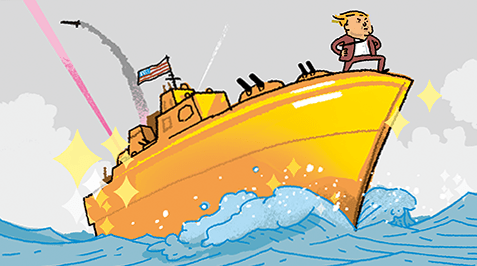
“Whoever controls the sea controls trade, and whoever controls trade controls the world,” stated Sir Walter Raleigh, an advisor to Queen Elizabeth I of England. In an essay written in 1615, he argued that to overcome Spain and the Netherlands, the navy needed to be strengthened. Although England had defeated Spain’s “Invincible Armada” in 1588, it had not yet established supremacy over the seas. In 1637, England constructed the battleship “Sovereign of the Seas,” which featured 102 cannons and was built at a significant cost. This vessel, decorated with gold leaf carvings on its hull, was known as the Golden Devil (Golden Devil). To its adversaries, it was a source of pure fear.
▶ Two centuries prior, in 1405, the treasure ship fleet of the Ming Dynasty, commanded by Zheng He, embarked on a naval journey. As documented, the main treasure ship was an exceptionally large vessel, measuring 137 meters in length and 56 meters in width. It was more than four times the size of Columbus’s ship that uncovered the New World. Currently, its length is similar to South Korea’s Gwanggaeto Daewang-class navy destroyer, although its width is almost four times greater. Zheng He’s fleet traveled as far as Africa, demonstrating the might of the Ming Dynasty and collecting tributes.
▶ The Industrial Revolution marked the beginning of the age of massive warships and powerful artillery. Admiral Alfred Mahan from the U.S. Navy, frequently referred to as the father of naval strategy, released a book in 1890 emphasizing the significance of maritime power. President Theodore Roosevelt, influenced by this work, established the Great White Fleet (Great White Fleet). Made up of 16 advanced large battleships painted white, along with destroyers and support vessels, the fleet embarked on its journey in 1907. Over the course of two years, it traveled around the world, showcasing national might. Motivated by this, Japan created the Combined Fleet, which later became dominant in the Pacific and Indian Oceans. The Combined Fleet was the first to prove, through the attack on Pearl Harbor, that aircraft carriers could destroy enemy fleets.
▶ In the Pacific War, major warships armed with heavy guns were easily destroyed by air strikes, resulting in a shift towards smaller naval vessels. The most advanced U.S. Aegis ships today, despite being just one-eighth the size of Japan’s Yamato, the largest warship ever constructed, have significantly greater combat effectiveness. Currently, the only genuine fleet remaining is the U.S. aircraft carrier strike group. However, even these carriers now encounter dangers from hypersonic missiles. Unmanned “ghost fleets” integrated with artificial intelligence are anticipated to represent the next wave of naval forces.
▶Nevertheless, Trump introduced the idea of a “Golden Fleet (Golden Fleet).” This concept features large warships comparable in size to those from World War II, armed with advanced weaponry such as lasers, and accompanied by unmanned and smaller escort vessels. This proposal, which contradicts current trends in naval development, echoes the Great White Fleet’s demonstration over a century ago. Its future is unclear, but it is hoped that it will support South Korea’s shipbuilding sector.


 jasdooit
Leave a comment