

On the 25th, North Korea stated that leader Kim Jong-un visited the construction site of a ‘nuclear strategic attack submarine,’ and also mentioned that the Missile General Bureau carried out a test launch of a ‘new high-altitude long-range anti-aircraft (surface-to-air) missile’ in the East Sea under Kim’s supervision the day before. This seems to be an anti-aircraft exercise aimed at ROK-U.S. joint air forces, including maritime patrol aircraft—the main system used for detecting submarines—prior to publicly revealing the nuclear submarine’s development.
The Korean Central News Agency (KCNA) reported, “The Missile General Bureau carried out the initial test launch to assess the technical capabilities of the anti-aircraft missile system currently being developed,” and mentioned, “The missiles accurately hit and destroyed simulated high-altitude targets located 200 km away.” Analysts suggest that North Korea conducted a trial of the new surface-to-air missile, which was first introduced during the Air Force’s 80th anniversary celebration on the 30th of last month. The Korea Defense and Security Forum (KODEF) noted, “Given that North Korea’s current long-range surface-to-air missile, the SA-5, is outdated, it seems they are working on a new surface-to-air missile that could be considered a ‘North Korean equivalent of THAAD.’ Although they claimed to have intercepted virtual high-altitude targets, the absence of any interception footage suggests that the test primarily focused on flight performance.”
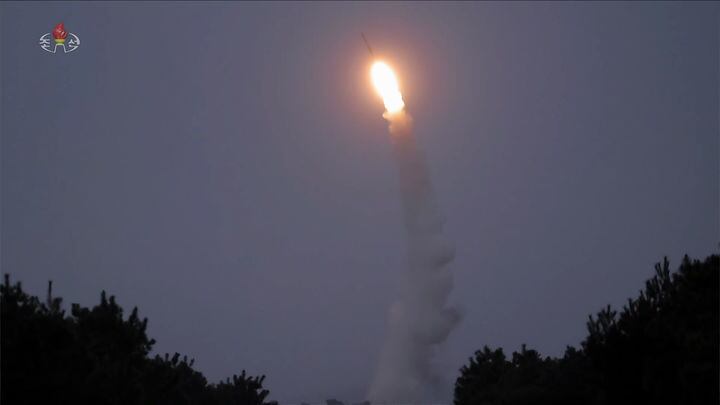
The SA-5 is a long-range, high-altitude air defense missile that is similar to Russia’s S-200. It has a range of 200–255 km and was employed during the Cold War to prevent or shoot down U.S. B-52 strategic bombers, high-altitude reconnaissance planes, and early-warning aircraft from a distance. Some reports suggest that North Korea tested this new missile with the intention of establishing a high-altitude, multi-layered air defense system comparable to the U.S. military’s ‘THAAD (Terminal High-Altitude Area Defense system)’. The interception height of 200 km surpasses THAAD’s interception range (40–150 km). It lies between THAAD and the SM-3 Block I, a sea-based ballistic missile interceptor capable of engaging targets at altitudes ranging from 90–500 km.
The Joint Chiefs of Staff (JCS) said, “We had previous knowledge of indicators related to North Korea’s missile test and were ready.” The JCS noted, “Around 5 p.m. on the 24th, we identified several suspected surface-to-air missiles fired from the Seondeok region in South Hamgyong Province towards the East Sea,” and highlighted, “With a strong ROK-U.S. joint defense stance, we are continuously observing North Korean activities and ensuring the ability and readiness to respond decisively to any provocation.”



 jasdooit
Leave a comment