
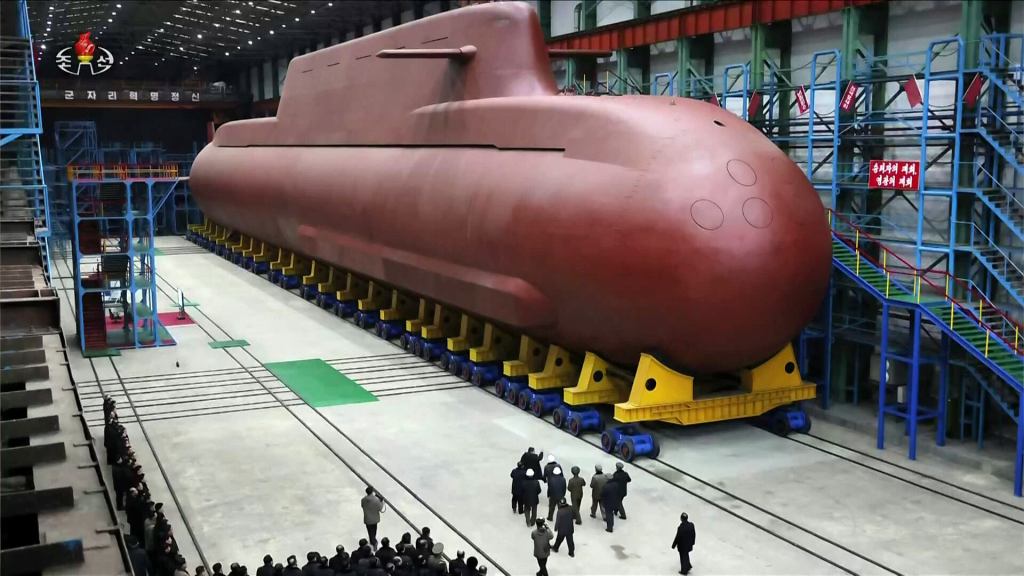
North Korea declared on the 25th that it is constructing a new 8,700-ton nuclear-powered submarine, referring to it as a “nuclear-powered strategic ballistic missile submarine” and a “nuclear strategic attack submarine.” It is believed this refers to a strategic nuclear submarine (SSBN) designed for extended underwater missions, utilizing nuclear power for propulsion and capable of launching submarine-launched ballistic missiles (SLBMs) armed with nuclear warheads. Previously, in September 2023, North Korea labeled the “Kim Gun-ok Hero Ship” as a “nuclear attack submarine,” signaling its plan to equip a diesel-powered submarine with nuclear weapons.
A nuclear-powered submarine (SSN) that South Korea intends to construct will not be equipped with nuclear weapons and will utilize nuclear fuel exclusively for propulsion. North Korea, which operates uranium enrichment facilities, is very likely to use weapon-grade highly enriched uranium (over 90%) as fuel for its submarines. South Korea, which has not yet obtained the right to enrich uranium, plans to import low-enriched uranium (20% or less) from the U.S. for this purpose. Highly enriched uranium does not need to be replaced until the submarine is retired, while low-enriched uranium requires refueling roughly every 10 years.
The true progress and schedule for the submarine North Korea is constructing have not been verified. Should North Korea develop its SSBN, it might represent a significant shift in military dynamics, surpassing the offensive potential of the nuclear-powered submarines South Korea is developing. Nevertheless, the South Korean military and authorities did not provide any reaction to North Korea’s statements on that day.
◇Experts: “Within Reach of the U.S. Mainland”
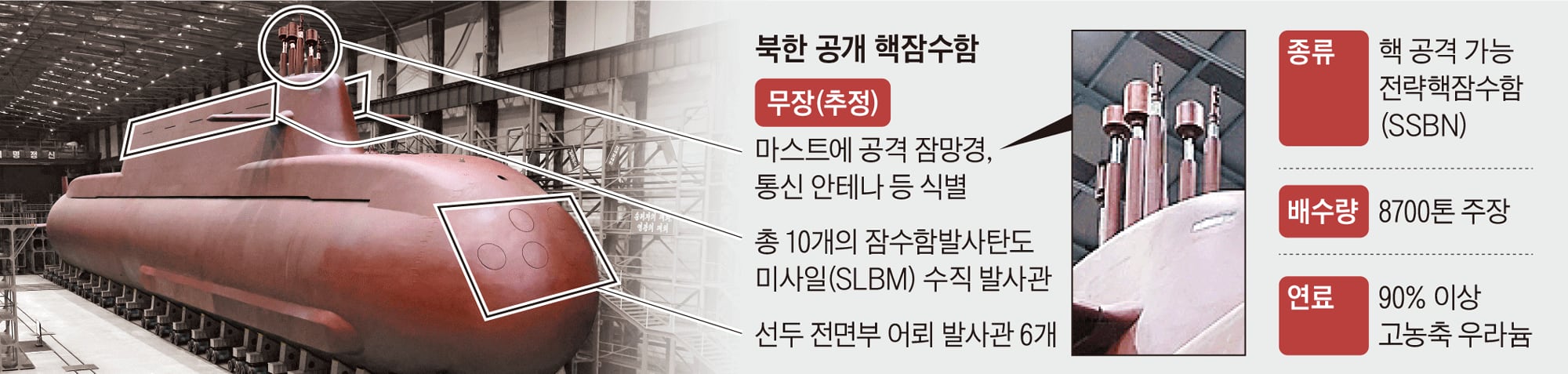
The 8,700-ton class displacement North Korea claims is less than that of U.S., Russian, and Chinese SSBNs but more than attack-type nuclear-powered submarines (SSNs). Based on the design of the sail, also referred to as the conning tower, it is believed that the submarine could carry 10 SLBMs. Yu Yong-weon, a member of the National Assembly Defense Committee from the People Power Party, commented, “It has an unusually distorted shape,” and noted, “This reflects North Korea’s urgent effort to install large SLBMs on its nuclear submarine.” Lim Cheol-gyun, a senior research fellow at the Korea Strategic Studies Institute, also mentioned, “It appears the sail was extended rearward to hold long-range SLBMs, which might lead to serious stability problems for the hull.”
North Korea has developed multiple types of submarine-launched ballistic missiles. Some analyses indicate that if North Korea tests a new SLBM such as the Pukguksong-6, “the U.S. mainland might fall within its reach.” Yu mentioned, “Even if the U.S. manages to neutralize North Korea’s intercontinental ballistic missiles during a crisis, there is now a chance that North Korea could launch SLBMs from stealthy submarines to carry out nuclear counterattacks against the U.S. mainland,” and noted, “This display of capability carries substantial strategic importance.” Lim said, “If North Korea’s nuclear-powered submarine, armed with long-range new SLBMs, moves into the East Sea, the U.S. West Coast and the Pacific region could be within its striking distance.”
The nuclear submarine that North Korea revealed is believed to feature six torpedo tubes at its front. On the same day, North Korea also introduced new weapons, including a newly developed medium-sized torpedo and underwater mines. The Korea Defense & Security Forum (KODEF) mentioned, “The new medium-sized torpedo appears to be in the development stage, utilizing a pump-jet system to minimize radiated noise, making it harder to detect.”
◇North Korea’s Nuclear Submarine Is More Advanced Than South Korea’s Nuclear-Powered Submarine
Experts have noted that the shape and displacement of the submarine revealed by North Korea bear resemblance to Russia’s retired SSBN Akula. There are also indications that Russia could have transferred small reactors from its decommissioned nuclear submarines or supplied associated technology. Hong Min, a senior research fellow at the Korea Institute for National Unification, mentioned that based on the current stage of the nuclear submarine’s construction, it seems that key components such as small reactors have already been installed, and the outer hull has been assembled. The next steps following the completion of the external structure are expected to involve system connection tests, vibration and noise testing, loading of nuclear fuel, sea trials, and full-power operations.
If this trend continues, North Korea’s nuclear submarine is likely to become operational before South Korea’s nuclear-powered submarine. The South Korean government has set a policy to construct more than four nuclear-powered submarines with a displacement of over 5,000 tons starting from the mid-2030s. In a business report released on the 18th, the Ministry of National Defense stated its aim to finalize negotiations with the U.S. regarding the transfer of nuclear fuel for the construction of nuclear-powered submarines within two years. It is anticipated that it will take a minimum of 10 years before the nuclear-powered submarine becomes operational.
The National Security Advisor Wi Sung-lac, who recently returned from a trip to the United States, said on the 24th, “We have reached an agreement with the U.S. regarding the necessity of a distinct agreement between South Korea and the U.S. concerning the transfer of nuclear-powered submarine fuel and have decided to move forward with it.” For this purpose, a U.S. working-level team is set to visit South Korea early next year to start detailed talks.



 jasdooit
Leave a comment