
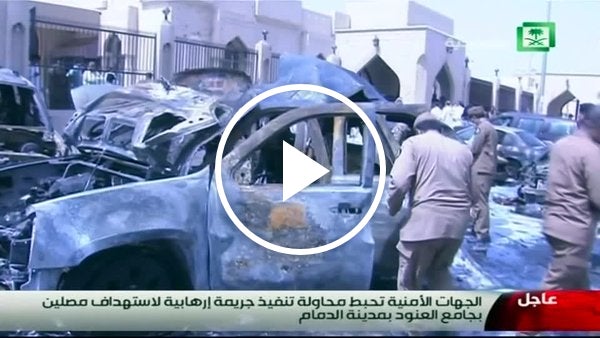
A blast targeted worshippers at a mosque in a region mainly inhabited by Alawites in Homs, Syria, according to official media, resulting in the death of at least eight people in the most recent assault on the minority group.
The explosion is the second incident at a place of worship since Islamist leaders assumed control of the nation a year ago, following a suicide attack at a Damascus church that resulted in 25 fatalities in June.
The state news agency SANA stated, “an explosion occurred inside the Imam Ali Bin Abi Talib Mosque located in the Wadi al-Dahab district” of Homs city.
Citing a representative from the health ministry, SANA reported an initial count of at least eight fatalities and 18 injured.
The Syrian interior ministry stated in a declaration that “a terrorist blast” occurred at the mosque “while Friday prayers were taking place.”
Homs witnessed intense religiously motivated conflict throughout Syria’s civil war.
The government established a security perimeter around the mosque, stating that officials “have started examining and gathering evidence to track down those responsible for this criminal act.”
SANA cited a security official who stated, “early inquiries suggest that the explosion… was the result of explosive materials placed inside the mosque.”
A local inhabitant, who asked to remain unidentified due to concerns for their security, shared with AFP that “they heard a powerful explosion, then experienced confusion and fear in the area.”
“No one is brave enough to step outside, and we can hear the sound of ambulance sirens,” he added.
SANA released images from within the mosque, including one depicting a gap in a wall.
Thick black smoke obscured sections of the mosque, while rugs and books lay scattered in the surrounding area.
– Minority fears –
The city of Homs is inhabited mainly by Sunni Muslims, although there are also several regions where the Alawite community is predominant.
Although the majority of Syrians are Sunni, the former leader Bashar al-Assad is part of the Alawite group, a sect that originated from Shiite Islam.
Following Assad’s downfall in 2024, the Observatory and locals in Homs province have documented abductions and murders aimed at individuals from the minority group.
Last month, thousands of individuals gathered along the Alawite coastline to express their discontent over recent assaults directed at the minority group in Homs and surrounding areas.
The coastal regions of Syria experienced a massacre of Alawite civilians in March, with officials blaming armed supporters of Assad for inciting the violence through attacks on security personnel.
A national commission of inquiry reported that at least 1,426 individuals from the minority group were killed during that period, whereas the Syrian Observatory for Human Rights estimated the number to be over 1,700.
The Observatory, along with witnesses and human rights organizations, stated that security forces and affiliated groups carried out massacres and “summary executions” throughout the three-day period of violence.
Human rights organizations and global bodies have reported that entire families were murdered, including women, children, and the elderly.
Although there have been numerous verbal promises from Damascus to safeguard all Syrian groups, the nation’s minority communities continue to be largely skeptical about their future under the emerging Islamist leadership.
Clashes between sectarian groups in Sweida, a region in southern Syria with a majority Druze population, resulted in the deaths of over 2,000 people in July, including 789 Druze civilians who were “executed on the spot by members of the defense and interior ministry,” as reported by the Observatory.
In June, a suicide attack at a church in Damascus resulted in 25 fatalities.
Syrian officials attributed the attack to the Islamic State (IS) organization, whereas a lesser-known Sunni extremist faction asserted accountability.
In a December address commemorating the anniversary of Assad’s downfall, Syrian President Ahmed al-Sharaa highlighted the significance of “the collaboration of all citizens in constructing a resilient Syria”.
Although there have been significant successes in restoring Syria’s international reputation, Sharaa continues to encounter a substantial internal challenge in preserving the country’s unity and ensuring security across the nation.
Provided by SyndiGate Media Inc.Syndigate.info).



 jasdooit
Leave a comment