
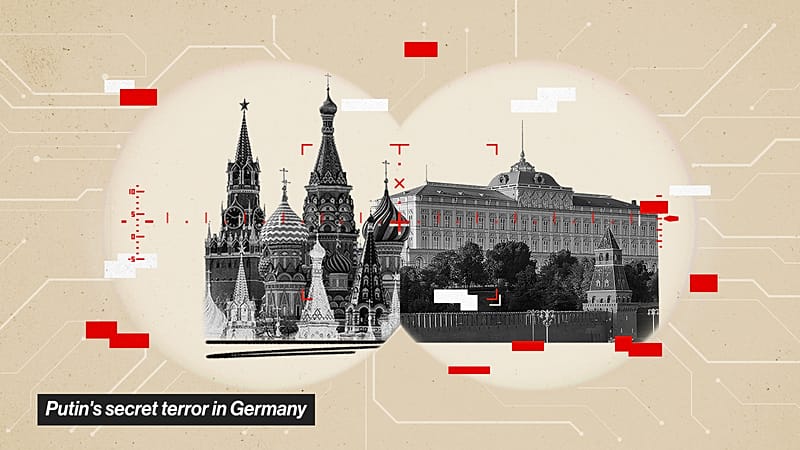
Low-level operatives play a crucial role in hybrid warfare — a combination of military, political, economic, and cyber strategies aimed at making the distinction between conflict and normalcy unclear.
In late October, German Chancellor Friedrich Merz introduced a “new holistic strategy” to address hybrid challenges, which will be examined by the National Security Council.
It is essential to determine which activities qualify as hybrid warfare before implementing defensive measures.
An Austrian disinformation expert, Dietmar Pichler, stated that occurrences like fires, explosions, accidents, attacks, pro-Russian activities, or public graffiti should be increasingly examined for connections to hybrid operations.
He cautioned that delays could complicate the response. “If officials fail to convey information clearly — such as clarifying that actions are precautionary, not aggressive — it may lead to significant challenges in the battle for information,” Pichler said to Euronews.
Resilience over shoot‑downs
The growing number of drone flights underscores the difficulty. Following the initial reports in the media, drone activity significantly rose.
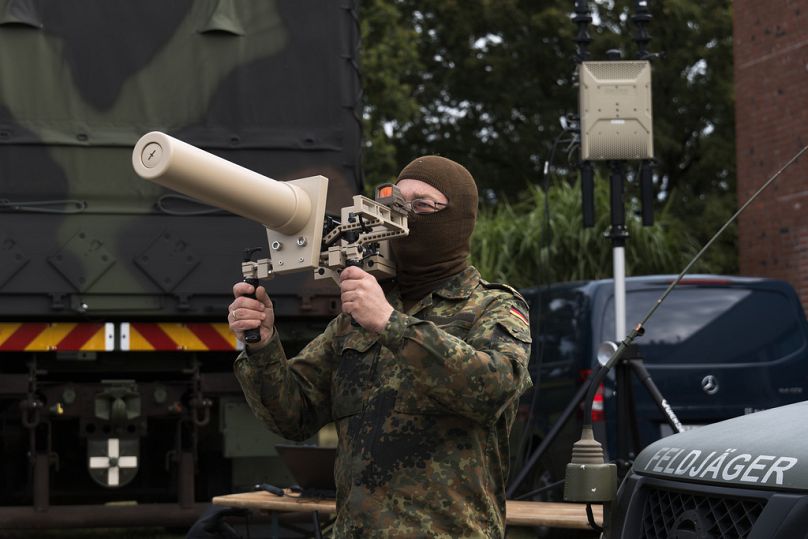
Germany’s Interior Minister Alexander Dobrindt characterized the situation as a “significant security risk” and revealed intentions to establish a new drone defense center.
Allies of NATO are said to have explored a “strong reaction” against Russian President Vladimir Putin’s growing aggressive behavior, according to the Financial Times.
Possible measures being discussed involve enhancing drone defenses – for example, a “drone wall” along NATO’s eastern border – and modifying engagement guidelines to permit pilots to target Russian planes. To date, there has been no official schedule or strategy established.
Numerous member nations, among them Germany and France, are advocating for restraint to prevent a direct military confrontation with Russia.
“Peace and war are not the only options; there is a middle ground,” said terrorism expert Dr. Peter Neumann to Euronews during this year’s Berlin Peace Dialogue at the German Ministry of Defence.
He cautioned that protective actions should not merely respond with an eye for an eye. Rather, deterrence needs to function by rendering attacks ineffective: communities and infrastructure must be capable of rapid recovery, making assaults pointless.
According to Neumann, resilience involves possessing the means to prevent and handle such assaults. He is cautious about engaging aircraft, suggesting that alternative actions—like disrupting Russian cyber activities—should be prioritized first.
“Downing an aircraft always involves the potential for increased tensions,” he stated, adding that any such move would likely trigger a Russian reaction and might lead to further complications.
What are ‘low-level agents’?
This kind of saboteur is also present in Germany. Referred to as “low-level” agents, they are not professional spies but are typically employed for small amounts of money to perform minor acts of disruption.
Once a mission is finished, they are “discarded” by the foreign operators – probably Russia and its allies – and are seldom utilized again.
Officials from multiple EU nations, such as Lithuania and the Czech Republic, have noted comparable incidents. It is suspected that Russian intelligence agencies utilize online platforms, particularly Telegram, to enlist minor operatives.
Via public platforms, individuals disseminate pro-Russian material and conspiracy narratives, with agents observing users: those who frequently like, comment, or share content might be identified as possible targets.
Advanced software examines millions of profiles to determine political leanings and allegiance. The first interaction typically involves innocuous messages or incentives before transitioning to encrypted applications.
The new trainees are assigned tasks such as taking pictures of military locations, setting cars ablaze, or painting political messages. Many have little experience, driven equally by financial gain and belief in the cause, and are dismissed following one mission.
As stated by Kacper Rękawek, a senior research fellow at the International Centre for Counter-Terrorism (ICCT), Russia has improved its strategy: numerous recruits are not regular citizens but individuals with criminal backgrounds.
“Individuals who were already engaged in criminal activities – across Europe, Ukraine, or Belarus – and had minimal prior ties to Russia,” Rękawek explained.
The head of Germany’s domestic intelligence agency, Sinan Selen, has stated that “foreign nations are endangering our democracy and safety by employing careless, untrained junior agents, driven by immediate financial gain, and brought in via social media and messaging platforms.”
He called on people to avoid being “tools of an external intelligence agency.”
Possible sabotage in Poland
Eight individuals, among them a citizen from Ukraine, have been detained in Poland recently, according to statements made by Polish Prime Minister Donald Tusk, who indicated this was linked to suspected preparations for acts of sabotage.
As reported by Polish media, the arrests occurred in mid-October 2025 in various cities, including Warsaw and Białystok.
Intelligence officer Tomasz Siemoniak stated that the individuals were not only planning to monitor military locations and essential infrastructure, but also to execute acts of sabotage and attacks.
The Polish domestic intelligence agency ABW stated that the detained individuals had communication with operatives from Russia and Belarus.
Warsaw alleges that Russia and its allies have sent operatives into the nation to gather spies — a statement that Moscow has rejected.


 jasdooit
Leave a comment