
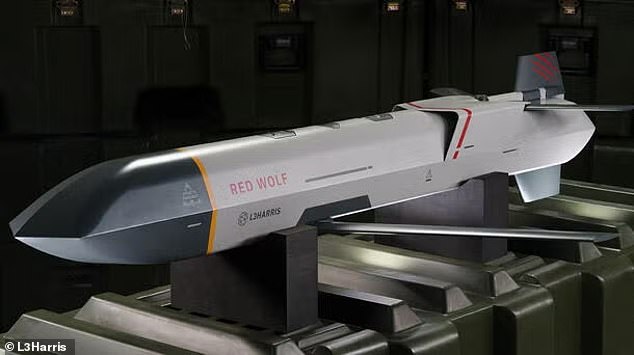
The United States Marine Corps has experimented with a revolutionary long-range attack system for its assault helicopters only a few days following the president’s announcement.Donald Trump issued a WWIII warning.
During the Atlantic Test Range, the Marines deployed the advanced Red Wolf system from an AH-1Z Viper helicopter, hitting a maritime target with exact accuracy.
Created by L3Harris, Red Wolf is a flexible, low-supersonic missile capable of transmitting target information and striking faraway objectives, providing helicopters with abilities previously limited to significantly larger systems.
Helicopter-based weapons, such as the AGM-114 Hellfire and the Joint Air-to-Ground Missile–Medium Range, have a maximum range of about 21 miles and 10 miles, respectively, whereas Red Wolf can strike targets up to around 230 miles when operating at low altitudes.
The successful trial signifies a significant advancement in the Marine Corps’ Long Range Attack Missile (LRAM) initiative, showcasing a cutting-edge system that greatly increases helicopter attack capabilities.
In the event of a possible conflict in the Pacific, the system might temporarily interfere with a warship’s sensors, creating an opportunity for subsequent attacks using more powerful weapons like the Long-Range Anti-Ship Missile or the Joint Strike Missile.
Earlier this month, Trump cautioned that the continuous conflict between Russia and Ukraine might escalate into a global war.
Events like these can lead to a third world war,” he said to reporters on December 11. “If everyone continues to act this way, it could result in a third world war, and we certainly don’t want that to occur.
Trump’s caution highlights the unstable condition of talks in the continuous conflict in Ukraine, which began when Russia initiated a major invasion on February 24, 2022.
Attempts to achieve a peace agreement have been blocked due to significant differences in objectives from both parties.
The president’s warning regarding a possible global intensification underscores the conflict’s broad consequences, involving NATO, European partners, and other international powers as tensions continue into another year.
Although the Marines’ evaluation of the new weapon was not a reaction to Trump’s statement, it signifies a significant advancement for the US armed forces.
The president of L3Harris’ Space and Airborne Systems, Ed Zoiss, stated: ‘This test confirmed Red Wolf’s sophisticated tracking and targeting features, highlighting its user-friendliness and compatibility with various systems.
We have now demonstrated that our developed effect vehicles will enable our military personnel to gain an unfair advantage necessary to deal with more advanced threats, without having to enter areas where enemy weapons are engaged.
A vehicle powered by a turbojet is approximately six feet long and includes extendable fins to ensure stability and maneuverability.
It is also capable of transporting loads as heavy as 25 pounds, according toThe Defense Post.
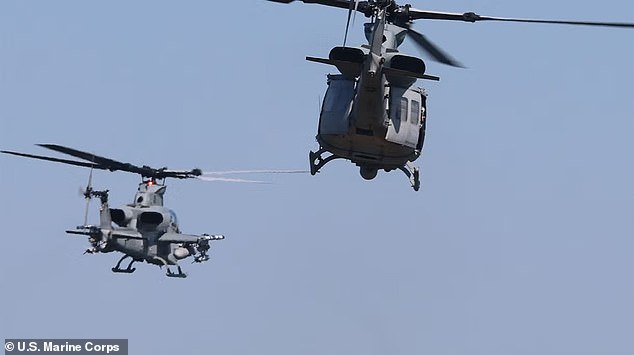
Starting from 2020, the Red Wolf system has completed over 40 flight tests on different types of platforms, such as manned and unmanned fixed-wing planes, helicopters, and ground-based launch systems, demonstrating its high level of technological maturity.
Priced approximately at $300,000 each, L3Harris plans to manufacture as many as 1,000 missiles per year.
Industry analyses suggest that Red Wolf is scheduled to begin operational use in 2026, as the Marine Corps and the Pentagon aim to increase their inventory of affordable, long-range strike and surveillance systems in anticipation of possible high-intensity conflicts.
The system plays a crucial role in the Pentagon’s plan to increase its stock of cost-effective, long-range strike weapons should a protracted conflict with a peer competitor arise, particularly in the Indo-Pacific region, where expensive systems such as the Joint Air-to-Surface Standoff Missile–Extended Range and Tomahawk are restricted by production capacity and cost.
- Could the next generation of Red Dragon drones, equipped with artificial intelligence, be shaping the future of combat through their rapid, autonomous targeting capabilities?
- What effect will President Trump’s caution regarding World War III have on the US military’s recent missile tests conducted with Lockheed Martin?
- What makes the Royal Navy’s latest Martlet missile a groundbreaking advancement in drone combat?
- Will the US military’s advanced drone lasers take control of battlefields saturated with suicide-style attacks?
- Could the unsettling emergence of armed robotic dogs from countries such as the United States, China, and Russia change the way wars are fought at the front lines?




 jasdooit
Leave a comment