
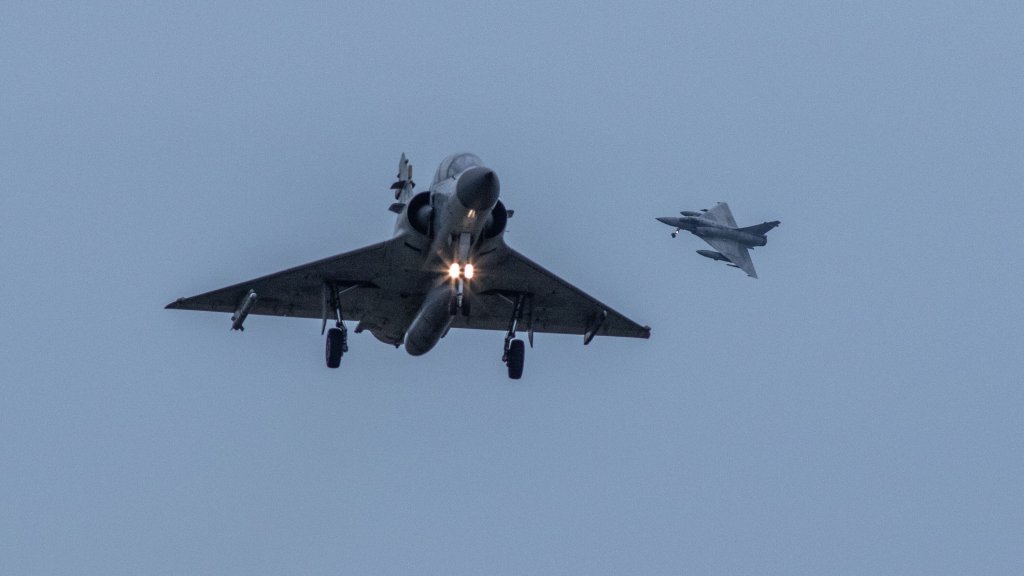
China demonstrates its blockading skills near Taiwan on the second day of military exercises
The Chinese People’s Liberation Army conducted another day of extensive military exercises surrounding Taiwan on Tuesday, featuring live-fire demonstrations as part of an operation named “Justice Mission 2025,” aimed at showcasing its capability to prevent any external military assistance to the island, which it has consistently claimed is an integral part of its territory.
The Eastern Theater Command of the PLA deployed destroyers, frigates, fighter jets, and bombers to the waters north and south of the island to evaluate its capabilities in sea-air cooperation and blockading operations. Its land forces conducted long-range, live-fire exercises in the northern waters near the island and also arranged live-fire training, combined with simulated long-range, coordinated strikes involving air, naval, and missile units, in the southern waters near Taiwan, resulting in what command spokesperson Li Xi described as “desired outcomes.”
Tensions escalated near the Taiwan Strait as 2025 came to an end, but the effects went beyond military actions and affected daily routines. The Taiwan Civil Aviation Administration was informed that seven temporary “danger zones” had been established around the strait. According to their websites, the schedules of Taiwan’s four international airports on Tuesday afternoon indicated that more than 100 international and domestic flights had their times adjusted, experienced delays, or were canceled.
The Xinhua News Agency, China’s state-run media outlet, published a statement late Monday emphasizing that the military exercises conveyed a clear message: Beijing remains prepared to stop any attempts to separate Taiwan from China. It stated that each increase in tension would be met with more robust responses.
“By seeking favor from the United States through submissive loyalty actions and encouraging arms deals, the DPP is tying the whole island of Taiwan to its disastrous separatist vehicle, ignoring public sentiment,” it stated, referring to Taiwan’s governing Democratic Progressive Party.
130 planes and a Chinese balloon observed
Taiwan’s President Lai Ching-te stated on Tuesday that his region would behave responsibly, avoiding both the intensification of conflicts and the incitement of disputes.
“China has recently increased military pressure in a regular way, which is not behavior one would expect from a responsible major country,” he wrote on Facebook.
The Taiwan Defense Ministry reported that it had identified 130 aircraft, such as fighter jets and bombers, 14 military vessels, and eight additional official ships near the island from 6 a.m. on Monday to 6 a.m. on Tuesday. Its military continued to track the situation and activated aircraft, naval ships, and coastal missile systems as a response. Ninety of the Chinese aircraft crossed the midpoint of the strait. Additionally, a Chinese military balloon was also observed, according to the statement.
It mentioned that a long-range artillery unit of the People’s Liberation Army in Fujian, a province in southeastern China, launched live ammunition toward a target area north of the island, with impact zones spread along the line 44 kilometers (24 nautical miles) off its coastline.
Taiwan’s Minister of Defense, Wellington Koo, stated that the actions of Chinese forces were extremely provocative, damaged regional stability, and created security risks and disturbances for vessels passing through, trade operations, and air routes.
Although Beijing dispatches warplanes and naval ships to the island on a nearly daily basis, the magnitude of these maneuvers has increased hostilities between the two parties. China has pledged to take control of the island, using force if required.
A spokesperson from the Chinese Defense Ministry, Zhang Xiaogang, stated that the military exercises acted as a strong warning to “Taiwan independence” separatist groups and outside influences, without specifying any particular nations.
He condemned Lai’s government for allegedly catering to outside powers and seeking independence, stating that this was the fundamental reason behind disrupting the current situation across the strait and increasing hostilities.
Last week, Beijing enacted penalties on 20 U.S. defense-linked companies and 10 executives, in response to a statement from Washington regarding significant arms deals with Taiwan worth over $10 billion. These transactions still need authorization from the U.S. Congress.
According to U.S. legislation, Washington is required to support Taipei in its defense, a matter that has grown more controversial with China over time.
Beijing slams Japan
On Monday, U.S. President Donald Trump mentioned that he hadn’t been notified about the military drill beforehand, and he wasn’t especially concerned about it. He highlighted his “strong relationship” with Chinese President Xi Jinping and indicated he didn’t believe Xi would invade Taiwan.
The Taiwan issue has also increased tensions between China and Japan. Beijing has shown frustration over a statement made by Japan’s Prime Minister, Sanae Takaichi, indicating that Japan’s military might intervene if China acts against the island, which is democratically governed. There is still significant general distrust in China towards Japan, rooted in historical memories of when imperial Japan forcefully occupied parts of China in the years leading up to World War II.
Chinese Foreign Minister Wang Yi criticized both Japan and Taiwan’s “pro-independence groups.”
Japan, which initiated the war of aggression against China, not only avoids a thorough reflection on the many crimes it committed, but also its present-day leaders openly question China’s territorial sovereignty, the historical findings from World War II, and the international order established after the war,” he stated Tuesday at an event in Beijing. Wang added that “China must remain highly alert to the revival of Japanese militarism.
China and Taiwan have been under separate governance since 1949, after the Communist Party took control in Beijing following a civil conflict. The Nationalist Party, which lost the war, moved to Taiwan, where the region eventually shifted from military rule to a multi-party democratic system.
Confronting the drills, Taiwan stated on Monday that the Chinese government is “the primary threat to peace.” It warned that conducting live-fire exercises near the strait could lead to more complicated challenges for the global community and nearby nations.
Escalating the tensions, China’s Eastern Theater Command shared a series of online images and videos with inflammatory messages during the exercises. It released a video showing live ammunition being fired from ships and a land-based launcher on Tuesday.
Chen Wen-chin, head of the Keelung District Fishermen’s Association in Taiwan, mentioned that the organization began hourly radio transmissions starting from Monday to update fishermen on the locations of China’s military exercises, advising them to stay clear of hazardous areas.
The Chinese military drills have stopped fishermen from engaging in their primary source of income,” Chen stated. “The inability to fish has greatly affected them and led to financial losses.
Provided by SyndiGate Media Inc.Syndigate.info).


 jasdooit
Leave a comment