
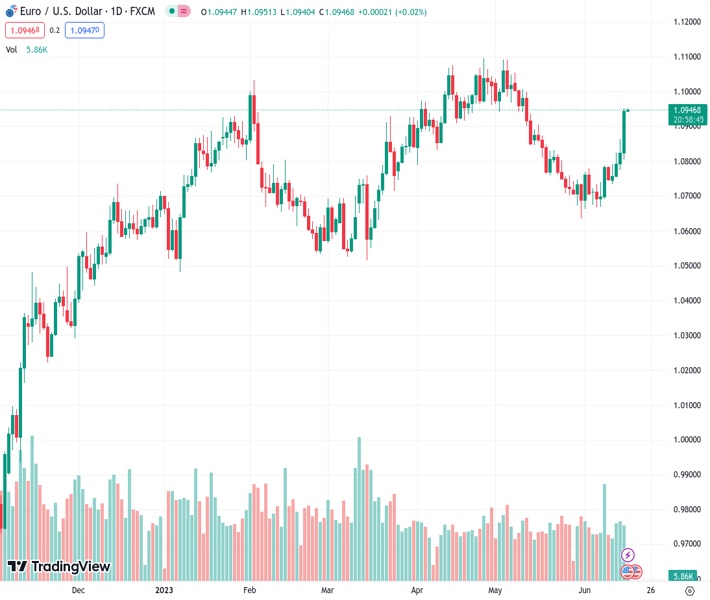
Last year, the intraday fluctuation range of the exchange rate against the dollar was the largest in 16 years since 2009, when the global financial crisis aftermath occurred.
As per the Bank of Korea’s Economic Statistics System on the 4th, the average difference between the daily high and low exchange rates over the 242 trading days in the foreign exchange market last year was determined to be 11.6479 Korean won. This represents an approximate 40% rise compared to the daily average fluctuation of 8.3553 Korean won observed over the 244 trading days in the prior year. Significantly, this is the highest fluctuation since 2009 (253 trading days), when the annual average fluctuation hit 14.5652 Korean won.
The major fluctuations observed last year were linked to the U.S.’s extended high-interest-rate strategy and the subsequent “strong dollar” trend. As the Federal Reserve, the U.S. central bank, postponed its anticipated rate reductions, the dollar’s value increased and decreased sharply, leading to considerable changes in exchange rates. In the previous year, the Dollar Index, which reflects the dollar’s strength against the currencies of six nations, dropped by roughly 9.4–9.5% due to predictions of U.S. rate cuts, representing the biggest drop in eight years. The dollar experienced significant daily swings of tens of Korean won as market expectations and anxieties conflicted with each U.S. economic data release.
Geopolitical instability further increased exchange rate fluctuations. Owing to tariff risks caused by President Trump, the dollar’s dominance and worries about South Korea’s weakened export competitiveness resulted in daily exchange rate changes of 39.3 Korean won and 24.8 Korean won on December 24 and 26 of the previous year, respectively. Reuters reported, “Fears regarding the implementation of U.S. tariffs go beyond impacting trade balances; they also hinder the Federal Reserve from lowering interest rates to boost the economy due to inflation concerns, maintaining the dollar’s value at an unusually high level.” It also mentioned that currencies of nations heavily reliant on U.S. exports, such as South Korea, serve as “indicators of tariff risks” and are subject to sell-offs. Bloomberg stated, “Global fund managers are decreasing their Asian asset allocations and are the first to sell the liquid won, which has been the primary factor driving intraday fluctuations to their highest point in 16 years.”



 jasdooit
Leave a comment