
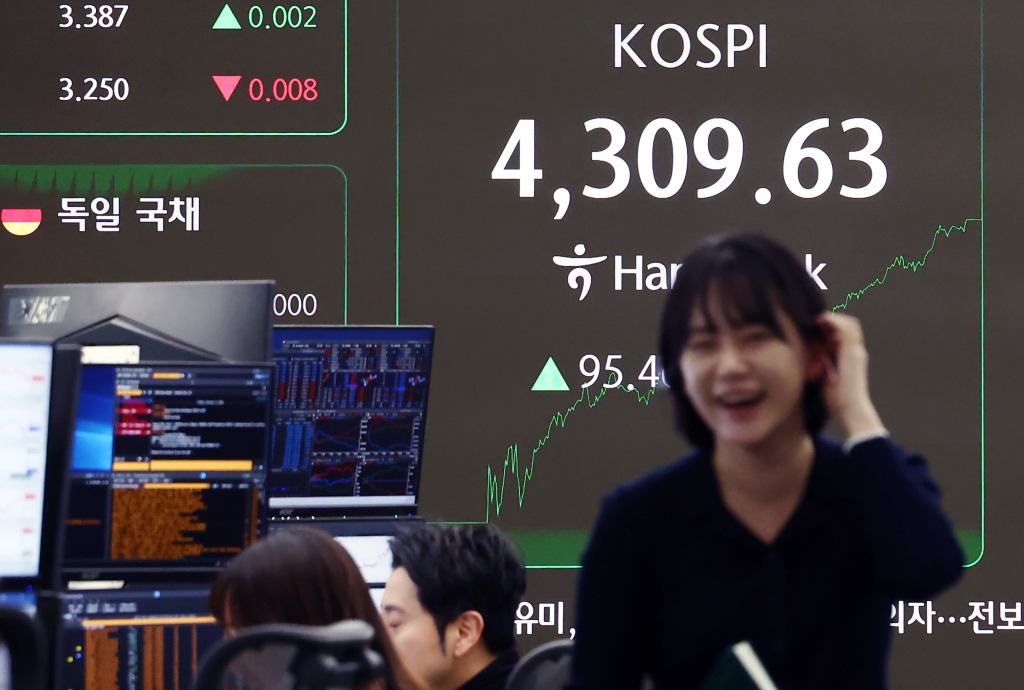
Towards the end of last year, the proportion of foreign investment relative to the overall market value of the local stock market hit its peak in five years and eight months.
As per a report authored by Senior Researcher Shin Sulwi from the Korea Center for International Finance on the 4th, the proportion of foreign ownership relative to total market capitalization reached 32.9%, marking the highest level since April 2020, following a resumption of foreign net purchases in December of the previous year.
Specifically, foreign investment in December focused on semiconductor firms. The net buying amount in the electrical and electronic industry hit 4.5 trillion South Korean won, exceeding the overall foreign net purchase (3.5 trillion South Korean won). Of this, SK Hynix represented 2.2 trillion South Korean won, while Samsung Electronics accounted for 1.4 trillion South Korean won.
As a result, the foreign ownership percentage of SK Hynix rose from 53.2% at the end of November last year to 53.8% by the end of December. In the same timeframe, Samsung Electronics’ foreign ownership rate also went up from 52.2% to 52.3%.
In December of the previous year, non-residents not only injected a net 8.8 trillion South Korean won into local stocks but also into bonds. The total value of bonds held by foreign investors rose from 329.5 trillion South Korean won at the end of November to 338.3 trillion South Korean won by the end of December, primarily in medium- and short-term bonds.
The Korea Center for International Finance noted, “Anticipations of better performance by local companies because of supply shortages and rising prices in memory semiconductors, the assessment that South Korean semiconductor stocks are relatively inexpensive, and policy expectations such as separate taxation on dividend earnings were elements that affected foreign stock buying in December last year.” It also mentioned, “Although reforms in the capital market could serve as extra motivators for inflows, foreign stock fund movements might show significant fluctuations due to worries about an artificial intelligence (AI) bubble and other issues.”


 jasdooit
Leave a comment