
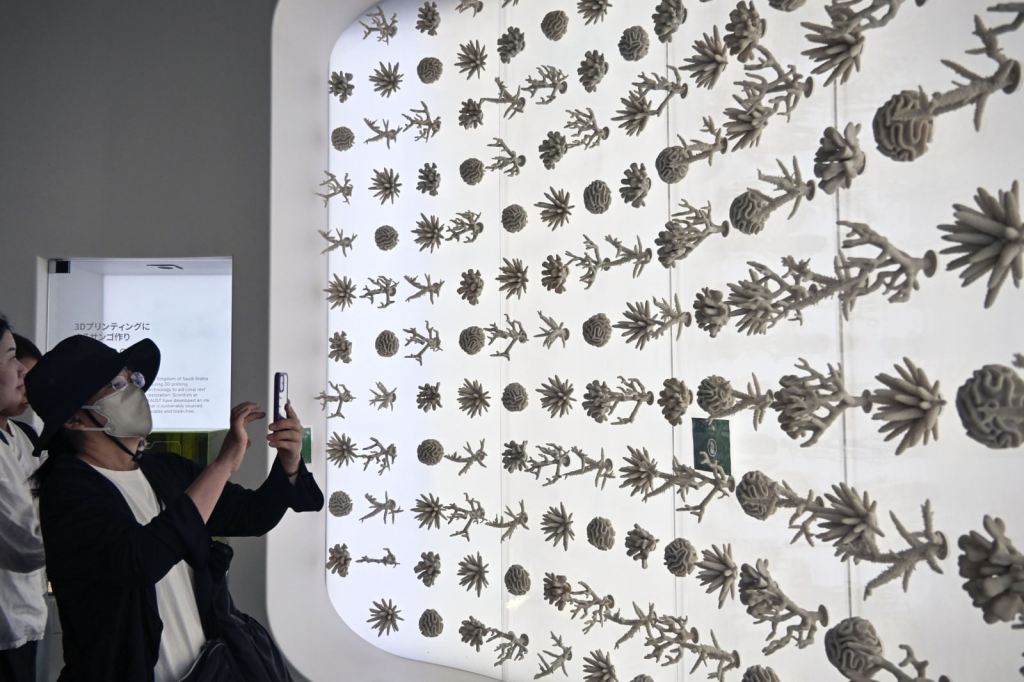
OSAKA – Japanese universities are working to revive coral reefs and marine environments, having taken over artificial coral structures created by Saudi Arabia and displayed at this year’s World Exposition in Osaka.
Coral skeletons, given to the University of the Ryukyus in Okinawa and Kansai University in Osaka Prefecture, consist of calcium carbonate, a substance that is thought to allow corals to thrive more readily than other artificial options like concrete or metal.
The bone structures were made with 3-D printers, producing one section each day throughout the exhibition and showcasing along a full wall in the area of the Saudi Arabian pavilion focused on sustainable oceanic ecosystems.
Coral reefs provide homes for a significant amount of oceanic life, yet more than 40% of the globe’s 892 coral species are in danger of disappearing, as reported by the International Union for Conservation of Nature.
The University of the Ryukyus, having received approximately 150 artificial coral frameworks, plans to deploy them in waters near the eastern shore of Okinawa’s primary island and subsequently study their effect on the environment.
“We want to determine if these 3-D printed corals can function as habitats for different organisms… we need to observe how they behave and interact within the coral reef ecosystem,” said James Davis Reimer, a marine biology professor at the university. He mentioned that numerous coral reefs in Okinawa have already perished.
Kansai University has deployed artificial coral frameworks into the waters near Yoron Island in Kagoshima Prefecture to monitor their development following the transplantation of coral polyps onto these structures. The corals have also been set up in a tank at the university.
Although recognizing the challenges involved in completely reviving natural ecosystems with synthetic substances, Masato Ueda, a professor focused on regenerative medicine at the university, stated his desire to show children that “humanity is making efforts to restore the environment.”
Both institutions intend to showcase their research findings at the Riyadh exhibition in 2030.
I never thought Japan and Saudi Arabia would collaborate on coral research,” Ueda mentioned. “Our goal is to present concrete outcomes within five years.


 jasdooit
Leave a comment