
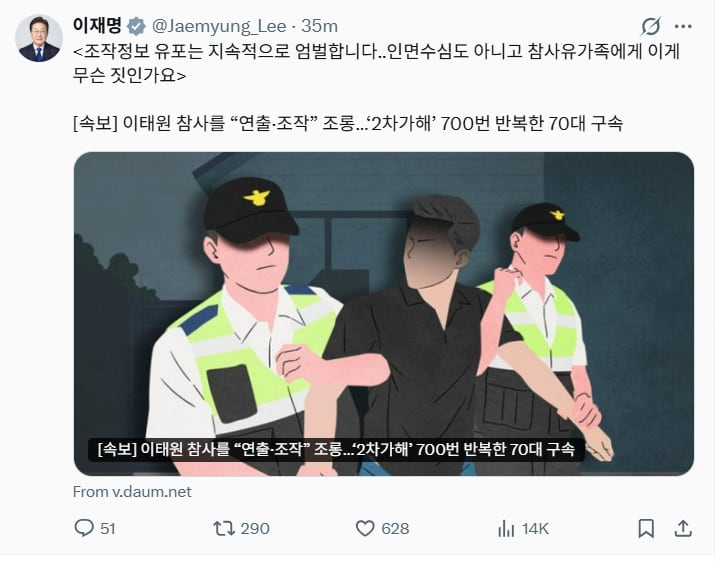
On the 4th, President Lee Jae-myung posted on his social media about the arrest of an elderly man who disseminated false information regarding the Itaewon crowd disaster, saying, “The continuous severe punishment of fabricated information will be enforced. How can this be done to the grieving families of the tragedy, without any sense of humanity?” Since assuming office, President Lee has consistently emphasized his policy of strictly penalizing the spread of false and fabricated information during Cabinet meetings and press conferences.
As per the police, the Seoul Western District Court issued a second bench warrant on the 2nd for A, who is charged with defamation and insult for repeatedly sharing around 700 videos and posts that included false statements regarding the Itaewon crowd incident, such as claims of ‘fabricated/staged,’ ‘drug terrorism,’ and ‘bodies are real dolls.’ This marks the first instance of apprehending an individual since the establishment of the National Police Agency’s Second Victimization Crime Investigation Division, which was initiated under President Lee Jae-myung’s directive in July of last year.
President Lee believes that economic sanctions, more severe than criminal penalties, are essential for individuals who disseminate false and misleading information. During a press conference celebrating his 100th day in office last September, he remarked, “Using fake news to achieve political goals, attack others, or gain economic advantages threatens the democratic system itself.” He further noted, “Even the United States, which strongly upholds freedom of expression, imposes substantial compensation for false information,” and stressed, “Implementing a punitive damages system that greatly raises compensation for maliciously fabricated information is crucial.”
During a Cabinet meeting in June of the previous year, he also directed the Ministry of Justice to develop strategies targeting YouTubers who disseminate false information for financial gain. At that time, President Lee remarked, “Illegal actions taken for profit must be fundamentally prevented,” and continued, “Similar to how sellers of counterfeit food products should be compelled to pay multiple times the sales amount, pushing them into bankruptcy to maintain control, punitive damages are the most effective approach for dealing with fake news.”
Nevertheless, some criticisms have arisen suggesting that President Lee’s approach of harshly penalizing false information and the newly enacted revised Information and Communications Network Act (Fake News Eradication Act) serve as a way to stifle opposing views. As the bill does not exempt politicians, senior officials, or major corporations from being targets of complaints, it has essentially created an opportunity for these groups to utilize the law in strategic lawsuits aimed at silencing public engagement (SLAPP). The National Union of Media Workers noted, “Introducing a system of punitive damages would turn into a weapon for politicians and senior officials to broadly initiate lawsuits and prevent unfavorable coverage.”



 jasdooit
Leave a comment