
Families with two or more children have experienced almost a doubling of their private education expenses since the start of the COVID-19 pandemic. The share of private education costs in this year’s household spending is projected to hit an all-time high.
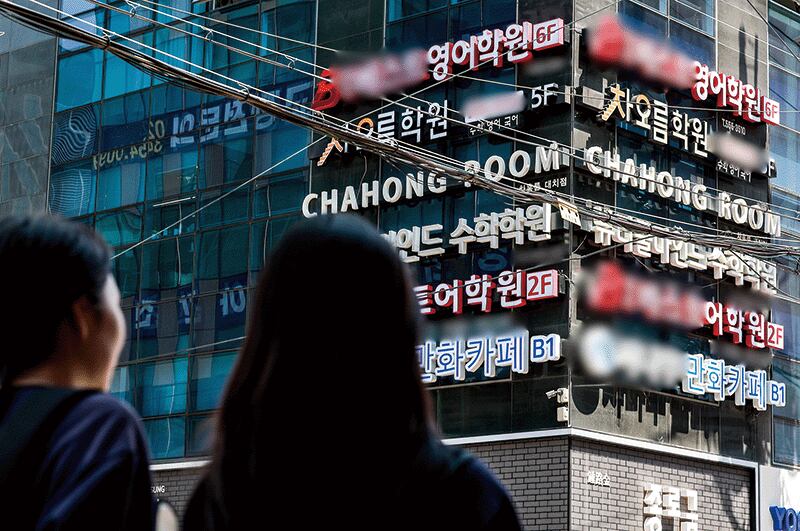
Even though the number of school-age children has been gradually declining because of low birth rates, total private education expenses are rising as more parents choose to send their kids to private schools well before they start elementary school.
As per the Ministry of Data and Statistics on the 4th, the average monthly private education cost (student academy tuition) for families with two or more unmarried children during the third quarter of last year (July–September) was reported as 611,000 South Korean won. Student academy tuition covers additional and advanced learning expenses for not only students in elementary, middle, and high school but also for infants, young children, and those retaking exams, referred to as “Nth-year students.”
Private education expenses made up 12.6% of the average monthly household spending, which amounted to 4,858,000 Korean won. In terms of spending categories, it ranked third, following dining out costs (720,000 Korean won) and grocery expenses (688,000 Korean won). This amount surpassed housing and heating costs (437,000 Korean won), considered necessary expenses, and was three times greater than spending on clothes and shoes (195,000 Korean won).
◇Double in Five Years… Historical Peak in Proportion of Living Expenses
The amount spent on private education has been rising quickly. It dropped from an average of 427,000 South Korean won per month in 2019 to 340,000 South Korean won in 2020 because of the impact of the COVID-19 pandemic but then started to increase again, almost doubling within five years. Especially in 2021 and 2022, it saw a significant rise with double-digit growth rates affected by the post-COVID-19 base effect. The previous year also experienced ongoing growth, with increases of 7.3% in the first quarter, 2.6% in the second quarter, and 4.6% in the third quarter.
The share of private education expenses within overall living costs has also been increasing. Beginning at 11.5% in 2019, when such data was first recorded, it fell to 9.2% in 2020 because of the COVID-19 pandemic but then steadily rose to 11.2% in 2021, 12.5% in 2022, 12.6% in 2023, and 12.8% in 2024. Last year, it hit 13.0% in the first quarter (January–March) and a new peak of 13.5% in the second quarter (April–June), indicating that the annual total might also set a new record.
Even though the number of school-age children has decreased, total private education spending has risen by more than 60% over the last ten years. In 2024, the total private education expenditure reached 29.1919 trillion Korean won, representing a 60.1% increase compared to 2014 (18.2297 trillion Korean won). The overall spending declined until 2015 but started to grow again from 2016, surpassing 20 trillion Korean won in 2019. Although it fell to 19.3532 trillion Korean won in 2020 due to the COVID-19 pandemic, it has been on an upward trend for four straight years since 2021.
◇Elementary school private education expenses have increased by 74% over the past ten years… significantly exceeding the growth rates of middle and high school costs
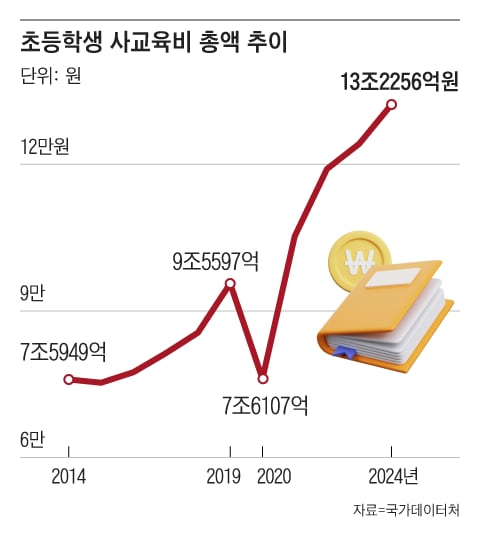
Private education expenses for elementary schools significantly contributed to the overall growth. In 2024, the total private education spending on elementary schools reached 13.2256 trillion South Korean won, representing a 74.1% rise compared to 2014 (7.5949 trillion South Korean won). Over the same period, middle schools experienced the smallest growth rate at 40.7%, whereas high schools saw an increase of 60.5%. In terms of overall scale, the private education costs for elementary schools were 1.7 times and 1.6 times higher than those for middle schools (7.8338 trillion South Korean won) and high schools (8.1324 trillion South Korean won), respectively.
In 2024, the average monthly private education expense for an elementary school student reached 442,000 Korean won, which is the highest ever recorded, representing an increase of 210,000 Korean won (90.5%) compared to ten years prior. The cost for general subjects was 278,000 Korean won, whereas expenses for arts, physical education, hobbies, and liberal arts totaled 163,000 Korean won. Meanwhile, middle school students’ private education costs per person rose from 270,000 Korean won to 490,000 Korean won, a growth of 220,000 Korean won (81.5%). For high school students, the private education costs per capita jumped from 230,000 Korean won to 520,000 Korean won, an increase of 290,000 Korean won (126.1%), indicating a more significant rate of growth.
In 2024, the proportion of students attending private elementary schools reached 87.7%, reflecting a rise of 6.6 percentage points compared to ten years earlier. This figure is notably greater than that for middle schools (78.0%) and high schools (67.3%). The participation rate in standard subjects at elementary schools was 67.1%, whereas activities such as arts, physical education, hobbies, and liberal arts had a higher rate of 71.2%. This trend is attributed to the growing number of dual-income families, with arts and physical education centers helping to fill the after-school care gap for children.
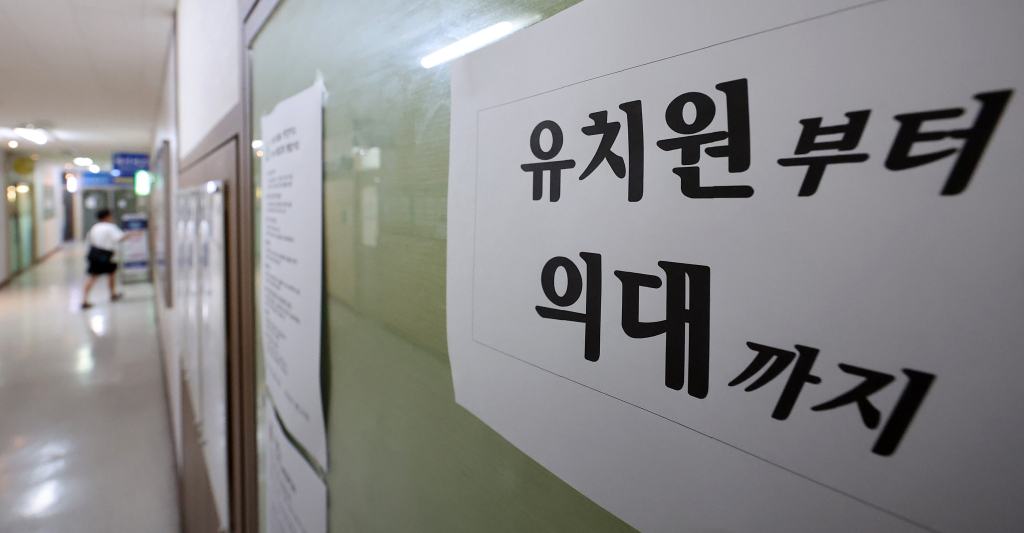
Experts highlight advanced learning as the foundation for the increase in private education at the elementary school level. The so-called “4-year-old exam” and “7-year-old exam” are part of the same trend. The “4-year-old exam” is a level test for admission to infant English classes, whereas the “7-year-old exam” is an assessment needed to enter top-tier English and math programs before starting elementary school.
In recent times, the government and the National Assembly have been intensifying efforts to tackle the issue of early-age privatization in education. A proposed amendment to the Private Teaching Institutes Act, which bans level tests for English academies catering to young children known as the “4-year-old and 7-year-old exams,” was approved by the National Assembly’s Legislation and Judiciary Committee on the 18th of last month, following a consensus between both political parties.


 jasdooit
Leave a comment