
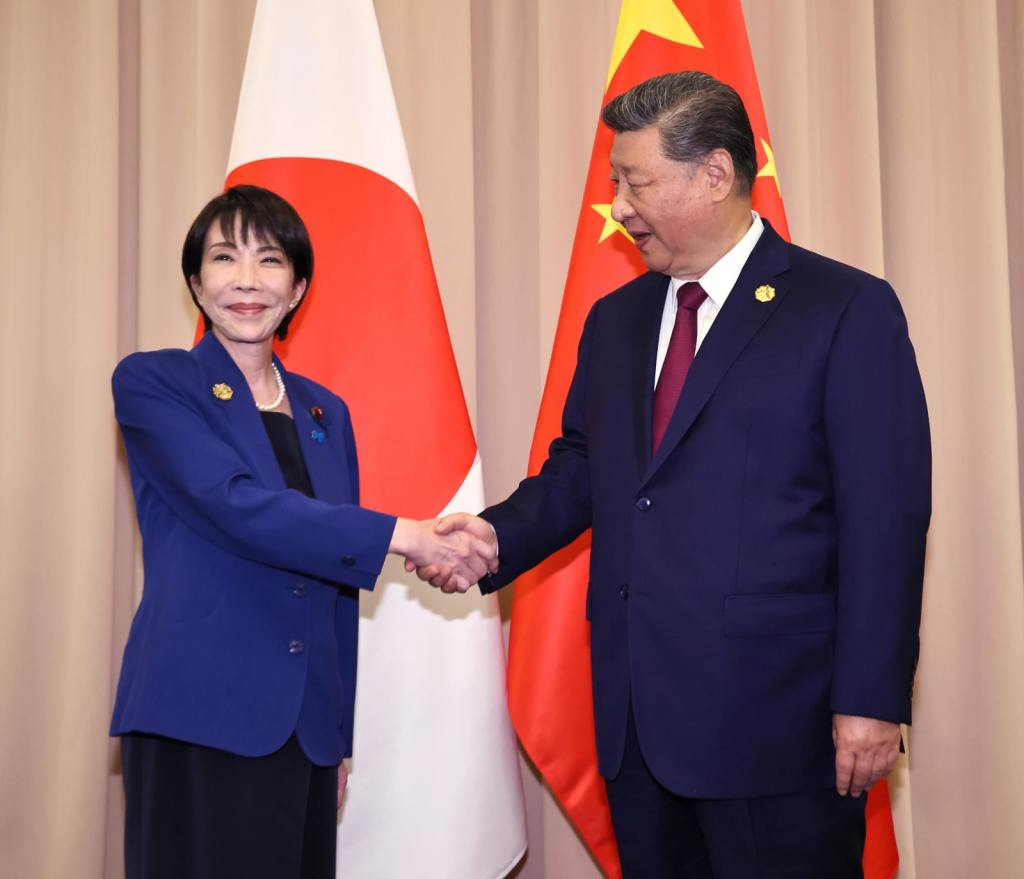
TOKYO – Prime Minister Sanae Takaichi is expected to encounter significant challenges in handling the deteriorating ties between Japan and China, with no indication of tensions decreasing following her comment about a potential situation in Taiwan that angered Beijing.
Takaichi, a staunch security advocate whose leadership started just a few months back, might not receive significant support from Japan’s ally, the United States, or President Donald Trump in the near future, as he is perceived to be developing a closer relationship with Chinese President Xi Jinping ahead of their meeting in April.
Takaichi has emphasized the significance of communication across different levels when dealing with issues involving Asian neighbors, noting that the government’s position remains unchanged despite her statement in parliament indicating that a situation involving Taiwan might lead to a response from Japan’s Self-Defense Forces.
China, according to foreign affairs analysts, may not feel an urgent need to address her request, as the possibility of a reduction in U.S.-China tensions could weaken the attractiveness of Beijing’s approach toward Tokyo.
Japan has faced a very challenging situation,” stated Li Hao, an associate professor at the University of Tokyo’s Graduate Schools for Law and Politics, who noted that Takaichi’s comment “crossed a red line for China.
“Japan has no alternative but to withstand this situation for some time…by keeping positive ties with the United States and South Korea and waiting for the turbulence to subside,” Li stated.
Takaichi mentioned that she is planning a visit to the United States in early 2026 to discuss with Trump, indicating her desire to align how the long-standing allies should address China before the U.S. president’s trip to Beijing.
Trump has remained neutral in the most severe Japan-China conflict in recent years. Li stated that this approach shows Trump’s desire to prevent issues with China before his meeting with Xi.
Takaichi diverged from her predecessors, who avoided referencing Taiwan when discussing potential situations where Japan, according to its security laws, could exercise the right to collective self-defense in support of the United States.
Takaichi’s reference to Taiwan provoked China, which regards the island as a wayward province that must be reunified with the mainland, potentially through force, and considers the Taiwan matter as an entirely “internal issue.”
As a reply, China took steps to exert influence over Japan, both economically and through military means, with Chinese planes using radar on Japanese fighter jets in international waters near Okinawa.
Prior to Beijing urging its residents not to travel or study in Japan and re-imposing restrictions on Japanese seafood imports, Chinese Consul General in Osaka Xue Jian responded to Takaichi’s remarks in a now-removed tweet on X, where he warned to “cut a dirty neck without hesitation.”
Robert Eldridge, the director overseeing North Asia at the Global Risk Mitigation Foundation, stated that the Japanese government’s reaction indicates it aims to “de-escalate” the situation, pointing out that the diplomat was not labeled as persona non grata and no demand was made for his return.
Eldridge stated that the conflicts are “completely caused by China” and the problem lies in China’s “strong reaction.”
“The responsibility lies with the Chinese to make genuine efforts to enhance relations with Japan and other nations affected by China’s statements and actions, demonstrating their commitment to addressing the situation in the Taiwan Strait peacefully, as they initially pledged in the 1970s,” he stated.
The sudden escalation occurred during a delicate period for Asian neighbors still locked in disputes over wartime history and territorial issues, as Takaichi’s Liberal Democratic Party is striving to revise three crucial documents related to national security and defense amid China’s growing aggression in maritime and aerial domains.
Japan, under Takaichi, has chosen to increase its defense spending to 2 percent of the gross domestic product in fiscal 2025, two years earlier than previously planned, although this amount is still significantly less than China’s military budget.
A significant transformation of Japan’s defense policy, potentially involving a reassessment of its long-standing non-nuclear stance, is also driving China to increase its pressure, as stated by Professor Naoko Eto from Gakushuin University’s political science department.
“We discuss national security and reaffirm our understanding within the country. That’s the correct approach,” stated the expert on Japan-China relations. “However, we should expect an inevitable reaction from China, so we need to be cautious,” she added.
China’s aspirations to increase its reach in the Indo-Pacific area and further afield have provided Japan with a motivation to play a greater role in maintaining regional peace and security, as well as to strengthen military partnerships with allied countries.
Japan, in particular, has been calling for peace and stability in the Taiwan Strait, due to its proximity to the southwestern Japanese prefecture of Okinawa and the Senkaku Islands in the East China Sea. Chinese ships are regularly spotted in waters around the Japanese-administered, Chinese-claimed islands.
Although Takaichi mentioned in late December that there is an opportunity for discussion, she conveyed her determination to “safeguard our national interest, dignity, and the lives of our citizens.”
“It is crucial for Prime Minister Takaichi, cabinet members, and senior officials at the Prime Minister’s Office to avoid further errors, but I am deeply concerned,” said Li from the University of Tokyo.


 jasdooit
Leave a comment