
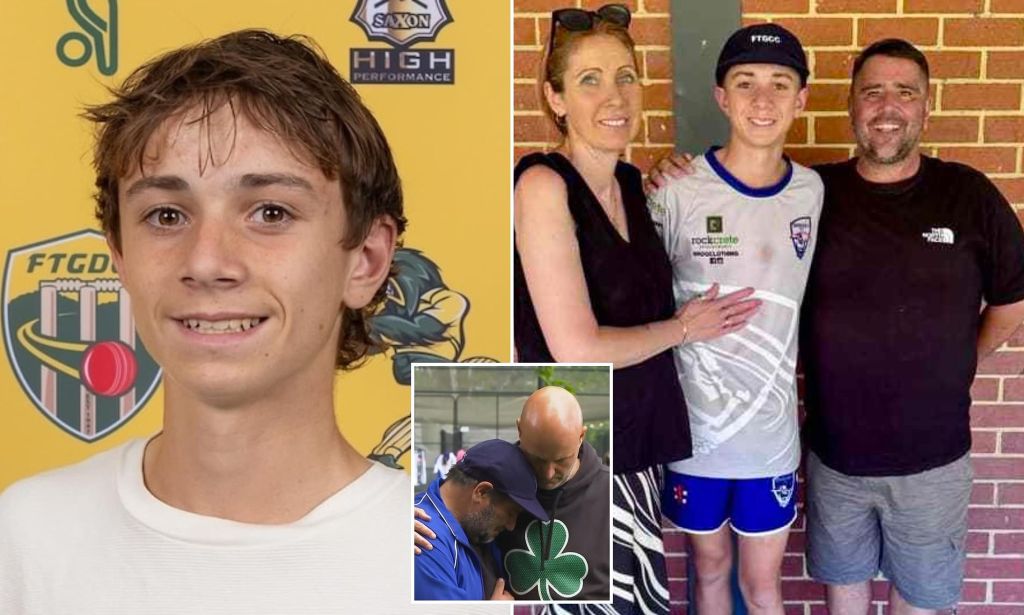
- Ben Austin’s parents honor their late son
- They don’t hold the teenager responsible for throwing the deadly ball
The parents of a teenager who died in an accident during cricket practice last year have relived the moment they realized they had lost their son — while also sharing their emotions regarding the boy who threw the deadly ball.
Ben Austin suffered an injury to his neck when struck by a ball during a practice session at Wally Tew Reserve in Melbourne’s southeast in October, after which he was taken to the hospital in a severe state.
A 17-year-old was put on life support but passed awayat Monash Children’s Hospital the next day.
His father Jace disclosed to theABC that he no longer follows the game he adores in the same manner.
He mentioned that on the day his son was injured, he had no desire to be involved with the sport, but he eventually found the strength to put his son’s cricket equipment in the nets where the tragedy occurred.
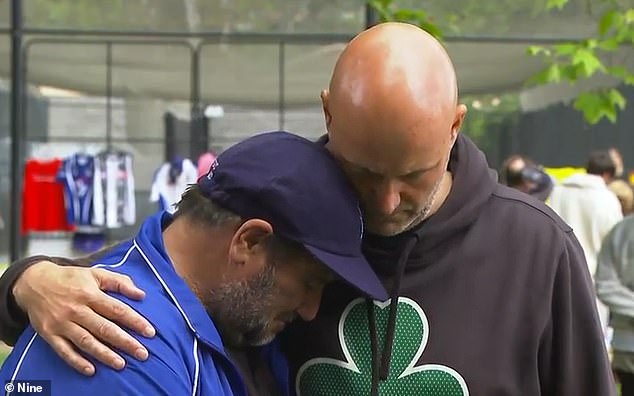
“We obtained his bat, his gloves, my family… we just wanted to be where he was last standing,” Mr. Austin said tearfully in October.

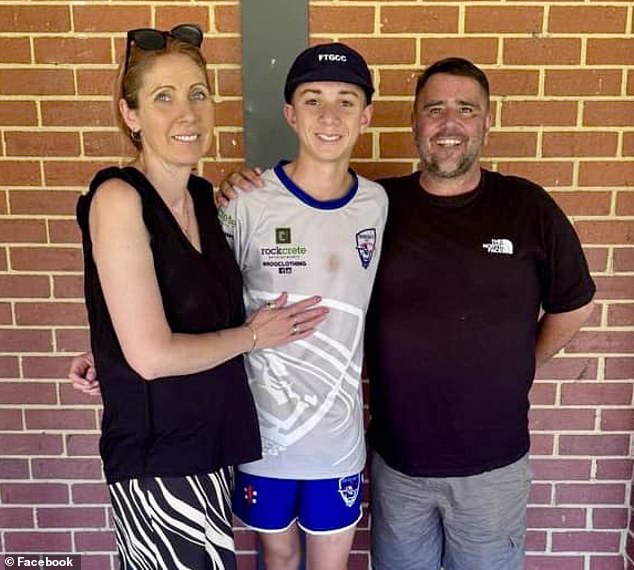
I believed I’d never return there, but Benny would have desired that since he cherished the sport.
Ben passed away due to a brain hemorrhage resulting from a severe injury to the left side of his neck.
The deadly ball was delivered by one of his teammates with the help of a ‘cricket thrower,’ a device designed to propel practice balls toward batsmen in the net.
Jace informed the ABC that he was aware his son would not survive his injury after his brother-in-law called to inform him that his son had been struck and he needed to rush to the nets immediately.
“So I just stepped out and was shouting, ‘Can someone let me know what’s happening?’ And I could sense the glances from all the players and that,” Jace said.
I walked around the ambulance to the nets and I was just about to reach the bowling mark at the end of the [nets] when I could see him; they were working on him.
I immediately realized he wasn’t present. I knew he had left right away.
The medical team detected a pulse, which Jace mentioned allowed the family to have a few more days with Ben at Monash Children’s Hospital, as his mother Tracey wished for a miracle.
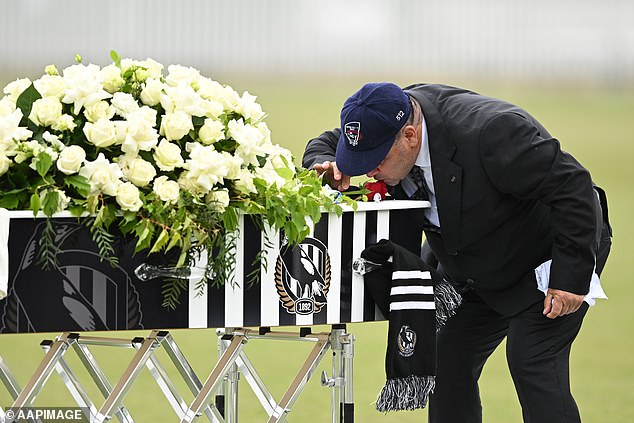
“I just kept thinking, as a mother would, there’s hope, there’s hope, there’s hope,” Tracey Austin said to theABC’s 7.30.
However, reality quickly became clear when doctors informed Jace and Tracey that there was nothing they could do for their son, who had been declared brain-dead.
Tracey mentions that she continues to sense her son’s presence in the family house daily, as she looks at his awards hanging up and photographs adorning the walls.
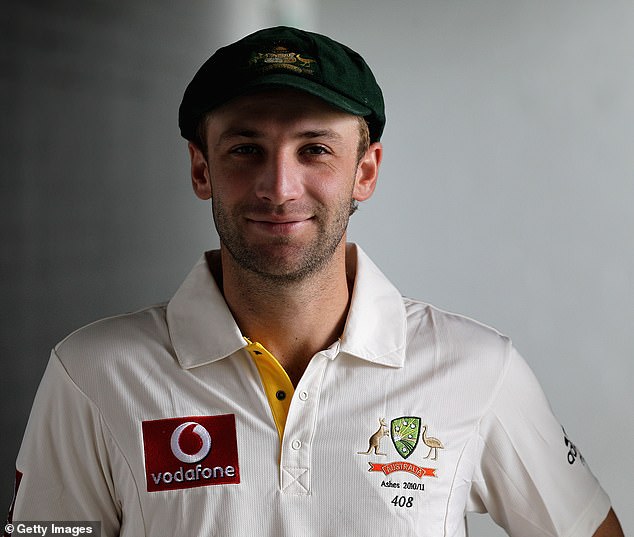
The tragedy came after the passing of Test cricketer Phillip Hughes in 2014, who was also hit in the neck by a ball while batting in a Sheffield Shield match for South Australia at the Sydney Cricket Ground.
Ben was an enthusiastic Australian rules football player who started officiating the boundaries while also aiming to eventually complete a marathon.
He aspired to become a physical education instructor following his high school graduation and had undertaken some internship at a primary school just before his passing.
“I could speak about him nonstop,” Tracey remarked.
We need to discuss him, and we will gather at the table at night. The first thing I’d like someone to say is something about him—a memory—and then we will bring in everyone else.
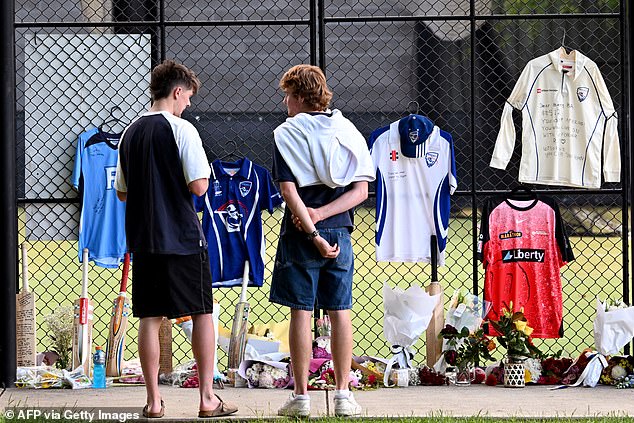
The Austin family have always claimed that Ben’s death was a heartbreaking accident, with no one to blame, and they continue to hold this position.
They have backed the 15-year-old who dropped the ball that struck him in the neck and remain supportive.
We regularly check in with him to see how he’s doing,” Tracey said. “And he appears to be managing well.
We managed to get him to the hospital…he wasn’t willing to come.
I said, ‘no, mate, you need to come along.’ And we just embraced him, telling him it wasn’t his fault.
The family stated they provided the teenager with their son’s cricket bat, aware that Ben would never have held him responsible for his passing.
The helmet Ben was using when he was struck lacked a neck guard, but it’s improbable that it would have made a difference.
The updated neck guards fail to shield the front, flexible area of the neck, which is where Phil Hughes was struck.
They are attached to the back of the neck and offer additional protection, as it is almost impossible to safeguard the front part of the neck.
A separate investigation into Hughes’ passing concluded that using a more advanced helmet and neck protection would likely not have saved his life.
- Devastated father honors legacy: Why does Ben Austin’s father encourage young cricket players to continue the sport following his son’s heartbreaking passing?
- Devastating twist of destiny: How did a regular cricket practice session result in the sorrowful passing of 17-year-old Ben Austin?
- Why did the funeral of the young cricket star Ben Austin serve as a moving reminder of Phillip Hughes’ sudden death?
- How did the sudden and heartbreaking accident involving 17-year-old cricket talent Ben Austin leave the Ferntree Gully community in shock?
- What heartfelt remembrances did the cricket world organize for young Ben Austin during the T20 game, and in what ways did they pay tribute to his legacy?




 jasdooit
Leave a comment