
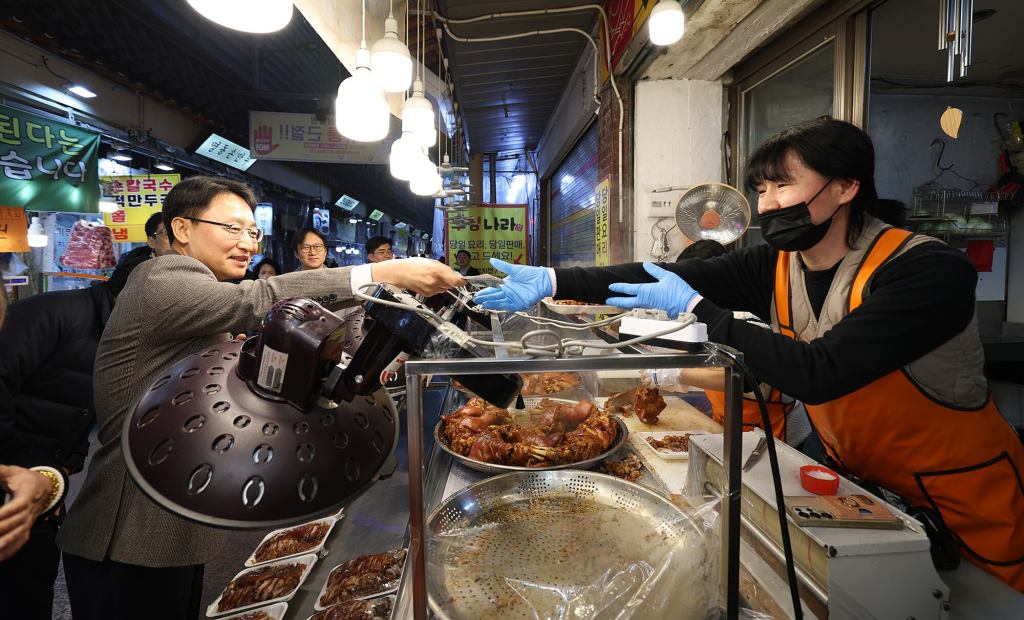
Beginning this year, small business owners facing a significant drop in sales will be able to postpone paying value-added tax for an additional two months and will get tax refunds up to 12 days sooner. Merchants operating in traditional markets can now benefit from simplified taxation according to their real sales volume, irrespective of their location, and the pressure from tax inspections will be greatly lessened.
◇ Automatic Extension of the Payment Deadline if Sales Decrease by 30%
Initially, the National Tax Service chose to automatically extend the tax payment deadline for small business owners encountering operational challenges. The eligible businesses are those in manufacturing, construction, wholesale/retail, food, accommodation, transportation, and service sectors with 2024 sales of up to 1 billion South Korean won, and whose sales in the first half of the previous year dropped by over 30% compared to the same period in the prior year. These business owners will be granted a two-month extension for paying value-added tax and comprehensive income tax without needing to apply separately. This initiative is intended to avoid scenarios where store operations are disrupted due to immediate tax obligations.
The National Tax Service has broadened the use of simplified tax procedures for vendors in traditional markets. In the past, certain traditional markets located in city areas were marked as ‘zones excluded from simplified taxation,’ resulting in situations where merchants were categorized as regular taxpayers even though their sales were minimal. The National Tax Service has chosen to revise the system so that small vendors operating within traditional markets can benefit from simplified taxation based on their actual sales, shop size, and customer count instead of their location.
◇ Prompt Refund and Incentive Payments to Alleviate Cash Flow Pressures
The National Tax Service intends to issue value-added tax refunds up to 10–12 days ahead of the scheduled date in order to enhance the cash flow for small business owners. This decision is made on the basis that receiving refunds a few days earlier—especially those resulting from overpayments—can significantly assist small business owners who are experiencing operational challenges. Additionally, the National Tax Service aims to streamline the review process for work and child-related incentives, enabling payments to be issued more than a month earlier than the legally mandated date.
The condition for collateral in relation to deferring tax payments will also be eased. Entrepreneurs with lower sales can delay tax payments as much as 100 million Korean won without needing any collateral. The objective is to lessen the pressure of offering guarantees or utilizing real estate as security to postpone tax obligations.
Temporary suspension of tax audits and review of reported information for small business owners will be implemented. Small business owners with sales below 1 billion South Korean won will be exempt from standard tax audits, and generally, their reported information will not be reviewed. Nevertheless, obvious instances of tax fraud will remain subject to scrutiny. The National Tax Service intends to create a ‘special tax assistance team for small business owners’ at every tax office to consistently receive and resolve merchants’ concerns.
Furthermore, a 22% tax on reemployment support funds received by owners of closed small businesses will be waived, with previously collected taxes being reimbursed. The charge for paying taxes via credit card will be lowered for the first time in seven years, reducing the fee for value-added tax and comprehensive income tax to approximately half of the previous rate. For small taxpayers experiencing financial challenges, the requirement to pay taxes will be exempted, and the seizure of used cars or small accounts that are not profitable will be removed boldly.




 jasdooit
Leave a comment