
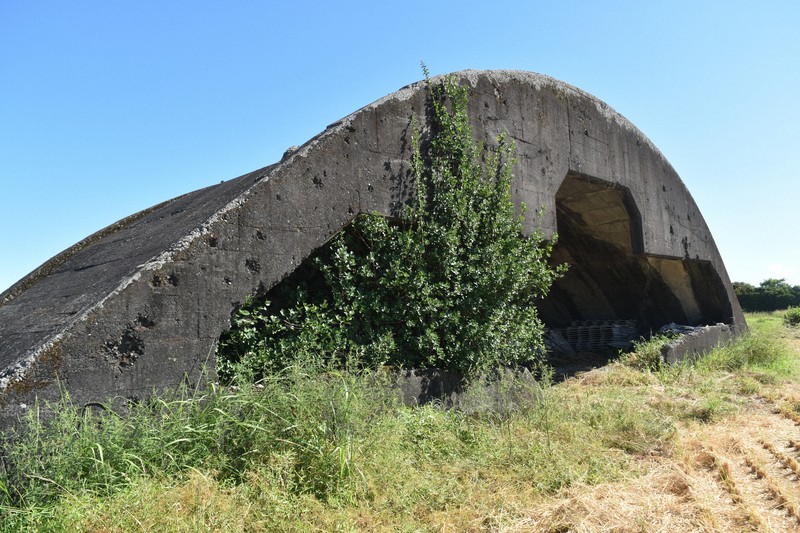
NANKOKU, Kochi — The leader of the Kochi prefectural association of retired teachers claims that the once-hated “entai” concrete bunkers constructed here during World War II to safeguard military planes should be maintained as “a fortress of peace.”
War-related relics are found across the region near Kochi Ryoma Airport in Nankoku city, serving as the air entrance to Kochi Prefecture. These consist of dome-shaped shelters constructed to safeguard aircraft from the former Kochi naval air force against attacks. To contemplate the significance of peace 80 years after World War II, this Mainichi Shimbun reporter visited the Maehama entai bunkers, a historical location in the city where seven surviving shelters can be seen.
As per the Nankoku Municipal Board of Education, 41 bunkers were constructed along the airfield’s guidance lines between 1941 and the conclusion of World War II in 1945. Individuals such as farmers, junior high school students who were required to participate in labor service, and prisoners from Kochi Prison were gathered to construct these structures following the plans of the Imperial Japanese military. Due to this, farmlands that had been handed down through generations are said to have been destroyed.
Seven bunkers that were not destroyed following the war are all located within a 500-meter distance from the Maehama Disaster Prevention Community Center in the town.
One especially notable structure is the No. 1 entai bunker. Approximately 60 bullet marks of different sizes are still visible on its walls, illustrating the brutality of war. Unlike the other six shelters, which are oriented east or south toward the sea, the No. 1 bunker is the only one facing west toward the mountains. Plants were placed on top of all the shelters to provide concealment and avoid detection from the air, yet the No. 1 bunker was spotted by fighter planes and endured heavy machine-gun attacks. The aircraft inside were harmed, but no fatalities occurred since individuals had likely left after receiving an air raid alert.
Among the seven, the No. 5 entai bunker is accessible to visitors since the Nankoku Municipal Government, which oversees it, has transformed the location into a park and utilizes it for peace education purposes. The No. 4 bunker nearby is bigger than the rest, with dimensions of 44 meters in width, 23 meters in depth, and 8.5 meters in height. It was constructed to accommodate large twin-engine aircraft and is one of the largest remaining entai shelters in Japan.
After crossing a prefectural road from that location, the No. 7 bunker becomes visible near the municipal Ominato Elementary School. Unlike other bunkers, a road and a canal pass through it, creating a tunnel-like look.
Initially, this site served as a vital community road and irrigation channel for the local residents. When the construction plan was revealed, farmers implored the Imperial Japanese military, arguing that constructing the shelter would obstruct the water flow and render rice farming impossible, but their requests were dismissed. Following the end of WWII, the farmers broke through the rear wall to restore the waterway and their usual path. This event was previously explained by Shinji Fujimoto, 93, chairman of the prefectural retired teachers’ association, who mentioned he participated in the construction of the No. 7 bunker.
“The shelters were merely symbols of resentment,” Fujimoto remembered thinking. To construct the airfield, 263 homes and roughly 1,500 residents were compelled to move, leading to the disappearance of Mishima Village. “Shiragiku” training planes from the Kochi naval air squadron were integrated into the kamikaze suicide squads, resulting in the deaths of 52 young individuals.
“When we, the generation that has experienced the war, are no longer here, these shelters will need to convey our message. I wish for them to be kept for coming generations as a symbol of peace,” Fujimoto stated.
(Japanese original by Kazuo Namekata, Chief of the Kochi Bureau)




 jasdooit
Leave a comment