
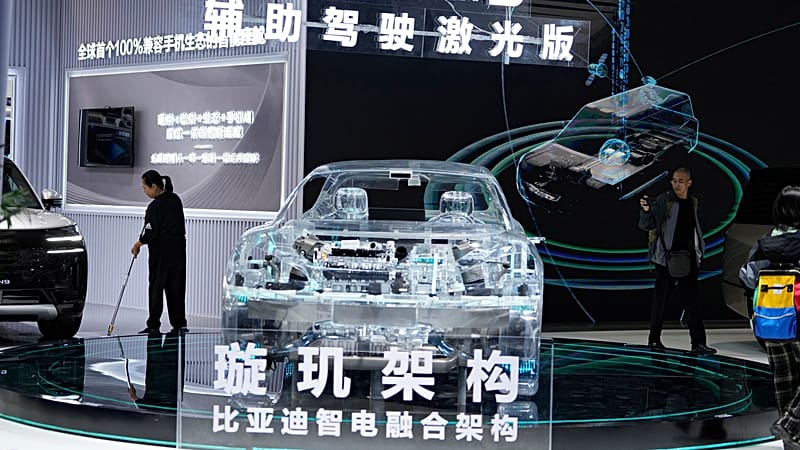
The European Commission and the Chinese government have revealed a new move to address the ongoing conflict regarding battery electric vehicles (BEVs) produced in China, which Brussels imposed duties on to counter the impact of Beijing’s significant financial support.
As the taxes were implementedin October 2024, both parties have been discussing a plan where Chinese manufacturers would agree to increase the price of their electric vehicles to promote more equitable competition with European brands.
Following several months of discussions, the Commission released on Monday a directive that enables Chinese manufacturers to present fresh proposals for price commitments, along with details regarding “future investments” within the region.
The applications will undergo a detailed internal review before any additional actions can be pursued, the executive stated briefly.press release.
“Every price commitment proposal is subject to the same legal standards, and the European Commission will evaluate each one in an impartial and equitable way, adhering to the principle of non-discrimination and following WTO regulations,” it stated.
The Chinese Ministry of Commerce, which has consistently criticized the EU tariffs as excessive, unwarranted, and fabricated, expressed a more positive view, describing the guidelines as a significant advancement.
“The advancement clearly embodies the spirit of dialogue and the results from discussions between China and the EU. It demonstrates that both China and the EU possess the capability and desire to appropriately address disagreements through consultation,” it stated.
This contributes not only to fostering the healthy growth of China-EU economic and trade relations, but also to protecting the rule-based international trade system.
BYD, Geely, and SAIC are some of the Chinese automakers currently facing additional taxes when exporting their electric vehicles to Europe. These taxes differ depending on the brand and are in addition to the 10% standard rate.
If the Commission were to accept a price commitment from a producer, the related duty would be removed. Nevertheless, approval is not certain: Brussels has indicated that any plan would need to effectively counteract the impact of the subsidies, which are seen as complex and widespread throughout the sector.
We have released this guidance because, in December, the first significant proposal for a price commitment was made,” said a Commission representative, adding that the offer pertained to one particular model. “Let’s all take a step back. This is currently just guidance. That’s all.
The controversy surrounding BEVs reshaped EU-China relations in 2024, as member nations were deeply divided on the tariffs amid Beijing’s threatening responses.
In an unusual instance, Germany, which maintains strong connections with the Chinese market in its automotive sector, was overruled when the final decision was presented.
Previously, the Commission presented a compelling argument in support of the tariffs, stating that without decisive measures, EU automakers faced the possibility of experiencing irreversible and unmanageable losses, potentially leading them to exit the competition for net-zero transportation, resulting in severe impacts on 2.5 million direct and 10.3 million indirect jobs throughout the region.
Nevertheless, Chinese battery electric vehicles have kept increasing their market share throughout Europe and worldwide, with BYDrecently overtakingTesla as the top brand.



 jasdooit
Leave a comment