
The announcement that the government is moving forward with the Yoon Suk-yeol administration’s initial plan to build two new large nuclear reactors is a significant comfort. It is impractical to believe that solar and wind energy alone can fulfill the substantial power needs of the AI sector without additional nuclear reactors. Nuclear, solar, wind, and gas each play unique roles. The matter is not about one being better than the other. Roads must support not only private vehicles but also buses and trucks. Private cars and trucks serve different functions; at times one is required, at other times the other. Solar and wind have their respective roles, and nuclear power has its own.
During a debate organized by the Ministry of Climate, Energy and Environment regarding the continuation of new nuclear reactor projects, Minister Kim Sung-whan mentioned, “South Korea holds the highest number of nuclear reactors per square unit.” KAIST Professor Jung Yong-hoon responded, “Is there anything where South Korea isn’t the most concentrated?” He pointed out that South Korea has the second-highest solar density in the world, following the Netherlands. Opponents of nuclear energy have highlighted that South Korea’s share of renewable energy is the smallest among OECD nations. According to a 2024 IEEFA report, South Korea’s renewable energy percentage (9.64% in 2023, covering solar, wind, hydro, and bioenergy) significantly trails the OECD average (33.49%) and the global average (30.25%). It seems unusual that South Korea has one of the highest solar densities globally.
Studies showed that IRENA’s 2023 global renewable energy data indicated South Korea’s solar capacity stood at 26.7GW. Within the OECD, only the United States, Germany, Japan, Spain, Italy, and Australia had higher solar capacity. However, when measured by density (per 100,000 square kilometers), the rankings changed. The Netherlands topped with 71.2GW, followed by Belgium (31.8GW) and South Korea (27.4GW). Even China, the world’s biggest solar market (887GW), ranked much lower in terms of density (9.45GW per 100,000 square kilometers). South Korea is already among the top performers globally in solar density relative to land area.
The same IEEFA report featured 2023 “clean power ratio” data, which incorporates nuclear energy along with renewable sources. South Korea’s clean power ratio stood at 40.32%, marginally higher than the global average of 39.36% but lower than the OECD average of 49.96%. Although South Korea’s share of solar and wind energy is relatively small, there is no basis for feeling inferior when nuclear power is considered part of clean energy.
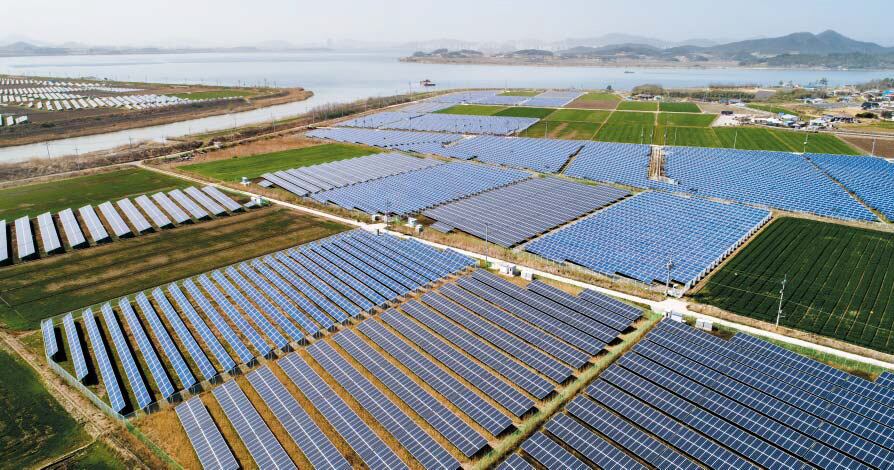
The Ministry of Climate, Energy and Environment plans to increase renewable energy infrastructure to 100GW by 2030, with 87GW coming from solar sources. This means adding more than 50GW of solar capacity within five years. To match the size of the Haenam Solaseado complex (0.098GW, completed in 2020), 500 similar facilities would be required. Using the complex’s area (1.58 square kilometers, about 480,000 pyeong), a total of 790 square kilometers (237 million pyeong, 1.3 times the size of Seoul) would be needed. If efficiency improvements reduce the required space to 500 square kilometers, South Korea would still need to install solar panels equivalent to 40 soccer fields every day for 1,825 days—or fill Yeouido Island every ten days. However, the actual electricity produced by 50GW of solar (with a 15% utilization rate) could be matched by six 1.4GW nuclear reactors designed in South Korea (with an 85% utilization rate) at one new nuclear power plant.
This should not be understood as opposing solar power. Solar energy offers numerous benefits: it is safe, environmentally friendly, and flexible. It can be set up on balconies, rooftops, parking areas, and reservoirs, providing exceptional scalability. I believe in expanding solar installations as much as possible. However, the issue lies with South Korea’s geographical constraints. With 63% of the land being mountainous, there is limited available space. Many suitable locations are already in use. Although the “100” target sounds clean and attractive, reaching 100GW of renewable energy within five years is impractical. This is why South Korea needs to implement an “energy mix” approach, utilizing all forms of power generation—nuclear, gas, solar, and wind—to fulfill its energy requirements.




 jasdooit
Leave a comment