
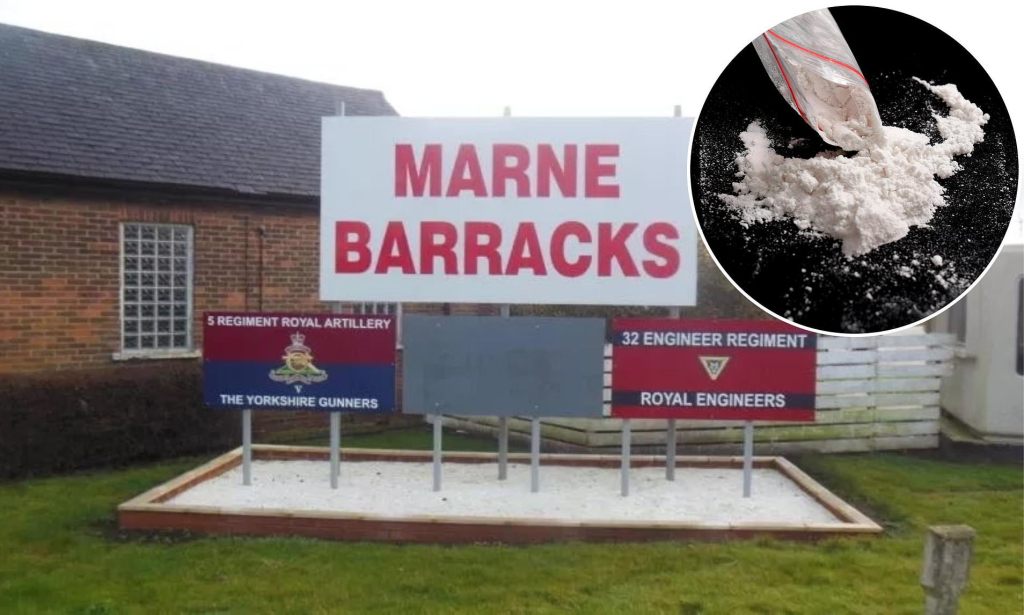
Over 20 troops belonging to the same unit have been apprehendedusing cocaine during one of the most significant drug indulgences in the Army’s recent history, the Daily Mail has uncovered.
Soldiers from the 32nd Engineer Regiment did not pass a Mandatory Drug Test (CDT) organized by their commanding officer, following claims of drug dealers being present in their base.
However, in a shift from earlier Army policies that focused on strict measures against drug users, some soldiers will be informed about the risks of substance abuse instead of being given their deployment orders.
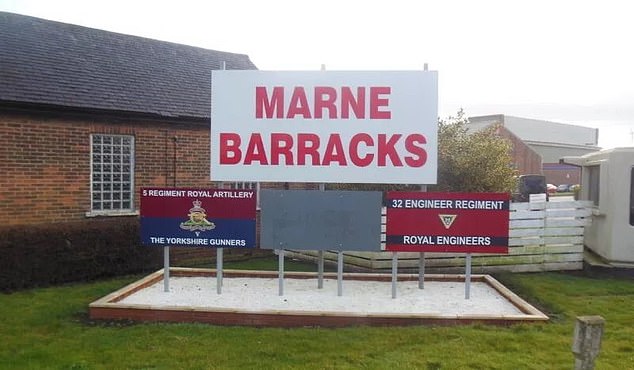
Last night, embarrassed military officials verified the tests carried out at Marne Barracks, Catterick Garrison in North Yorkshire.
The 32 Engineer Regiment offers direct engineering assistance to the combat unit of the 7 Light Mechanised Brigade and is coordinated with theNato Very High Readiness Joint Task Force.
The Emergency Response Unit is expected to support any British forces sent to Ukraine following a truce with Russia.
Established in 1948, the unit’s capabilities encompass scouting, building, and deploying temporary bridges that allow soldiers and vehicles to cross barriers like rivers or gullies.
Its troops, historically referred to as ‘Sappers’, also operate 33-tonne Terrier armored combat tractors capable of reaching a maximum speed of 40mph.

Earlier missions have involved Iraq and the Balkans.
On Wednesday, a representative from the Royal Engineers stated: “There was a Boxing Day celebration before Christmas, and many of the team members became quite rowdy. They’re young, foolish, and inexperienced. No senior members were involved.”
The authorities need to eliminate the drug culture. It’s incredibly easy to obtain cocaine at major bases in the UK, which is absurd.
It is expected that the majority of the 23 soldiers will be removed, but some will be offered another opportunity.
According to official Army guidelines, soldiers are required to adhere to certain standards.caught taking drugsshould anticipate being released. However, this is not always true.
The military must adopt a practical strategy for addressing drug use among soldiers, taking into account their prior contact with illegal drugs before joining and during social interactions.
Commanding Officers have the authority to keep soldiers in service when there are extenuating factors, such as youth, lack of experience, and if it is their initial offense.
On Wednesday, former high-ranking officer Colonel Hamish de Bretton-Gordon acknowledged the importance of practicality rather than theoretical thinking.
He said to the Daily Mail, “We likely need to view this from a 2026 perspective. Losing more than 20 soldiers would be a catastrophe, and we can’t afford such losses.”
Perhaps two strikes and you’re out is plausible, given the prevalence of drug use in society. We definitely need to maintain well-trained soldiers, particularly in light of the threat from Russia.
After a decrease in activity as soldiers came back from Afghanistan, the Army took a more rigid approach to dismissing individuals who used drugs.
The trend reached its highest point in 2019, with 660 soldiers—equivalent to a full battalion—being dismissed following positive results for illegal drugs, primarily cocaine.
The number increased from 630 dismissals in 2018 to 580 in 2017.
The use of drugs and drug testing subsequently decreased during the Covid lockdown periods.
Currently, it is believed that the Army dismisses approximately 500 soldiers each year due to failing CDTs.
On Wednesday, a military representative stated: ‘Drug use is not tolerated within the Army. We strictly implement a zero-tolerance approach towards substance abuse for everyone serving and offer an educational initiative to make all personnel aware of the risks and impacts.’
Several soldiers from the 32 Engineer Regiment recently did not pass a Mandatory Drug Test. Since this issue is under investigation, it would be improper to provide additional comments.
- Might the sharp increase in stress among UK soldiers be contributing to a disturbing surge in drug consumption among their ranks?
- How severe is the situation where overweight soldiers exceed the number of those discharged due to drug issues in the British Army?
- What occurred to the soldiers part of a £100,000 drug trafficking operation, and what was the progression of their sentencing in court?
- Why are anxious military leaders turning to expensive obesity medications to ensure soldiers are battle-ready?
- Is the UK Army experiencing a problem with almost a quarter of its troops unable to be sent on duty?

 jasdooit
Leave a comment