
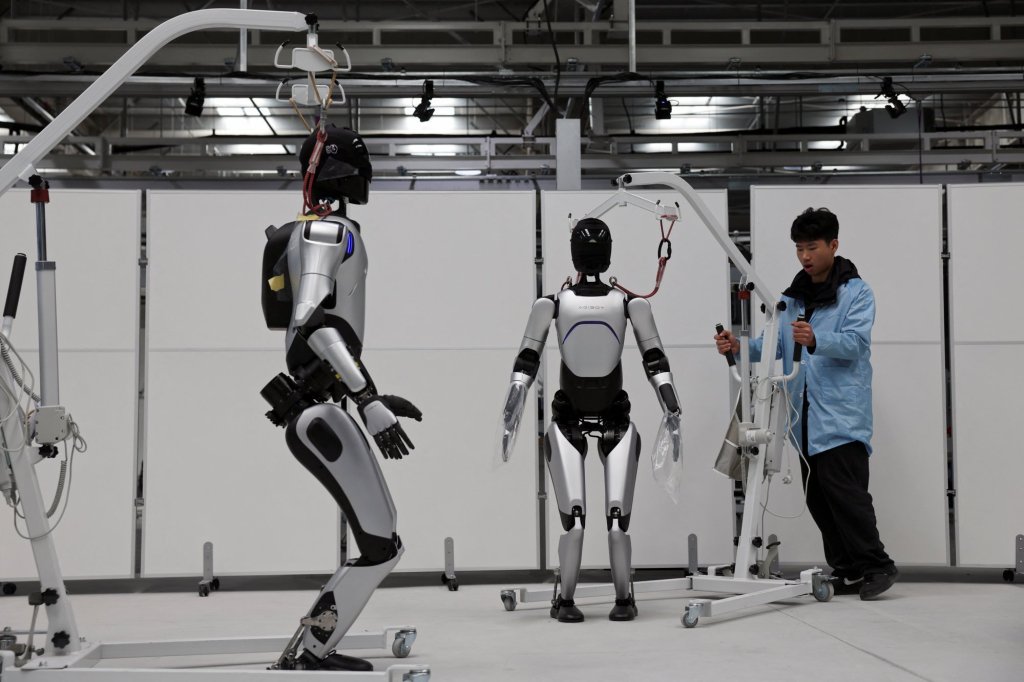
AgiBot and Unitree contribute to China’s dominance in global deployments in 2025, according to a report predicting the market will grow sixfold by 2027.
More than four out of five were from Chinahumanoid robot installationsIn 2025, worldwide, fueled by local startups AgiBot and Unitree Robotics, mass production and commercialization sped up, as per a report from Counterpoint Research.
A total of 16,000 human-like robots were deployed worldwide in 2025, primarily for data gathering and study, as well as in the logistics, manufacturing, andautomotive sectors, as per Counterpoint data published on Wednesday.
The market is expected to surpass 100,000 units by 2027, representing a sixfold increase from 2025, withsupply chain, production, and vehicle industry applicationsexpected to account for 72 percent of all installations, the research firm stated.
Are you curious about the most significant issues and developments from across the globe? Find the solutions withSCMP Knowledge, our latest platform offering carefully selected content including explainers, FAQs, analyses, and infographics, presented by our acclaimed team.
“Over the next two years, more human-like business ventures will begin to commercialize the mass-produced versions of robots, and their effectiveness will significantly influence the growth rate of the entire sector,” Counterpoint stated.
AgiBot, based in Shanghai, dominated the market with a 30.4 per cent share of global installations in 2025, closely followed by Unitree from Hangzhou with 26.4 per cent.
AgiBot’s wide array of products and its open-source approach facilitated commercial adoption in multiple industries, according to Counterpoint, while Unitree attracted interest due to its skills in dynamic movement and stability control.
Third and fourth places were taken by Shenzhen-based companies UBTech Robotics and Leju Robotics, with market shares of 5.2 per cent and 4.9 per cent respectively.Elon Musk‘s Teslawas fifth with 4.7 percent as the manufacturing of Optimus Gen 2 and Gen 2.5 increased.
The Counterpoint report echoed earlier findings by Omdia, which placed AgiBot and Unitree at the top in terms of shipment volumes.
China’s human-like robot industry has experienced significant growth in recent years, backed by robust government assistance, although the National Development and Reform Commission, the nation’s economic planning body, has cautioned againstthe dangers of over-repetition in November.
Companies have increased their commercialization initiatives due to rising competition and established collaborations with the wider manufacturing sector to facilitate the extensive use of robots in factory environments.
Counterpoint mentioned that certain robotic companies are entering the home market with more cost-effective options thatprioritise interaction over performing complex tasks.
“A significant opportunity exists within various home situations, and companies would not want to overlook it,” the report stated.
Robot leasing, led by AgiBot and Unitree, has also become popular as it reduced the cost of ownership and promoted usage in areas like live performances, according to Counterpoint.
More Articles from SCMP
This piece was first published in the South China Morning Post (www.scmp.com), a top news outlet covering China and Asia.
Copyright (c) 2026. South China Morning Post Publishers Ltd. All rights reserved.




 jasdooit
Leave a comment