
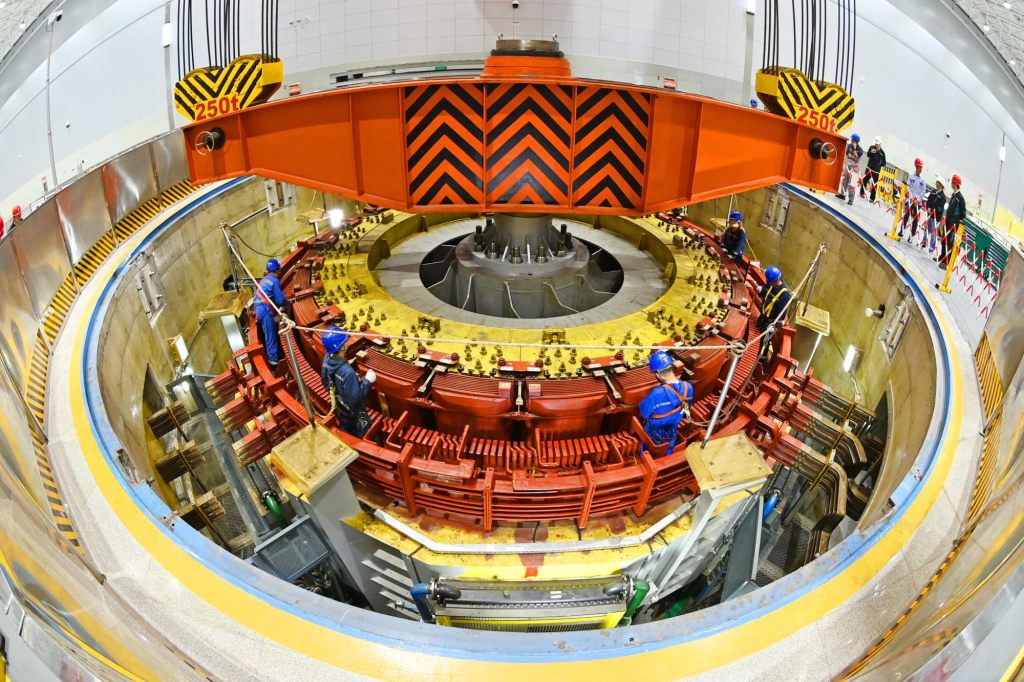
The utility’s five-year strategy to upgrade power networks and increase renewable energy sources is boosting electricity equipment manufacturers, as rising AI demand fuels energy expansion.
Chinese electricity and grid equipment stocks rose following State Grid’s announcement of a 4 trillion yuan (US$574 billion) initiative to modernize the nation’s power infrastructure, as increasing demand and the worldwide competition in artificial intelligence fuel investments inenergy infrastructure.
The manufacturers of Transformers, Sieyuan Electric and Shanghai Guangdian Electric, activated the trading halt protocol following a 10 percent increase on Friday morning. At least 11 companies listed on the mainland saw gains of 10 percent or more in the morning session before falling in the afternoon. This contrasted with the CSI 300 Index, which declined by 0.41 percent.
The State Grid, the biggest utility in China and globally, stated on Thursday that it plans to increase its effortsinvestment in infrastructurewithin the next five years up to 2030, representing a 40 percent rise compared to the previous five-year span and setting a new high for the state-funded major player.
Are you curious about the most significant issues and developments happening globally? Find the solutions withSCMP Knowledge, our latest platform offering handpicked content including explainers, FAQs, analyses, and infographics, presented by our acclaimed team.
The money would be allocated toward creating a “new kind of power system,” with goals such as incorporating 200 million kilowatts of renewable energy capacity each year and raising the proportion of non-fossil fuel consumption to 25 percent by 2030, according to State Grid. The company manages electricity use for 1.1 billion people across 88 percent of China’s land area.
Major investments would focus on China’s western areas, where there was an excess of power generation but a lack of infrastructure to transport the energy, as stated by Huatai Securities.
The investment in non-ultra high voltage grids is anticipated to increase rapidly,” stated Liu Jun, an analyst at the brokerage. “It is evident that the underdeveloped power grids in the western region require improvement within the context of establishing a unified national power market.
The western part of China is also home todata centresconstructed by leading technology companies such as Huawei Technologies, Tencent Holdings, and Alibaba Group Holding as part of a national initiative launched in 2022, which moves data produced by businesses on the eastern coast to the resource-abundant west for processing and storage.
“State Grid’s investments have exceeded market expectations and are expected to aid China in maintaining its advantage over the United States in power supply,” said Pierre Lau Hin-tat, China equity strategist at Citigroup Global Markets.
The significant funding arrives as theworld grapplesdue to the massive energy demands of AI. The International Energy Agency projected that between 2024 and 2030, China’s data centers would use 170 per cent more electricity, while the US’s consumption would rise by 130 per cent, with both nations contributing almost 80 per cent of the worldwide increase.
However, China and the United States – the world’stwo AI powerhouses– have entirely different scenarios. China leads all nations with a third of the world’s electricity production volume because of strong governmental strategies, whereas the US is dealing with a growing energy shortage, leading tech companies from Google to Meta to purchase energy assets to ensure supply for training their AI models.
The gap in renewable energyis also expanding. In 2025, China was anticipated to increase its average renewable power generation by approximately 97 gigawatts (GW), which exceeded ten times the expected 9.6GW addition from the US, as reported in a study published in the journal RSC Sustainability in December.
In addition, China Southern Power Grid, which provides electricity to five southern provinces such as Guangdong and Hainan, announced last week that it plans to invest over 2.4 billion yuan in grid infrastructure during the first quarter of the year, representing an increase of more than 20 percent compared to the previous year.
The investments reflect guidelines from the National Development and Reform Commission and the National Energy Administration that urge improvements to current networks and the development of anext-generation power system.
In November, UBS forecasted that China’s electricity consumption by AI data centers would grow at an annual rate of 2.3 per cent between 2028 and 2030, supporting the 12 per cent annual increase in the nation’s power investment under the new five-year plan.
More Articles from SCMP
Standard Chartered Hong Kong Marathon: A group of five North Koreans invited as participants
Residents of Cebu in the Philippines complain about increasing waste and health dangers
This piece was first published in the South China Morning Post (www.scmp.com), a top news outlet covering China and Asia.
Copyright (c) 2026. South China Morning Post Publishers Ltd. All rights reserved.




 jasdooit
Leave a comment