
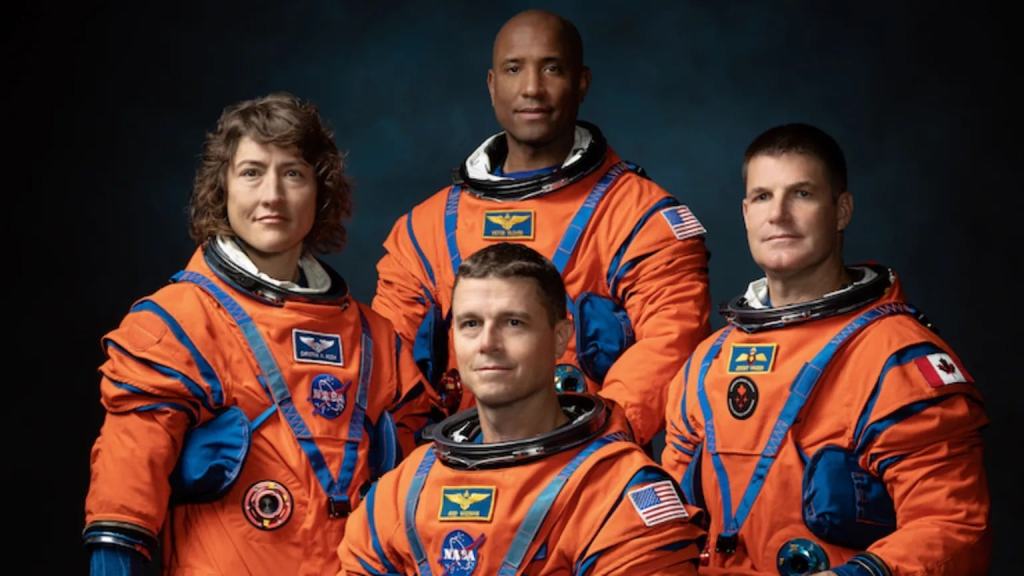
The National Aeronautics and Space Administration (NASA) is set to send a manned spacecraft on a lunar mission as early as the first week of February, according to BBC. This will be the first crewed lunar launch in 50 years, signifying humanity’s return to the Moon for the first time since the Apollo missions of the 1960s and 1970s.
◇Lunar Manned Probe Set to Launch as Early as February 6
As reported by international media, NASA intends to send the Artemis II mission into space as early as the first week of February. Potential launch dates in February are scheduled for the 6th, 7th, 8th, 10th, and 11th. Additional backup dates have been set for March and April in case of any postponements or issues.
In preparation, NASA intends to start relocating the Space Launch System (SLS) and Orion spacecraft from the assembly facility to the launch site as early as the 17th. This movement will be carried out using a unique vehicle known as the crawler-transporter-2. Because of the high level of care required, the roughly 4-mile (6.4 km) trip may last up to 12 hours.
In late January, NASA is scheduled to carry out the Wet Dress Rehearsal (WDR). Much like a theater rehearsal that checks lighting, costumes, and sound before the main performance, this process includes a full countdown simulation, along with fueling tests, just before the actual launch. South Korea’s Nuri rocket, which managed to successfully launch on its fourth try in late November last year, also performed a WDR exercise two months before its launch.
If problems occur during the WDR, NASA might bring the SLS and Orion back to the assembly building for further modifications. If all systems are functioning properly, the earliest possible launch date would be February 6. Nevertheless, factors like the rocket’s flight path and the Moon’s location might influence the timeline.
◇Four Space Explorers Set for Lunar Mission After Half a Century
The Artemis II mission will include four crew members: Commander Reid Wiseman, Victor Glover, and Christina Koch from NASA, along with Jeremy Hansen from the Canadian Space Agency. Should it succeed, Victor Glover will make history as the first Black astronaut to reach the Moon, while Christina Koch will be the first woman to do so. Jeremy Hansen will also be the first Canadian and the first non-U.S. citizen to travel to the Moon.
The 10-day expedition seeks to explore the most distant parts of deep space that humans have ever reached. The crew will send information and pictures gathered while in lunar orbit to Earth. They will reside in a compact microgravity module throughout the mission and land in the Pacific Ocean near the U.S. West Coast after 10 days.
The final manned mission to the Moon was Apollo 17, which touched down on the lunar surface in December 1972. As stated by NASA, 24 astronauts have ventured to the Moon, with 12 of them stepping onto its terrain.
◇Next Mission to the Moon… Targeting the Lunar South Pole
Artemis II will not involve a Moon landing. A mission to land on the lunar surface is scheduled for Artemis III, with a planned launch around 2028. NASA has yet to decide on the lander, which will be either SpaceX’s Starship or Blue Origin’s proposal. The U.S. company Axiom will supply new space suits.
Artemis III intends to reach the Moon’s south pole, an area that has never been explored before. The objective is to create “sustainable human presence on the Moon.” NASA also intends to construct a small space station in lunar orbit via Artemis IV and V, involving additional nations and a variety of participants.
◇Are Other Nations Planning to Send Astronauts to the Moon?
In addition to the U.S., numerous countries are working towards sending humans to the Moon by approximately 2030. China is creating its own spacecraft with the goal of landing on the lunar south pole by 2030. Russia has announced intentions to send cosmonauts to the Moon and establish a small base between 2030 and 2035. India aims for a manned lunar mission around 2040, building upon the success of Chandrayaan-3’s landing near the south pole in August 2023.
Several nations are becoming involved in the Artemis program. Japan has already secured a spot for Artemis IV and V.




 jasdooit
Leave a comment