
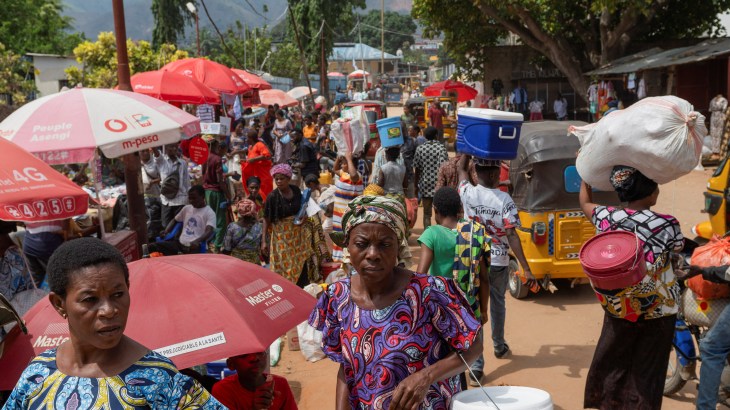
Reports of looting, gunfire, and the displacement of civilians were documented in Uvira city, located in eastern DR Congo, after the departure of the AFC/M23 movement, with alarming images and videos being shared on social media platforms. ALSO READ: AFC/M23’s Bertrand Bisimwa explains the reasons behind the rebels’ capture of Uvira in a rapid advance. Videos posted on social media on Sunday, January 18, depicted frightened civilians running through the city center while continuous gunshots echoed. In one video, a person recording can be heard shouting, “These are Wazalendo, they have entered,” as residents, believed to be Banyamulenge, run in different directions seeking safety. Additional footage showed groups of young men in civilian attire, identified by locals as Wazalendo militia members, entering buildings and taking belongings. Among the affected locations was the 37ème CADC Church, communauté des Assemblées de Dieu au Congo, a Banyamulenge religious site in Kimanga, where chairs, timber, iron sheets, and other materials were taken, with parts of the roof removed. The church is led by pastors including Budederi Bigabo, who, according to later reports, was abducted from his home along with his wife hours after the looting. Their current location remains unknown. ALSO READ: Goma: Thousands protest against AFC/M23’s withdrawal from Uvira The Wazalendo militia is aligned with the Congolese armed forces (FARDC), alongside Burundian troops, the Congolese-backed Rwandan genocidal militia FDLR, mercenaries, Mai Mai groups, and other local militias. They are returning to Uvira just days after AFC/M23 announced on January 15 that they had left the city. The city had been captured by the rebels on December 10. ALSO READ: Nangaa asks UN to deploy a neutral force to Uvira The AFC/M23 began withdrawing from the city on December 17, describing the move as a confidence-building measure aimed at supporting the Doha Peace Process and paving the way for a lasting resolution to the conflict in eastern DR Congo. The final phase of the withdrawal was formally communicated to United Nations Secretary-General Antonio Guterres by the movement’s political coordinator, Corneille Nangaa, who called for the urgent deployment of a neutral force to prevent retaliation against civilians. In a statement posted on X, the movement attributed the chaotic situation in Uvira to “the madness of the Kinshasa regime, through its criminal militias Wazalendo, Mai Mai and FDLR.” UVIRA, QUAND LA PAIX SE RETIRE ET QUE LA PEUR ET LE DÉSORDRE REVIENNENT PAR LES HOMMES DE TSHILOMBO Uvira mourns. Not in the noise of political speeches, but under the gunfire of men of Félix Tshilombo who, today, have broken families, pillaged… pic.twitter.com/gwCnQGnwBX — AFC-Alliance Fleuve Congo (@afcongo) January 18, 2026 The movement stated it had officially placed Uvira under the responsibility of the international community as an act of political responsibility intended to protect civilians and strengthen the Doha peace efforts. “This gesture was meant as a signal of good faith, a bet on the protection of civilians, on the hope of the Doha peace processes, on the ceasefire and lasting peace,” the statement said, adding that the calm experienced during its presence in the city was abruptly disrupted after its withdrawal. The AFC/M23 warned about the return of the militias to Uvira. “Their entry into the city did not bring order, but fear. Not protection, but predation. Not peace, but violence,” the group said, citing forced shop openings, gunfire in residential areas, and terrified families fleeing their homes. Rebel leader Nangaa claimed the events unfolding confirmed warnings the movement had issued before its withdrawal. “What we feared has now become reality: score settling, looting of public and private property, manhunts, targeted killings, forced displacement of the Tutsi Banyamulenge community and others,” Nangaa wrote on X. He added that “chaos was predictable, and yet everyone had been warned,” noting that proposed accompanying measures were ignored. #UVIRA- Retrait de bonne foi de l’ AFC_M23 ! Ce que nous redoutions est désormais réalité : règlements de compte, pillages des biens publics et privés, chasse à l’homme, tueries ciblées, déplacements forcés de la communauté Tutsi #Banyamulenge et autres……. Le chaos était… pic.twitter.com/TajPE8lB0T — Corneille Nangaa (@CNangaa) January 18, 2026 Moise Nyarugabo, a former Congolese minister and senator, blamed international pressure on the rebels for the security vacuum that followed their pullout. In a post on X, Nyarugabo said AFC/M23 and Twirwaneho had fully withdrawn during the night of Saturday and early hours of Sunday, but no effective arrangements were made to prevent the violent militias from entering the city. “In pressuring and insisting, not to mention threatening, they (international community) did not consider the consequences, They did not prevent the Wazalendo or the FARDC from entering the city,” Nyarugabo wrote. “While there were no attacks against civilians or reprisals when AFC/M23 captured Uvira, just hours after this withdrawal, the Wazalendo returned to the city. What was feared has come to pass, and the international community was well warned.” Those who pressured the AFC/M23 and Twirwaneho to withdraw from Uvira succeeded. They have completely withdrawn during the last night and early this morning of Sunday, January 18, 2026. But in pressuring and insisting, not to mention threatening, they didn’t consider the… pic.twitter.com/hq0SFMCxvB — Me Moise Nyarugabo (@MoiseNyarugabo) January 18, 2026 He reported ongoing “systematic looting and malicious destruction” targeting Banyamulenge homes and churches, as well as public institutions including the High Court and state-owned companies. According to Nyarugabo, hundreds of Banyamulenge households have fled Uvira amid circulating death threats.
Provided by SyndiGate Media Inc.Syndigate.info).

 jasdooit
Leave a comment