
The Africa Cup of Nations, hosted by Morocco, was never just a standard sports event that could be defined by a score or a trophy, but rather a significant moment in a broader journey, representing a test of shared consciousness rather than a purely skill-based competition on the field.
Texts that limit the experience to the framework of victory and defeat are essentially incomplete, as they succumb to what might be referred to as event-focused reductionism: viewing significant occurrences as separate events rather than as parts of an extended historical and mental progression.
What the competition demonstrated is that a nation might not achieve every success on the field but can still attain more profound, long-lasting triumphs beyond it, triumphs that transform mental structures, alter perspectives, and create enduring forms of shared understanding.
In this context, the competition turned into a point of collective clarification, where symbolic authority, regional conflicts, story battles, data distortion, and the rise of a more sophisticated and robust public awareness all became clearly visible.
One of the most important results from this experience was the rise of a new political consciousness within many parts of Moroccan society: an increasing belief that what truly counts is not outside approval nor sentimental talk about solidarity, but clear national interests.
The competition significantly concluded what could be described as relational naivety, the belief that unity among nations is inherent and without conditions.
Reality once more showed that nations primarily act based on their own interests. This change caused the collective mindset to move away from an emotional view of the world toward a more practical comprehension of power dynamics.
Within this framework, the competition served as a means of revealing politically motivated speech. Phrases that were previously seen as signs of friendliness, like “brotherhood” ideas, fell apart under examination, showing they were actually instruments of symbolic control used by opponents when it suited them, typically to weaken unity from within.
During this process, the idea of “backroom fixing” slowly became part of public discussion in Morocco. Brought in from opposing stories, the term was eventually accepted and later became the usual reason given for any achievement.
Repetition turned it into a mindset that erodes self-confidence, persuading people that achievement must always be the result of hidden manipulation. What this experience demonstrated, however, is that success built on work, planning, and continuity requires no conspiratorial mythology to explain it.
At the same time, the campaign surrounding the competition was not uniform. It functioned through a deliberate distribution of responsibilities. Certain individuals disseminated complete lies, allegations, and uncertainties regarding the organization, credibility, and motives.
Some provided calm and polite statements that commended the event and recognized its achievements, using diplomatic wording. This shift between intensifying and holding back was not random but calculated: one party launched unbounded attacks, while the other appeared rational, bewildering the public and giving the impression that the truth was somewhere in the middle.
This reasoning became even clearer when psychological pressure was applied directly to the national team. The goal was never solely about achieving a technical victory but rather causing internal instability, weakening the players’ and coach’s confidence, questioning the integrity of the competition, and gradually reducing public trust through constant statements, media influence, and created tension before, during, and after games.
The objective was to undermine confidence, as a team that lacks self-belief does not require a strong rival to suffer defeat.
The tension persisted until the final whistle. The Senegalese team, led by a coach infamous for negative reasons, resorted to some of the most unsportsmanlike tactics: inflammatory remarks, constant pressure on officials, taking advantage of any situation that went against the spirit of fair play, and efforts to turn the match into disorder.
These strategies were adopted by parts of the fans who turned to violence and chaos, incidents that could have caused major disruption in the game if not for the well-organized and successful actions of Moroccan security personnel. At the same time, Moroccan public opinion grew more conscious of organized efforts that started with false information and minimization, then moved to boasting and ridiculing, using troll farms, expert online operators, fake identities, and misleading stories, all intended to disturb public discussion and weaken group self-esteem.
It would be an error, nevertheless, to dismiss or mock the opponent. The adversary is not naive, even if their language occasionally seems rough or inconsistent. What is being implemented is organized misinformation employing thoroughly recorded methods, such as the “firehose of falsehood” – saturating the information environment with quick, repeated, and diverse lies to overwhelm public understanding and confuse judgment.
This reality highlights the importance of identifying and addressing such attacks in a timely manner. Practical signs of misinformation consist of repeated messages with minor variations, a significant number of anonymous or recently created accounts, quick progression from discussion to personal attacks and distrust, and the lack of credible evidence. These behaviors are associated with what is referred to as coordinated inauthentic activity.
A proper reaction is not about emotional responses or random counterarguments, but about maintaining information hygiene: checking sources, placing statements in context, refusing to spread harmful content, and developing mental resilience by learning how misinformation operates before being affected by it.
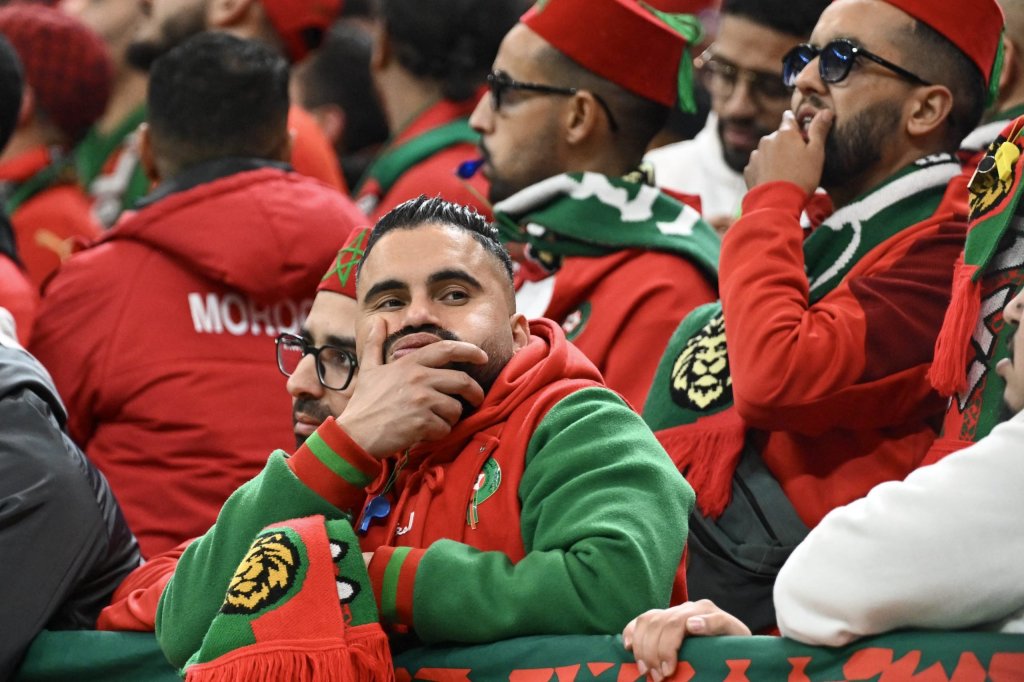
Amidst this complex pressure, a key element stood out as one of the tournament’s most significant achievements: the Moroccan audience.
Instead of using emotional manipulation to gain short-term backing from local communities, Moroccan fans support their team genuinely and without hesitation, wherever the team competes, motivated by deep-seated loyalty rather than artificial organization. Pride was shown not through intense feelings but through organized, aware attendance based on a prolonged national history.
On the field, athletes competed with a clear understanding of the significance of the national jersey and the duties it entails. This meeting between an aware public and a dedicated team turned stadiums into areas of symbolic support, enhancing identity and unity, and achieving a real moral triumph by fostering collective resilience against influence.
Morocco’s effective organization throughout the tournament reinforced its reputation as a dependable nation with significant organizational skills. However, achievements in national branding do not only inspire admiration; they can also lead to underlying jealousy. Progress that is noticeable and consistent often triggers opposition. The principle is straightforward: advancement tends to draw resistance.
On a more profound level, none of this can be grasped without acknowledging Morocco’s unique characteristics. Morocco is not a fleeting state or a government clinging to remnants and memories. It is an ancient country with a lengthy history of accomplishments, a thriving cultural heritage, and an unbroken historical lineage. In contrast to groups that only functioned as pathways for invading forces, Morocco maintained its essence and developed through accumulation, rather than disruption.
What Moroccans took away from this experience extends well beyond the realm of football. They developed a more sophisticated understanding, a clearer capacity to differentiate valid criticism from psychological tactics, and sports competition from symbolic attacks.
In a time when psychological combat overlaps with political struggles, the most profound success is achieving a society that is harder to influence, more self-assured, and clearer about its direction.
That triumph cannot be judged by medals, yet it is the factor that defines a country’s capacity to progress steadily towards long-term success.
The post Editorial: AFCON showed Morocco how true hostility functions appeared first on English – Morocco News.




 jasdooit
Leave a comment