
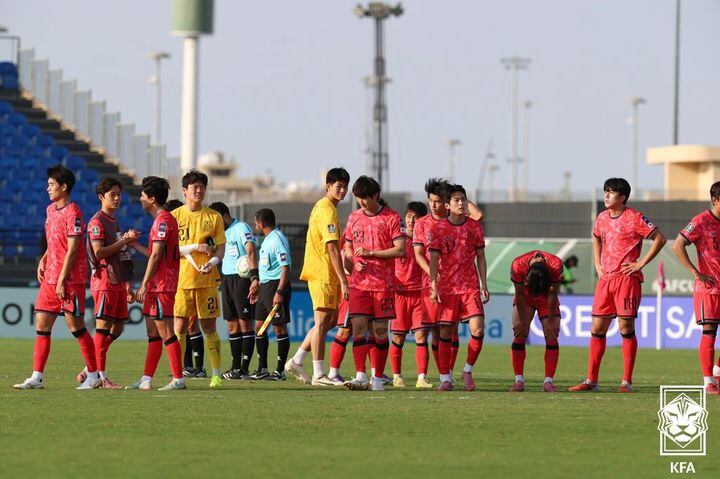
The U-23 national football team, managed by Lee Min-sung, suffered a 0-1 defeat against Japan in a dull performance during the semifinals of the 20th U-23 Asian Cup. The disappointing part of this outcome isn’t just that South Korea lost to Japan. It’s because, despite opting for the immediate benefit of military service exemptions rather than focusing on long-term development, the team didn’t show a level of play that justified that decision. This game highlighted the current state of South Korean football, which is behind Japan both in the present and the future.
Two years back, in early 2024, South Korea faced a significant setback by not qualifying for the Olympics for the first time in four decades following their elimination in the quarterfinals of the U-23 Asian Cup, which also acted as the qualifiers for the Paris Olympics. At that moment, former Manager Hwang Sun-hong, who had been in charge of the national team, highlighted, “Age-based national teams should concentrate on the Olympics and be managed on a four-year cycle.” Nevertheless, the Korea Football Association announced in June 2024 an enhancement strategy for age-specific national teams, mentioning, “We will get ready for the Asian Games using a central group of players for two years before shifting to an Olympic framework.” The association only mentioned assigning different coaches to handle under-23 and under-21 players, with no substantial changes compared to the current setup.
On the other hand, Japan has been utilizing under-21 players in the Asian Cup and Asian Games since 2022 with the aim of securing an Olympic gold medal. Their approach involves developing team cohesion over a four-year period with the same squad members before participating in the Olympics. During the Paris Olympics, where South Korea did not progress to the main competition, Japan showcased its perseverance by finishing first in its group and advancing to the quarterfinals.
The main reason South Korea doesn’t have a long-term development initiative similar to Japan’s is because of the military service exemptions granted to athletes. The emphasis is on allowing players to gain military benefits through an Asian Games gold medal, which is more attainable than an Olympic bronze. The association mentioned, “Considering local circumstances, an Asian Games gold medal is essential,” and noted, “It has served as a pathway for Son Heung-min, Kim Min-jae, and Lee Jae-sung to play abroad.”
Nevertheless, the national team’s performance in this U-23 Asian Cup exposed a deep-seated crisis that would be challenging to resolve even at the Asian Games. The team displayed weaknesses in strategy, individual abilities, and coordination, suffering total losses against Uzbekistan and Japan, both of which consisted of under-21 players. Even with overseas-based players such as Yang Min-hyeok, Coventry, Bae Joon-ho, Stoke City, and Kim Ji-su, Kaiserslautern, winning a gold medal at the Asian Games is not assured. There is ongoing criticism that rather than employing specialized coaches dedicated to developing young talent, the team has depended on the ‘reputations’ of coaches like Hwang Sun-hong and Lee Min-sung.
The national team’s only remaining match is the third-place playoff against Vietnam, guided by Manager Kim Sang-sik, scheduled at midnight. Vietnam suffered a 0-3 loss to China in the semifinals. If they don’t beat Vietnam and conclude their performance strongly, it will significantly hinder the momentum for preparing for the Aichi Nagoya Asian Games in September this year.



 jasdooit
Leave a comment