
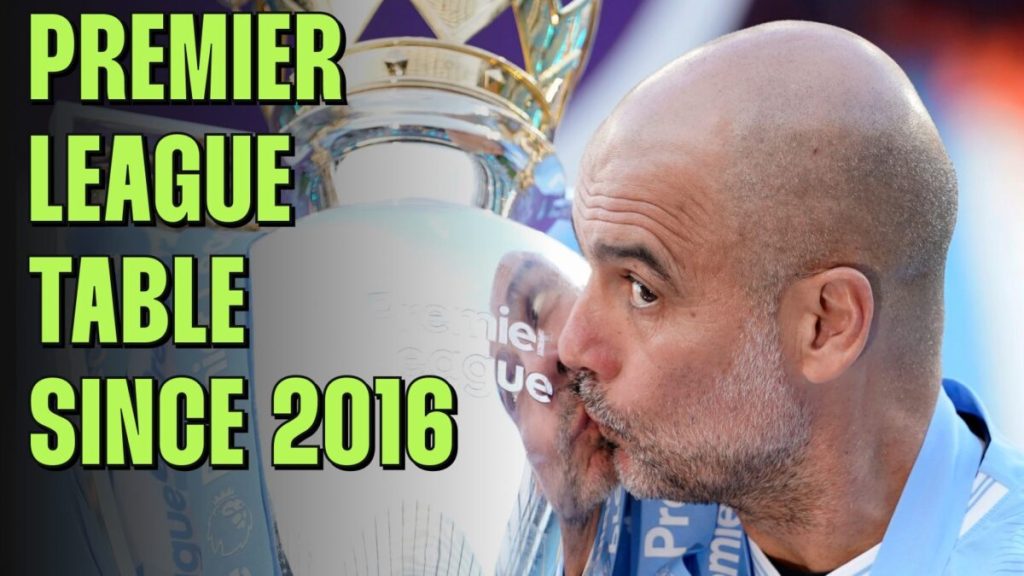
The year 2016 seems like a lifetime back, as the newest social media craze has brought to mind.
A decade later, Leicester’s league victory still feels almost unbelievable. Particularly considering how the established giants have made a comeback, while the Foxes are now fighting to stay in the middle of the Championship table.
But how does the English top division look when viewed from a broader perspective since that time? That’s precisely what we’ve done here, by creating a Premier League table starting from the beginning of the 2016-17 season.
Leicester secured the FA Cup and competed for a spot in the Champions League for several years during Brendan Rodgers’ tenure, so it hasn’t been entirely negative since their remarkable moment of winning the Premier League title with Andrea Bocelli in attendance.
They are currently ranked 12th in the standings since their championship victory, which isn’t too bad given that it includes two relegation periods and two spells in the Championship.
Only nine teams have remained in the top division across the last 10 seasons, with the usual ‘big six’ joined by Crystal Palace, Everton, and West Ham.
The top six teams are significantly leading the rest. Tottenham, positioned in sixth place, have accumulated over 100 more points across the last 10 seasons compared to Everton, who are in seventh.
Manchester City hold a strong advantage at the summit, and it’s also expected to see Liverpool far ahead of third-placed Arsenal.
This highlights the years of control where Pep Guardiola’s City and Jurgen Klopp’s Liverpool have been competing for the championship with consistent 90+ point totals.
A decade ago, Arsenal was still led by Arsene Wenger and went through their own challenging period, often finishing outside the top four and frequently trailing Tottenham, before their resurgence under Mikel Arteta. Now, they are in their fourth consecutive season in the top two, far ahead of their North London competitors.
Guardiola joined in the summer of 2016, and although the initial season was disappointing—without any trophies and finishing third—they have since experienced one of the most prosperous eras in the history of English football.
Six league championships in seven years are demonstrated by their impressive point total, having accumulated more than 200 points over the last 10 seasons compared to their city rivals, Manchester United.
Despite being somewhat unexpectedly the top among the rest, Everton have spent recent years hovering near the relegation zone, yet their seventh-place standing shows their steady performance. They managed to finish in the upper half of the table in four out of five seasons from 2016 to 2021.
Newcastle United and Aston Villa could be competing for a spot in the Champions League now, but this is a more recent situation. Their positions at eighth and thirteenth indicate periods they spent in the Championship and lower parts of the league. Do you recall the time of Steve Bruce and Steven Gerrard?
At the bottom of the table, we have teams that had brief spells in the league, such as Cardiff City, Hull City, Middlesbrough, Luton, and Ipswich, all of whom arrived and departed without leaving a significant mark.
In the end, this ten-year overview supports what you might instinctively sense. Although the Premier League can be unpredictable from season to season, eventually structure tends to return.
Note: this table has been created using our sister websiteFootball365 and their outstanding Premier League Tables tool– a treasure trove for designing and investigating custom tables.
READ NEXT: Listing the 11 most mind-bending 2016 transfers that we had completely overlooked
TRY A QUIZ: Can you list all the athletes who were shortlisted for the 2016 Ballon d’Or prize?



 jasdooit
Leave a comment