
We can typically warm the apartment to seven degrees Celsius, occasionally reaching eight. Our highest achievement to date has been 8.8 degrees, while the lowest was four.
Rusanivka, an artificial island located on the left side of the Dnipro River in Kyiv, was constructed in the 1960s. Viktoria and her husband, Konstantin, reside in one of its standard 16-floor buildings. Similar to most people living in the capital, they have been without heating since January 9, over two weeks ago. Viktoria showed us around her dimly lit apartment, using her phone for light: half-wet pants were hanging on the door – under these circumstances, it takes about a week and a half for clothes to dry, she mentioned.
Standing beside the bed in the bedroom, she indicated a structure built from bricks: in the evenings, they warm the room by lighting a portable gas cylinder used for camping, which is placed underneath it. In the kitchen, they use the gas stove for heating. If everything goes smoothly, they can heat the two rooms to 1.5 degrees Celsius at this time of the year. If they are home more and have the time to keep the heat running, the temperature can rise as much as 2 degrees higher. As she speaks, she takes me to the window: it is so cold here that the condensation has gradually turned into ice, causing the bottom of the curtain to stick to the windowsill.
She mentions that they make an effort to remain active throughout the day. Warming up their apartment consumes a significant amount of time, and they also visit the nearby crisis shelter next to their building to charge their phones and stay warm, while simultaneously assisting their elderly neighbors in the building. Given these conditions, she is unable to go to work: if she were to commute, she wouldn’t have enough time to maintain the apartment’s warmth. “I’m really concerned about the radiator: if the water freezes, the pipe might burst, so it’s crucial that the apartment doesn’t get too cold. We can’t leave, so I feel like I’m trapped—like a prisoner in my own home. However, we are not without hope. We are resilient, and we can manage to organize ourselves to handle the situation. We are doing what we can, to the best of our ability.”
Kyiv is facing its toughest winter since the initial year of the Russia-Ukraine conflict, which has now affected the entire country. Ongoing Russian strikes have caused a severe humanitarian situation in large parts of the capital. The past three winters since February 2022 have been the warmest in Ukraine over the last 150 years, but this season is entirely different. Kyiv has seen temperatures below freezing since the end of December, and in mid-January, they stayed below -10 degrees Celsius, a condition that Russia has exploited through multiple major attacks. In January, Moscow attacked the capital’s energy system four times with such intensity that it is now more common for people to lack electricity, heating, or water than to have them. In the extreme cold, those who lost power only a few days or weeks ago are considered especially fortunate.
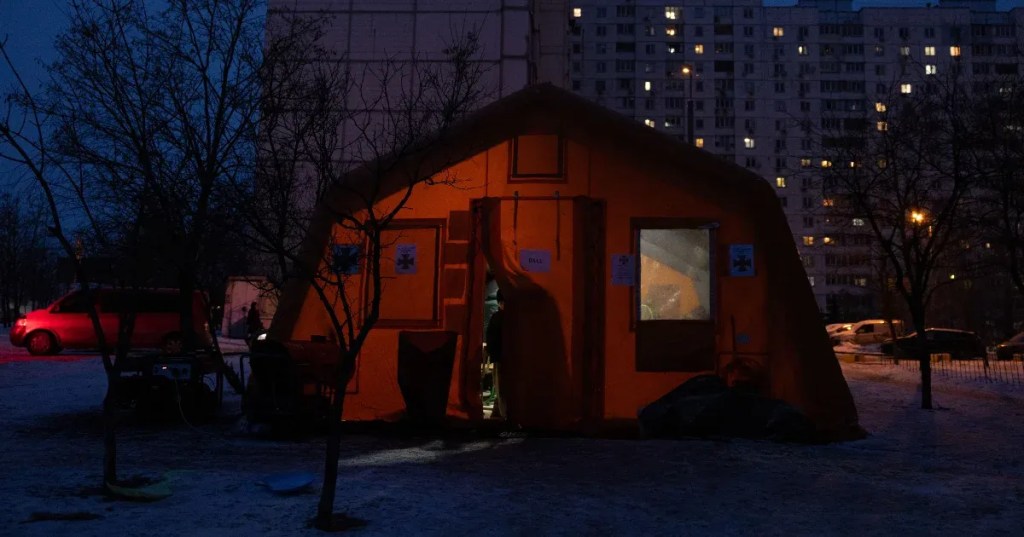
The most recent Russian attack of this nature occurred on Saturday morning. As per Ukrenergo, the company managing the national electricity network, 80 percent of Ukraine was expected to face unplanned power cuts on Saturday. The windows showing some illumination are from apartments that have either had their electricity briefly restored or are using battery-operated lights. The mayor of Kyiv, Vitali Klitschko, statedon Telegramhalf of the city’s 12,000 residential structures lost heating following the attack on Saturday, despite the previous day seeing the number of affected buildings drop below 2,000.
In recent weeks, it seems there has been no neighborhood in Kyiv that hasn’t experienced some impact. We visited various areas on January 21 and 22, and the stories from everyone we spoke with shared a common theme: they didn’t complain. Those who only lost electricity consider themselves fortunate to still have heating, while those without heating but with good insulation stress how lucky they are compared to those whose homes have completely frozen. Viktoria and her family, whose apartment is between 4-8 degrees Celsius, are among the worst affected in the area, but there are others who have faced even tougher conditions over the past few days. On Tuesday, a drone hit the building next to Viktoria’s, shattering the windows of many apartments. Residents are now trying to prevent their homes from freezing completely in the -9 to -10 degrees Celsius weather by using boards, blankets, and insulating foil.
We’ve returned to the 16th century,” a person on the ground floor remarks. “But it’s not our doing.
“Our apartment doesn’t experience much cold because we replaced our windows a few years back. We’re fortunate in that aspect,” an elderly man on the ground floor of the building next to Viktoria says, as Helena, the building’s caretaker, observes us from her seat, illuminated only by a single candle. Several windows in Vitali’s building, where he works as a chemist, were damaged during Tuesday’s drone attack, but he thinks they managed to survive due to their new windows and doors. “This building was built in 1969, and many residents still have the same Soviet-style windows installed back then because they can’t afford to replace them. It’s very chilly in those apartments now,” he mentioned.
His building has lacked electricity for ten days, with only a few hours each day when they use electric heaters to maintain the apartment temperature at approximately 16-17 degrees Celsius. “There is no resolution to this issue. I go to work at the institute and attempt to carry on with my research. There is power, heating, and water there, but that is an exception in Kyiv nowadays.”
A 45-year-old woman named Katerina previously resided in Luhansk but moved to Kyiv in 2014 to avoid the Russian occupation. Since January 9, her apartment in Rusanivka has experienced intermittent heating and electricity, and for the last three days, she has had no power or heat, forcing her to stay temporarily with family members.
When you’re by yourself at home during the cold, without light or heat, everything can seem scary, and you might feel anxious or even panic,” she said. “But then I go outside and see older people climbing the stairs in the dark because the elevator isn’t functioning due to the power cut, and I witness parents struggling to look after their young kids. This gives me courage. Observing how others are managing the situation helps me deal with it as well, and reminds me that I’m not the one facing the hardest time. I still believe Kyiv is the best place in the world – especially when there’s no electricity, heating, or internet.
Vadim resides on the same street. We accompanied him to the seventh floor of a 16-story building. He also sees himself, his wife, and their five-year-old daughter as fortunate: the building’s insulation was fully updated a few years ago under a government initiative, meaning their apartment remains warm, with temperatures typically ranging between 18 and 20 degrees Celsius. On the day we visited, it was 15 degrees.
His parents reside in the building located across the street, he mentions while we are in the kitchen. They went without electricity for five days, but now it’s restored; at Vadim’s home, the situation is reversed: they had power until two days ago, but then it was cut off, and now it returns only for an hour or two each day. “The buildings in the neighborhood resemble a chessboard these days,” he said, gazing out the window. “One has electricity, the other doesn’t.”
The Russians aim to frighten us and lower our spirits, he said, as his wife Irina prepared tea for us. However, the Russians fail to comprehend us; we are not easily frightened. The Ukrainian people are courageous, and they remain undeterred by Russia’s actions. We will endure for a long time, even in the toughest circumstances. The present situation is serious, but we will protect our homeland. We have no other option.” Vadim works as a manager at a company based in Kyiv. He shares with us his experience of assisting in the evacuation of individuals from the Kyiv region in 2022, rescuing dozens of people fromBucha, one of the locations of the Russian massacre with his vehicle.
The tea had just reached a comfortable temperature when the electricity suddenly returned, illuminating the entire apartment. We moved to the living room where he demonstrated his curved gaming monitor – he was obviously pleased with it – then he entered something on YouTube and divided his screen. A fireplace showed up on the TV in the living room, and his young daughter, who had been bouncing on the bed, descended and sat in front of the television to watch the flames.
In the last four years, every individual in Kyiv has become familiar with the location of the closest shelters near their residence, and most people are now aware of where they can find warmth, charge their devices, and have a hot cup of tea when their homes are cold and lacking power. These crisis centers, referred to as “points of invincibility,” are typically schools, kindergartens, and public buildings, but in areas around residential complexes, disaster relief tents equipped with generator heating have also been established.
The atmosphere and interior of the tents differ significantly, yet they share several common features: warm conditions, electrical outlets, areas for children, and the immediate offer of a cup of tea upon entry. In a downtown park named after the Ukrainian poet Taras Shevchenko, a tent inspired by a Kazakh yurt was established as an emergency station: besides tea, we were given baursak (Kazakh fried dough balls), while a man was preparing to heat oil for the next batch by lighting a fire in front of the tent. In one part of the yurt, local seniors were charging their devices, with a television playing in the background. Approximately fifteen books, mainly focused on Kazakhstan, were placed on one of the chairs, while on the opposite side, a small display showcased traditional Kazakh clothing and folk patterns.
We encountered Sasha, a young reporter, in one of the tents in Rusanivka, seated in front of her laptop while wearing a coat. “Two days ago, you couldn’t even sit down—the tent was completely packed, and all the chargers were in use, likely due to the recent drone strike,” she mentioned. The temperature in her apartment is currently 5 degrees Celsius, which is one reason she comes to the emergency center, along with the availability of internet. During air raid alerts, people are evacuated from the tent, but aside from those times, this is where she has been working recently.
The girl comes from Zaporizhzhia, where her parents still reside, and her grandparents live just ten kilometers away from the frontline. “If this were happening during the summer, it would be easier. It’s extremely cold, and this impacts our mental health: people become more stressed, they get upset more easily, even here in the tent.” Almost everyone walking by had a ten-liter container or two. They carried them to the water distribution point across the street, where the sound of generators could be heard, supplying power to shops and cafes.
Margarita studies at a university in Kyiv, where she is pursuing a degree in philology, English, and Italian. A few days ago, she completed her final exam of the semester—she took it online since the university lacks heating—and it was during our visit that she first went to one of the emergency tents in the Bereznyiak district to read. “Our apartment is around 16 degrees Celsius. We do everything we can to stay as warm as possible: we sleep with hot water bottles, we use them to warm up our cat’s clothes, and we bake in the oven and cook on the stove. A few years ago, having a gas-powered kitchen was an issue, but it’s been very helpful now.”
They have been without heating since January 10, and the electricity completely stopped functioning two days ago. She mentioned that she made a strong effort to study during this period and achieved a score of 93 out of 100 on her exams. There will now be a two-week break, although it’s difficult to refer to it as a break given these conditions, she noted. “But at least we have this place,” she said, looking around the tent. “When it’s cold outside, there are no people on the streets, but here we have created a community. A few minutes ago, I helped a woman in her seventies order an indoor humidifier online because she had never done it before and didn’t know how to.”
In 2022, when Russia invaded Ukraine, Margarita had just begun high school, and now she is a first-year college student. “These should be the best years of my life, my teenage years and college,” she mentioned. “But I try to cope with it and accept whatever happens.” She resides with her mother; her father is currently engaged in the conflict. “My father came to see us a week ago, and he was shocked by what he witnessed: at his current location, they have electricity, but here, in the capital of Ukraine, we don’t. He is more concerned about us than about himself: he is in a place where anything can happen at any moment, while we only face issues like the lack of water and electricity. Still, he is more worried about us.”
In the early stages of the conflict, she crafted camouflage nets for her father’s vehicle at the front lines, utilizing fishing nets and T-shirts from home. More recently, she created a winter variant, this time using white T-shirts to blend in with the snow. Additionally, she regularly sends financial support to the Ukrainian military each month.
I’d like to contribute more. My father always tells me that I’m already doing all I can by pursuing my education during this war, and that our main role is to support the army and one another. However, I feel embarrassed because I can’t do more. My father is at war. I want to help Ukraine achieve victory. Many of my friends are considering studying abroad, such as in nuclear physics, so they can bring their knowledge and innovations back to Ukraine later. I also thought about studying overseas, but ultimately decided to stay. I want to be here, even if things don’t end well for Ukraine. I want to remain in Ukraine until the very end.
The ongoing attack on Kyiv’s energy system is not the outcome of one incident, but a sequence of planned strikes that had been in preparation for months. Russia has consistently targeted Ukraine’s energy facilities since 2022, and the immediate trigger for the recent intensification was a major strike on October 3. On that day, 35 missiles and 60 drones were deployed to hit the Ukrainian gas network in the Kharkiv and Poltava areas, destroying 60 percent of the country’s gas production before winter arrived. This also severely affected the electricity supply, as a significant portion of Ukraine’s power comes from gas-powered plants. Subsequently, the attacks moved from one region to another, focusing on substations and transformers, further damaging the infrastructure ahead of the current winter season.
A powerful drone and missile strike caused 6,000 structures in Kyiv to lose heating on January 9. Following the assault, Klitschko urged residents who could evacuate Kyiv to do so, aiming to ease the strain on the supply network.
On January 13, during one of the coldest nights of this winter, the civilian infrastructure’s energy supply faced another fierce Russian assault. At that moment, the weather service had already issued warnings about nighttime temperatures near -20 degrees Celsius in Kyiv for the coming days. The attack resulted in 70 percent of the capital losing electricity, leading to a critical power shortage that prompted Ukrainian President Volodymyr Zelensky to declare a state of emergency in the energy sector the next day.
Subsequently, as the morning of January 20 arrived, Russia initiated its third significant wave of assaults, deploying 18 ballistic missiles, 15 cruise missiles, and 339 drones, primarily aimed at Kyiv’s infrastructure. The following attack occurred during the early hours of Saturday, January 24, after which Ukrenergo, the entity managing the national power grid, cautioned that electricity cuts were anticipated across 80 percent of the nation.
The frigid climate, which is unusual for recent years, is not only causing challenges for residents, but also the sub-zero temperatures, ice, and ongoing assaults are greatly hindering infrastructure restoration efforts. Energy specialists claim that, in comparison to previous years, the present circumstances are the most severe. Along with draining the population, Russia’s intention behind these strikes is to cut off industrial areas (Dnipro, Zaporizhzhia) from primary energy generation hubs.



 jasdooit
Leave a comment