
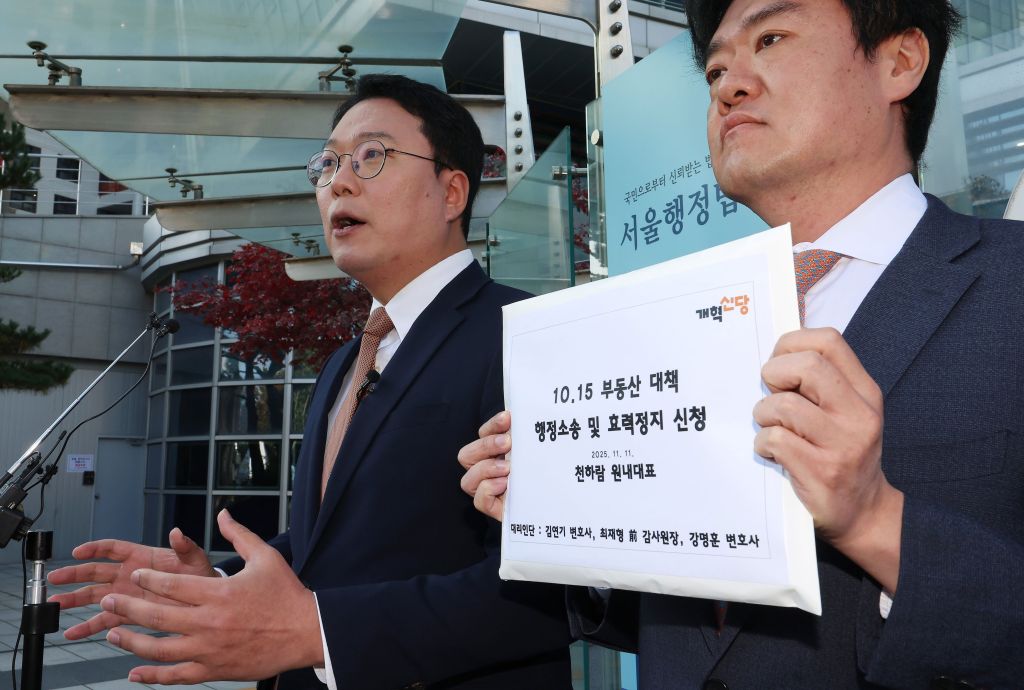
Chun Ha-ram, the head of the Reform Party’s floor operations, along with others, initiated a legal action seeking the annulment of the government’s ‘October 15 Real Estate Policy,’ but was unsuccessful in the initial court ruling.
On the 29th, the Seoul Administrative Court’s Division 14 (led by Presiding Judge Lee Sang-deok) decided in favor of the defendant in a legal case initiated by Representative Chun and others against the Minister of Land, Infrastructure and Transport, aiming to annul the ‘October 15 Real Estate Policy.’
The ‘October 15 Real Estate Policy’ focuses on the government’s classification of all of Seoul and 12 cities and districts in Gyeonggi Province as restricted areas (speculative overheating zones and adjustment target areas). In this context, Representative Chun and other opposition leaders stated that the government deliberately omitted housing price data from the three months just before the policy announcement (July to September 2025) and instead used the ‘June to August data’ to determine which areas would be included in the restricted zones. They asserted that if the ‘July to September data’ had been used, eight areas—Jungnang, Gangbuk, Dobong, and Geumcheon Districts in Seoul, along with Uiwang, Seongnam Jungwon District, and Jangan and Paldal Districts in Suwon within Gyeonggi Province—would not have been designated as restricted areas.
The court said, “Even if the housing price data from September 2025, which had already been publicly released when the policy was announced, are taken into account, eight regions including Gangbuk District in Seoul do not satisfy the requirements,” but also noted, “Since the September data were not made public until the day before the meeting of the Housing Policy Deliberative Committee, it is challenging to view the Ministry of Land, Infrastructure and Transport’s failure to include them in the policy as unlawful.” The Housing Policy Deliberative Committee discusses key housing policies and real estate measures, such as the designation and removal of speculative overheating areas, and is led by the Minister of Land, Infrastructure and Transport.
Representative Chun, who initiated the legal action in November, stated, “(The government) openly concealed the September data from the public although it was available, made false claims with political motives, and improperly enforced the ‘October 15 Real Estate Policy’ to an excessive degree,” and further noted, “The actions of the Lee Jae Myung administration must be restrained even through judicial means.”
Later, during the debates on the 15th, the plaintiffs, including Representative Chun, claimed that the Ministry of Land, Infrastructure and Transport did not fulfill legal obligations by obtaining last year’s September data but not utilizing it, stating that the ‘October 15 Real Estate Policy’ was unlawful.
On the contrary, the Ministry of Land, Infrastructure and Transport stated, “As the September data was not accessible until the day prior to the Housing Policy Deliberative Committee meeting, we relied on the figures from June to August,” and further mentioned, “Utilizing data before its official release breaches the Statistics Act and may erode public confidence.” They justified their actions by asserting that they did not deliberately exclude or alter the data.
Following the ruling on the same day, Representative Chun addressed journalists, stating, “This is a disappointing outcome that is difficult to accept,” and mentioned, “Once we obtain the court’s decision, we will thoroughly examine the possibility of an appeal if there are any concerns.” He added, “The core issue that the ‘October 15 Real Estate Policy’ is unnecessarily limiting the property rights of our citizens without any positive impact remains unchanged,” and remarked, “I am convinced that it is evident that excessive regulations were implemented with political motives.”



 jasdooit
Leave a comment