
Artificial intelligence (AI) and humans have been competing in the task of translating Korean literary pieces into English. Who won the contest?
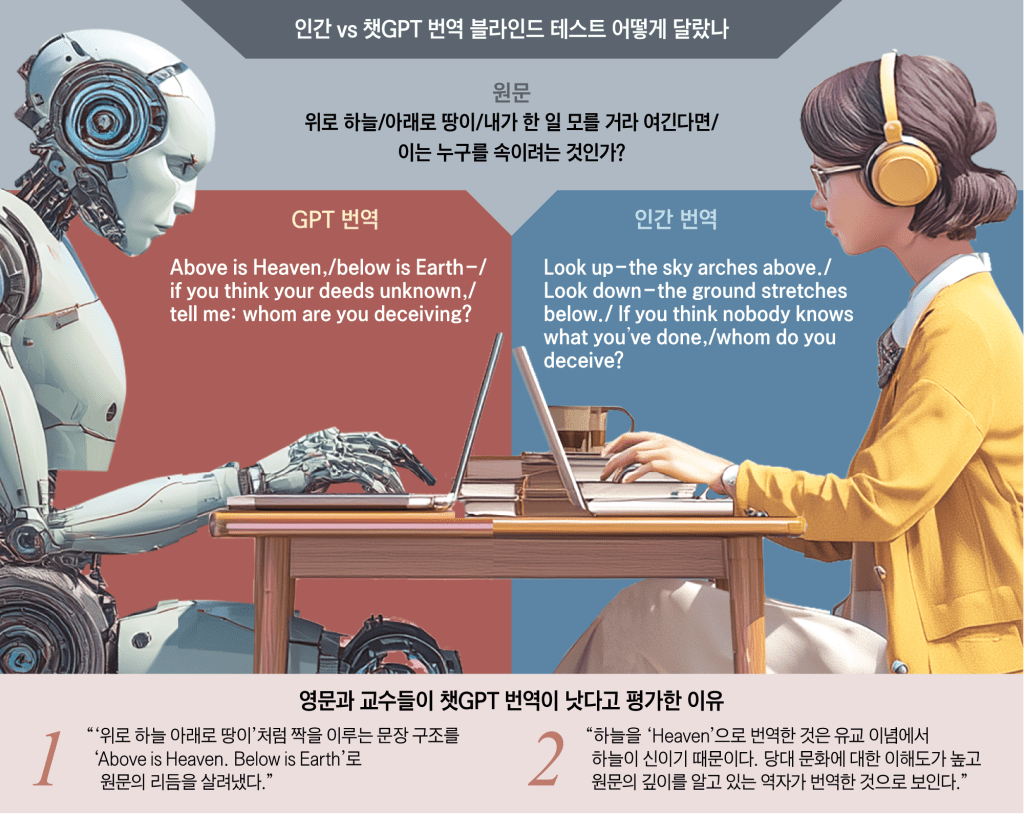
Recently, the Literature Translation Institute of Korea, part of the Ministry of Culture, Sports and Tourism, carried out a blind test with 16 local English literature professors. The test compared an English version translated by a professional translator with one generated by ChatGPT for the poem “Be Cautious When Alone (Shindokjam)” by the Joseon-era poet Jang Yu, which is planned for export to English-speaking countries. Without being told which translation was done by whom, the professors were shown the original Korean text along with both translations and asked to choose the better one. The results indicated that 12 professors preferred the ChatGPT translation, two chose the human translation, and two found it difficult to decide.
◇AI Translation Achieves… “Surpassing the Limit of Language Learning”
Professors who supported the use of AI translation commended ChatGPT’s thorough grasp of Korean history and culture, along with its ability to maintain the original text’s rhythm and style. For instance, in the excerpt “Above, the sky / Below, the earth / If you think I don’t know what I’ve done / Who are you trying to deceive?”, the human translator used “Sky,” whereas ChatGPT translated it as “Heaven.” Given that the author was a Confucian scholar, “Heaven,” which includes the idea of a deity, was considered more suitable than the physical concept of “Sky.” Additional feedback noted, “The original text’s parallelism was effectively conveyed in English literary terms,” and “The brief word count retains the original’s core meaning.”
Instructors who favored the human translation mentioned that it contained “fewer ungrammatical sentences” and offered “a more natural title translation.” A professor who found the translations indistinguishable remarked, “The difference wasn’t significant enough to argue which translation is superior if one was created by AI,” and added, “It should be noted that AI has progressed to the stage where it is challenging to tell it apart from human translation.”
Experts believe that large language models (LLMs), such as ChatGPT, which are built to grasp context effectively, naturally perform well in translation and have become highly advanced due to extensive training. Choi Byung-ho, a research professor at Korea University’s Human-Inspired AI Research Center, said, “In Korean-to-English translation, it has achieved a level that can substitute for human translators,” and noted, “It should be taken into account that all publicly accessible web data has already been absorbed, and the amount of training has exceeded the limit.”
The examination was carried out by the office of Min Hyung-bae, a member of the National Assembly’s Committee on Culture, Sports, and Tourism from the Democratic Party of Korea. Min remarked, “Artificial intelligence is already an unavoidable reality,” and emphasized, “As we take advantage of AI’s effectiveness, it’s time to consider the cultural background and ethics that are distinct to humans.”
◇The Fortress of ‘World Literature Collections’ Begins to Crumble… Absurd Translation Errors Such as “Kingbatne” Also Appear
With the advancement of AI translation, publishers that were once seen as the domain of major publishing companies such as Minumsa and Munhakdongne are now beginning to create “collections of world literature.” These publishers are leveraging AI to translate works by renowned authors whose copyright protection has expired (after 70 years from the author’s death) without any associated costs.
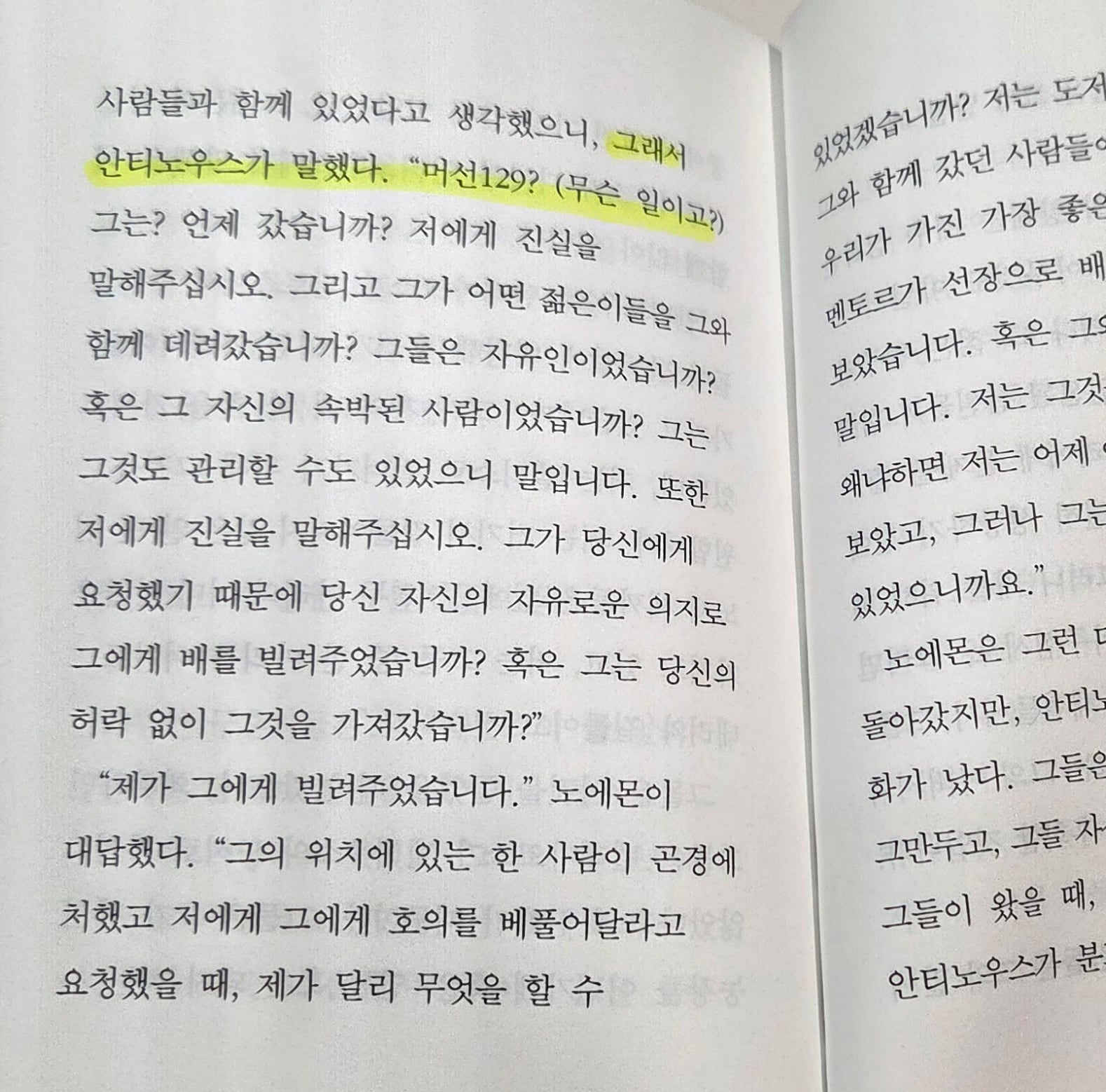
A publishing house that has been specializing in science and technology academic publications for more than three decades recently sparked debate within the publishing sector. Starting from October of last year, it published 12 books, including “The Little Prince” and “The Metamorphosis,” within a span of three months. This publisher, without employing professional translators, relied on Gemini for translation and had human editors check the content. The controversy emerged with the translation of Homer’s epic “The Odyssey,” which featured lines such as, “Futile conversation is useless. Alppano? (None of my business),” which caused a stir. Newly created terms like “Kingbatne! (I’m pissed!)” and “Seubuljae (self-inflicted disaster)” also appeared in the classical text’s translation. A representative from the publisher stated, “We couldn’t afford to produce books if we had to pay for translation services, so we used AI translation. We deliberately kept the new terms as they are, believing they might be useful for fun intergenerational communication.”
◇ “Human Translators Will Make Use of AI”
In foreign countries, business models that involve collaboration between humans and AI have developed. GlobeScribe, a company based in the UK, launched a service last summer that offers to translate a book for $100 (about 145,000 South Korean won). Considering that the minimum translation cost for a novel with approximately 1,000 manuscript pages in South Korea ranges from 3 million to 4 million South Korean won, this price is very reasonable. The publisher uses AI to translate most of the content, while human translators handle sections with high literary value or complexity. Translators in the UK are expressing their dissatisfaction. Ian Giles, chairman of the Translators Association of the UK Society of Authors (SoA), stated in an interview with The Guardian, “It is entirely incorrect to suggest that AI can match, let alone exceed, the nuanced work of human translators by replacing authors.”
Domestic translator No Seung-young said, “Since AI learns and employs translation sentences improved by humans, most current translated works are expected to be adequate with AI in the near future,” and added, “However, the significance of proofreading to avoid subpar translations from AI has grown.”




 jasdooit
Leave a comment